
Szczepanik Research Group
Department of Theoretical Chemistry
Faculty of Chemistry, Jagiellonian University
Gronostajowa 2, 30-387 Krakow, Poland
Tel: (+48) 12 686 23 90
E-mail: dariusz.szczepanik@uj.edu.pl
HOME PROJECTS PUBLICATIONS runEDDB X
About EDDB Download Tutorials Manual
EDDB reads aromaticity from the chemical bond. It measures how much of a molecule’s electron density is shared by conjugated, multi-centre bonds — and shows where that density lives.
A ground-state property
Aromaticity as something a molecule is — written into the distribution of its bonds — not only something it does in a magnetic field.
Every electron counted
The whole density is analysed, the electrons a magnetic field cannot stir included.
Straight from the density matrix
No resonance structures to assume, no orbital localization to choose, no fitted parameters.
◼ Two kinds of delocalization
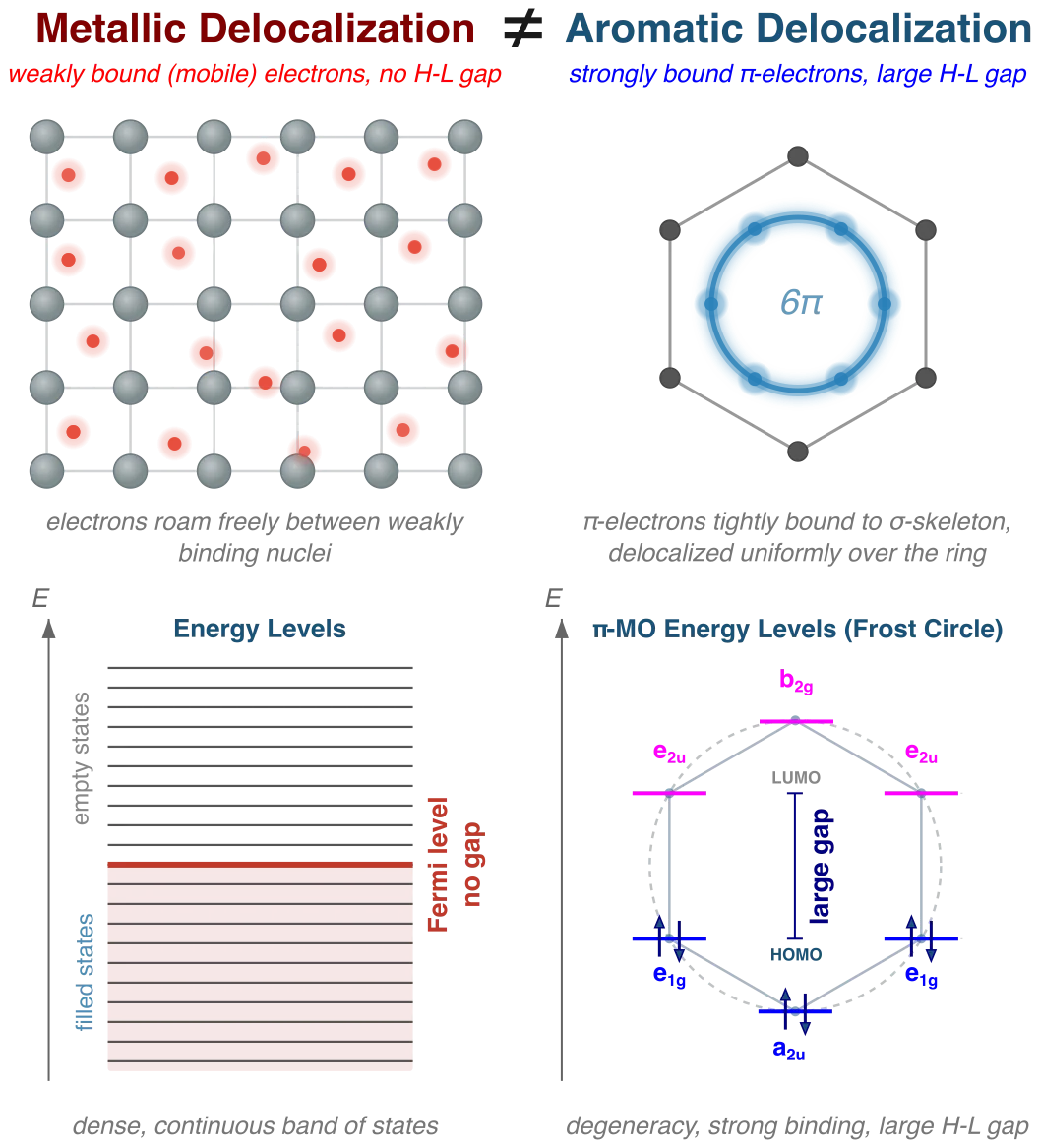
“Delocalized” means two almost opposite things. In a metal it means mobile; in benzene it means coherently shared and tightly bound.
| metal | benzene | |
|---|---|---|
| valence electrons | weakly bound, mobile | more tightly bound than in hexatriene |
| HOMO–LUMO gap | about zero | large |
| what is delocalized | the electrons | the bonds: every C–C bond gets the same share of π-bonding |
| consequence | conductivity, reactivity | stability, inertness |
The cyclic topology makes the occupied π-levels degenerate (the Frost–Musulin circle). They lie lower, the gap widens, and the π-bonding spreads evenly over the ring. Benzene’s π-electrons are at once more delocalized and less mobile than those of an open chain.
◼ How EDDB works
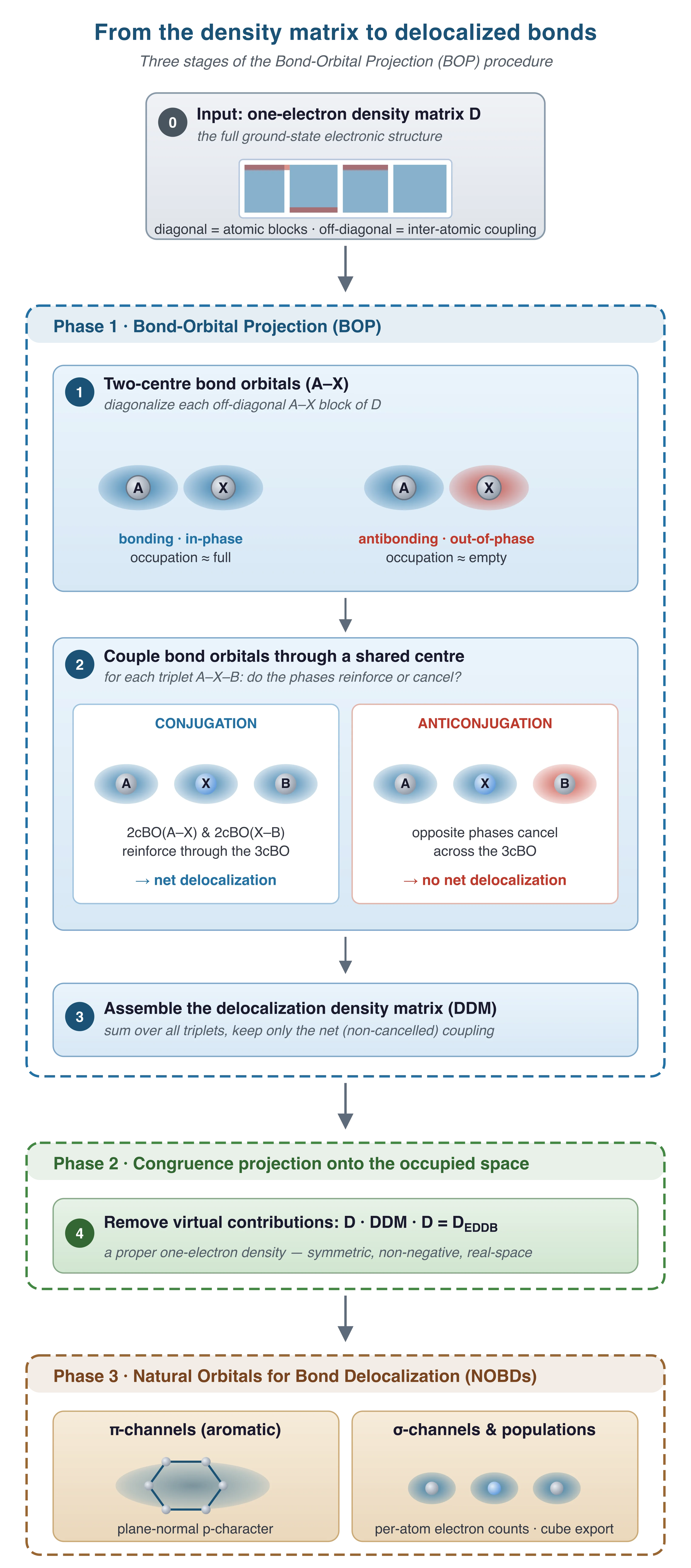
Bond orbitals are used only as probes of the one-electron density matrix D; what comes out is a density.
- Two-centre bond orbitals. For every bonded pair A–X, the A–X block of D gives the bonding and antibonding bond orbitals.
- The conjugation test. For every triplet A–X–B, the bond orbitals A–X and X–B are projected onto the three-centre orbitals of A–X–B. In phase: the bonds conjugate. Out of phase: they are independent, however close. The net coupling, summed over all triplets, is the delocalization matrix DDM.
- Back to electrons. Projection onto the occupied space gives a proper, non-negative density:
- its trace = the number of electrons in delocalized bonds;
- its eigenvectors = the natural orbitals for bond delocalization (NOBDs), sorted into π, σ and δ channels automatically;
- the rest of the density is the EDLB: localized bonds and lone pairs.
◼ BDF: delocalization you can see
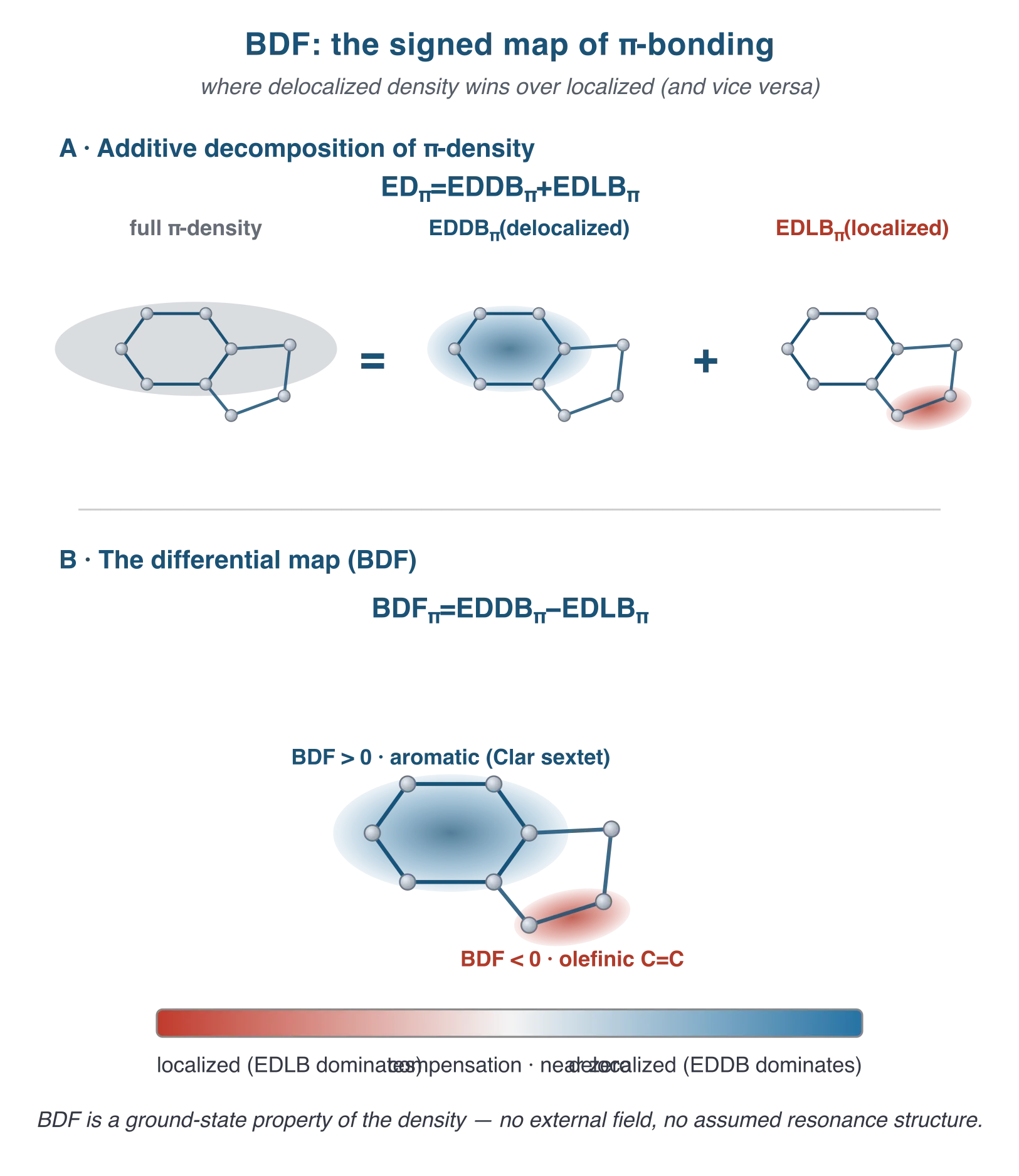
The Bond Delocalization Function is the signed difference of the two densities:
- positive — delocalized bonding wins: aromatic circuits, Clar sextets;
- negative — localized bonding wins: olefinic double bonds, lone pairs;
- near zero — the two compensate: ionic resonance, competing Kekulé and quinoid patterns.
One run gives EDDB, EDLB and BDF as cube files or 2D maps, for the π-system or for all electrons.
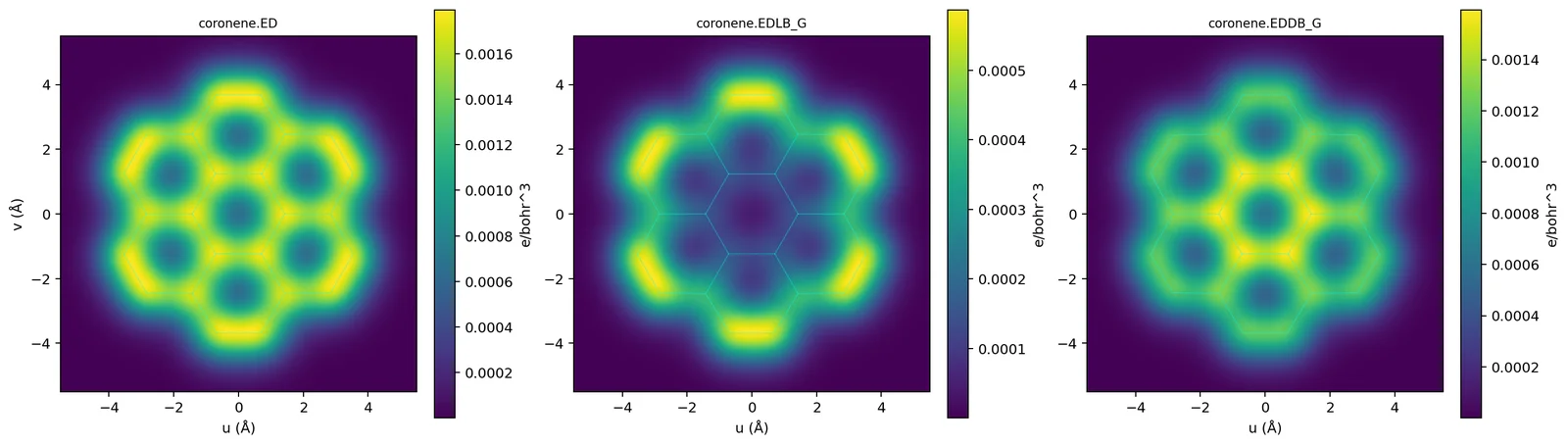
Coronene, 1.5–2.5 Å above the molecular plane: ED = EDLB + EDDB, each panel on its own colour scale. Localized density is strongest on the rim bonds; delocalized density grows toward the core. (Manual, Maps & files)
◼ Bonds and ring currents answer different questions
Magnetic response — NICS, ring currents, AICD
How the molecule responds to a magnetic field. The response is carried mostly by a few frontier orbitals (the Steiner–Fowler selection rules); most of the occupied π-density stays invisible to it.
Bonding — EDDB, BDF, CDI
How the bonds of the ground state are organized. Every electron counts, the magnetically silent ones included.
In benzene the two pictures agree. In topologically rich systems they can part ways:
Porphyrin nanoring
A global ring current — yet BDF shows twelve locally aromatic porphyrins linked by olefinic bridges.
Aza-supernaphthalene
Its Clar sextets survive oxidation while the magnetic classification flips. (Tutorial 4)
Indacene dimer
The open-shell ground state trades one π-bond for two Clar sextets — visible in BDF, not in the current, and it explains the gap between the open- and closed-shell states.
Pentalene
A strong paratropic current, carried mostly by localized π-electrons. (Tutorial 8)
◼ As reliable as the density
◼ What runEDDB does
Reads your calculation
Gaussian, ORCA, Q-Chem, GAMESS, Turbomole, Molden, NBO — or a bare geometry (xyz, mol, sdf, pdb) through the built-in GFN2-xTB.
Analyses the bonds
EDDB and EDLB globally, for fragments, pathways and rings; CDI; π-selection by NOBDs; atomic populations, bond orders.
Draws maps
Cube files and 2D maps of EDDB, EDLB and BDF; differential maps between two structures.
Splits the magnetic response
NICS, ring and bond currents, current-density maps and ACID — each into EDLB and EDDB.
Models AFM and STM images
nc-AFM and STM pictures from the density, with the share of localized and delocalized bonds.
Works in seconds
From a geometry to EDDB, BDF and NICS with GFN2-xTB, on a laptop.