
Szczepanik Research Group
Department of Theoretical Chemistry
Faculty of Chemistry, Jagiellonian University
Gronostajowa 2, 30-387 Krakow, Poland
Tel: (+48) 12 686 23 90
E-mail: dariusz.szczepanik@uj.edu.pl
HOME PROJECTS PUBLICATIONS runEDDB X
About EDDB Download Tutorials Manual
Manual (2026-Nov-03)
An NMR calculation tells how the electrons of a molecule respond to a magnetic field: the shielding of every nucleus, the NICS at any point in space, and the induced ring currents. runEDDB takes that response and splits every one of these quantities into the part carried by the localized electrons (EDLB) and the part carried by the delocalized ones (EDDB), or by a set of NOBDs or MOs you choose. It also draws the response in space: shielding maps (ICSS), current density maps and ACID.
- What do you want to compute?
- Which calculation to run
- Shielding tables
- NICS
- Ring and bond currents
- Orbital contributions and MO layers
- Chemical shifts
- Without an NMR job: the approximate lane
- NICS from a bare geometry (GFN2-xTB)
- Maps: ICSS, current density, ACID, div J
- What a ring current is evidence of
- Methods and references
1. What do you want to compute?
| You want | Run |
|---|---|
| the shielding of every nucleus, split into EDLB / EDDB | runEDDB -i mol.fchk --table nmr |
| NICS(0), NICS(1), NICS(1)zz of every six-membered ring | runEDDB -i mol.fchk --nics-rings 6 |
| ... of the π electrons only | runEDDB -i mol.fchk --nics-rings 6 -a |
| the ring current strength of every ring (nA/T) | runEDDB -i mol.fchk --nics-rings 6 --rcs |
| the current through every bond | runEDDB -i mol.fchk --nics-rings 6 --bcs |
| the current carried by the HOMO pair (an MO layer) | runEDDB -i mol.fchk --nmr-log mol.log --nmr-mos homo-1:homo --rcs |
| 1H chemical shifts against TMS, split into EDLB / EDDB | runEDDB -i tms.fchk --table nmr, then
runEDDB -i mol.fchk --nmr-ref tms.nmrref |
| a picture of the current density (ParaView, PNG) | runEDDB -i mol.fchk --nmr-log mol.log --export-vtk jcur,acid |
| a shielding map (ICSS) in a plane above a ring | runEDDB -i mol.fchk --nics-rings 6 --export-map icss |
| a quick first look, no quantum-chemistry job | runEDDB -i mol.xyz --nics-rings 6 --rcs |
Every command works on the built-in molecules as well, e.g. runEDDB -i @benzene --nics-rings 6 --rcs;
runEDDB --examples nmr lists more.
2. Which calculation to run
The response of the electrons comes from one of four sources. The totals do not depend on the choice; the split into parts does, a little, and the cost and accuracy differ a lot.
| Lane | Input | Best for |
|---|---|---|
| GIAO | Gaussian NMR .fchk; ORCA ! NMR KeepDens .json; Turbomole
mpshift + XDENS | shieldings of nuclei and chemical shifts (fast basis-set convergence) |
| CTOCD-DZ (ipsocentric) | Gaussian NMR=CSGT IOp(10/33=2): the .fchk and its .log | ring currents, their σ/π and orbital contributions; MO layers; partitioned current maps |
| Approximate | any SCF wavefunction file without NMR data | signs and trends from a file you already have (section 8) |
| GFN2-xTB | a geometry or a built-in molecule | NICS and currents in seconds, as a screen (section 9) |
The program reads the lane from the input and says which one it used in the stage line and in every table title; approximate lanes are marked APPROX. How to prepare the files is on the Input files page.
Details of the GIAO and CTOCD-DZ inputs
- Gaussian GIAO:
NMR(GIAO is the default) and formchk; the .fchk then holdsMagnetic Field P1 (GIAO).int=nobasistransformis recommended for generally contracted basis sets. - ORCA 6:
! NMR KeepDensand%eprnmr NMRShielding 2 Origin GIAO end; put a fileBaseName.json.confnext to the .gbw containing{ "MOCoefficients": true, "Basisset": true, "Densities": ["all"] }and runorca_2json BaseName.gbw(without the .conf file no densities are exported). - Turbomole 8:
$gimicin the control file andmpshiftafter the SCF; keep the XDENS file next to the .tmol (or--nmr-xdens FILE). Closed shells only; every functional of mpshift works, local hybrids included. - Gaussian CSGT:
NMR=CSGT IOp(10/33=2)and keep the .log next to the .fchk (or--nmr-log FILE); runEDDB reads the six response densities from the .log and evaluates the CTOCD-DZ shielding itself. This is not the CSGT number Gaussian prints. Without the .log the run falls back to the approximate lane with a WARNING naming the missing file. - References: HF and DFT (RHF; UHF with the spin-summed response of Gaussian or ORCA). With
-b naothe total reproduces the program's own isotropic shielding to every printed digit, a built-in check. - CTOCD-DZ shieldings converge slowly with the basis set: the table prints the translational sum rule (100 % = complete basis). NICS away from nuclei are reliable from about 80 %, nuclear shieldings need 90 % or more.
3. Shielding tables
--table nmr prints the isotropic shielding of every nucleus. Each table has four numeric
columns: the value, its EDLB_G and EDDB_G parts, and other, the share of the core and
Rydberg orbitals that lie outside the analysis basis (zero with -b nao). The parts add up to
the total exactly. With -a or -s the EDDB column is restricted to the selected NOBDs,
e.g. the π system.
$ runEDDB -i benzene.fchk --table nmr          # all nuclei
$ runEDDB -i benzene.fchk --table nmr -a       # EDDB column = the pi NOBDs only
$ runEDDB -i benzene.fchk --table nmr -v       # + benzene.NMR_DIAG.txt, full precision
- -v writes
<stem>.NMR_DIAG.txtwith eight columns at full precision: each part split further into the contribution of the unperturbed density and of its response (GIAO: dia | para, CTOCD-DZ: trans | rot), plus the checks of the calculation (sum rules, the loop-current fit, the edge terms of the current integrals). - Which analysis basis.
-bdoes not change the shielding, only which orbitals are partitioned. Use the defaultnvbfor nuclei (the large core contribution stays apart in other) and-b naofor NICS away from nuclei (then other ≡ 0 and NICS = EDLB + EDDB exactly). The EDDB column barely changes either way. - Scoped runs (
-f,-p,-r,-h) print the columns rest_X | EDDB_X, where rest_X is the valence density minus EDDB_X (not EDLB).
The two parts in the -v file, and the π-NOBD vs π-MO question
GIAO: dia = the Larmor circulation of the unperturbed density about the probe (the nucleus, or the NICS point); para = the response of the density about the same point. With the probe as the origin the split does not change when the molecule moves in the coordinate frame. CTOCD-DZ: trans = the translational response (diatropic type), rot = the rotational response (paratropic type), about the probe; these follow the ipsocentric selection rules (in benzene the e1g π pair carries the whole diatropic current, the a2u π orbital nothing). Both tables sum to the same NICS.
The π-NOBD column equals the sum of the π-MO contributions only when the selection is exactly the
occupied π space: a planar molecule without σ/π mixing, -b nao, and a selection that
catches every π NOBD and nothing else. Check the star markers of --table nobd before
calling a π-restricted NICS "the π-MO ring current".
4. NICS
NICS (nucleus-independent chemical shift) is the shielding at a point in space where there is no nucleus, with the sign reversed: negative NICS = shielded = a diatropic current nearby. runEDDB puts the probes for you:
$ runEDDB -i @benzene --nics-rings 6 -a        # NICS(0), NICS(1), zz, of every 6-ring
    R1  1-2-3-4-5-6-1
    Probe              NICS      EDLB_G      EDDB_G       other
  R1 NICS(0)       -3.83842     6.75904   -10.59745     0.00000
  R1 NICS(0)zz    -16.41028     6.21626   -22.62654     0.00000
  R1 NICS(1)       -6.98526    -0.55909    -6.42616    -0.00000
  R1 NICS(1)zz    -17.34598    -0.47342   -16.87255    -0.00000
$ runEDDB -i @benzene --nics-ring 1-2-3-4-5-6-1 --nics-scan 2.0,0.25   # a scan along the normal
$ runEDDB -i @benzene --nics 0,0,0,0,0,1.5     # explicit points x,y,z (Angstrom)
--nics-rings 6(or5,6:8) takes the rings found like-r;--nics-ring 1-2-3-4-5-6-1names a cycle. NICS(1) is the mean of the two probes 1 Å above and below the ring; zz is the component along the ring normal.--nics-scan R,stepscans the normal from −R to +R;--nics x,y,z,...takes any points in the frame of the input file.- Every
--nics*option switches--table nmron. - NICS of rings of different size are not comparable (the probe sits at a different distance from the current); compare the ring currents instead (next section).
5. Ring and bond currents
The ring current is the flux of the induced current through a plane from the ring centre out to the vacuum, the number GIMIC calls the bond current strength. runEDDB measures it without a current-density grid, from Ampère's law: it integrates the induced field (the shielding) around the edges of that plane. Every edge probe carries the EDLB / EDDB split, so the current of the delocalized electrons comes out directly. Units nA/T; positive = diatropic, negative = paratropic.
$ runEDDB -i @benzene --nics-rings 6 --rcs     # ring current strength I_cyc
     Ring  Item                          total      EDLB_G      EDDB_G
     R1    I_cyc                        6.29691    -0.05455     6.35145
$ runEDDB -i @azulene --nics-rings 5,7 --bcs   # bond by bond
     R1    I_bond 1-2                   6.60447     3.27288     3.33159
     R1    I_bond 3-9 (R2)              1.60763     0.67864     0.92898
     R1    I_cyc                        6.54803     3.20021     3.31310
     R2    I_bond 3-4                   4.94910     2.53690     2.41220
     R2    I_bond 9-3 (R1)             -1.60763    -0.67864    -0.92898
     R2    I_cyc                        4.92197     2.53047     2.38185
$ runEDDB -i @naphthalene --nics-rings 6 --rcs 1-2-3-4-5-6-7-8-9-10-1   # + the perimeter
--rcsprints I_cyc of every NICS ring, or of the closed cycles you list (i-j-...-i, first atom repeated). I_cyc is the minimum flux over the ring's planes to the vacuum: the largest current that can circulate coherently around the whole cycle, the current analogue of the CDI.--bcsprints I_bond for every bond of the rings, of listed cycles, chains (1-2-3) or single bonds (4-9), followed by the I_cyc row of each cycle.- A bond shared by two rings carries the difference of the two ring currents and appears under both rings with opposite signs (azulene above: 6.5 − 4.9 ≈ 1.6). The sign belongs to the plane, which starts at the centre of the ring named in the row.
--bcs-box L,h[,n]sets the size of the integration rectangle (default 5,5 Å) and the Gauss points per edge (12); the result does not depend on it.- Cost: about 300 probes per benzene ring; the probes run in parallel (
-n).
Shared bonds, enclosed rings and the mesh picture (coronene, macrocycles)
Think of a planar ring system as a Kirchhoff network: one loop (mesh) current per ring; an outer bond carries the mesh current of its ring, a shared bond the difference of two. I_cyc is the mesh current. For a ring whose every bond is shared (the hub of coronene) runEDDB continues the plane through the neighbouring ring to the vacuum. Coronene (GFN2-xTB): outer rings I_cyc = 9.74 nA/T, hub I_cyc = 6.41 nA/T (diatropic), hub bonds −3.34 nA/T seen from the hub (= 6.41 − 9.74). The textbook "paratropic hub current" is the net current of the hub bonds; the mesh current of the hub is diatropic. Both are printed under different names; say which one you quote.
A listed cycle that runs along another one over two or more shared bonds (a macrocyclic path over the rim of a benzene) cuts the planes of that ring, so its I_cyc becomes a mesh current that depends on the list; runEDDB prints a WARNING naming both cycles. Compute such cycles in separate runs.
The loop-current fit (in the -v file) and why it differs from I_cyc
Under -v the diagnostics file also fits the NICSzz(z) profile with the field of a thin
circular loop (I_loop), with the ring radius fixed and fitted. It is a model, I_cyc a measurement; for
benzene they differ by about 10 % because the real π current is not a thin loop at the ring radius.
Quote I_cyc or I_bond, never mix them with I_loop. Use --nics-scan 4,0.25 when the fitted
radius matters.
Validation
For a divergence-free current every outer bond of a ring carries the same flux: benzene at RHF/def2-TZVP, CTOCD-DZ, 13.04 nA/T total and 10.22 nA/T EDDB for all six bonds; the GIAO lane gives 12.96 / 10.14. Boxes of 3, 5 and 8 Å give 13.05, 13.04, 13.04 nA/T. GIMIC gives 11.8 nA/T for benzene at B3LYP/def2-TZVP; runEDDB 11.97.
6. Orbital contributions and MO layers
In the ipsocentric picture of Steiner and Fowler the ring current is a sum of contributions of the occupied orbitals, dominated by a few frontier ones. runEDDB gives the shielding and the currents carried by any set of occupied MOs, and resolves them by NOBD or MO in files.
$ runEDDB -i @benzene --nics-rings 6 --nmr-mos homo-1:homo --rcs
    MO 14   (eps=  -0.40093, occ=2.00000): ED_G=2.00000 EDLB_G=0.21692 EDDB_G=1.78308
    MO 15   (eps=  -0.40091, occ=2.00000): ED_G=2.00000 EDLB_G=0.21701 EDDB_G=1.78299
     Ring  Item                            set      EDLB_G      EDDB_G        rest
R1 I_cyc 7.15171 0.77583 6.37587 -0.85480| Option | Gives |
|---|---|
--nmr-mos LIST | a table for a chosen set of occupied MOs (numbers of --table mo):
n, n:m, all, homo, homo-N, ranges such as
homo-2:homo or 5:homo-1, and -TOKEN to remove (all,-homo); UHF:
a/b prefix for one spin (a5:12,b5:11). With --rcs/--bcs
also the currents of the set: set | EDLB | EDDB | rest, with set + rest = total. |
--table nmr-homo[N] | the same for HOMO−N ... HOMO (N ≤ 9) |
--table nmr-somo | the same for the singly occupied MOs |
--table nmr-mo | <stem>.NMR_MO.txt: every probe resolved by occupied MO |
--table nmr-nobd | <stem>.NMR_NOBD.txt: the EDDB column resolved by NOBD
(use with -a/-s, otherwise the file is huge) |
--nmr-approx: the
ipsocentric response is rebuilt from the MOs (within about 5 % for closed-shell aromatics; paratropic
currents of small-gap 4n systems come out about 25 % too strong).A degenerate HOMO (benzene's e1g pair) triggers a warning suggesting the whole shell. For UHF, level k pairs αk with βk. Benzene at B3LYP/def2-TZVPP (NMR=CSGT): the e1g HOMO pair carries 12.03 nA/T of the total 11.96, all other MOs −0.07.
7. Chemical shifts
Run the reference (TMS, or your solvent) and your molecule with the same method, basis set and NMR
gauge. The reference run writes an .nmrref file once; every later run subtracts it column by
column:
$ runEDDB -i tms.fchk --table nmr                       # writes tms.nmrref
$ runEDDB -i benzene.fchk --nmr-ref tms.nmrref          # + CHEMICAL SHIFTS table
$ runEDDB -i benzene.fchk --nmr-ref H=31.7,C=185.4      # explicit reference values (delta only)
Every column of the CHEMICAL SHIFTS table is δ = σ(ref) − σ: positive = that part deshields the nucleus relative to the reference.
- Same gauge (GIAO with GIAO, CTOCD-DZ with CTOCD-DZ) and the same
-bin both runs; on a gauge mismatch only δiso is printed. - No
.nmrrefis written under-a/-s, and--nmr-refis then ignored: for shifts and the π dissection run the molecule twice. - Reference values are averaged over the atoms of each element (the 12 protons of TMS); elements missing from the reference are skipped.
Example: benzene vs TMS (RHF/6-31G, GIAO)
δ(H) = 7.85 ppm = 10.09 (EDLB) − 2.27 (EDDB) + 0.03 (other): the deshielding of the benzene protons comes from the C–H bonds and the σ framework, while the π density shields them in the GIAO bookkeeping. The π ring current shows where it belongs, in NICS: NICS(0) = −8.6 ppm, of which −21.4 ppm from the three π NOBDs. In the CTOCD-DZ lane the π contribution to the proton shielding is almost zero and the e1g pair alone carries the ring current. For nuclei and shifts use GIAO; for currents and their orbital origin, CTOCD-DZ.
8. Without an NMR job: the approximate lane
If the file holds no NMR response (a plain SCF .fchk, an ORCA .json without densities, a .tmol without XDENS, a GAMESS log), runEDDB does not stop: it builds the CTOCD-DZ response from the MOs and their energies and prints every table, current and map as usual, marked [APPROX., UNCOUPLED] with a WARNING. Use it for signs, trends and the partition; for numbers to quote, run the NMR job. It needs all MOs with their energies and an SCF reference.
The only thing it needs to know is which method made the orbitals. runEDDB finds it in the .fchk
header, the Gaussian route, the ORCA output next to a .json/.molden (keep it there), the Turbomole
$dft section or the GAMESS log, and prints what it used under the first table. Otherwise:
$ runEDDB -i mol.json --nics-rings 6 --nmr-kernel b3lyp     # name the method
$ runEDDB --nmr-kernel @list                                 # the 110 functionals it knows
$ runEDDB -i mol.fchk --nics-rings 6 --nmr-approx            # approximate even if NMR data exist
| Method family | Accuracy of the ring currents |
|---|---|
| pure LDA / GGA (PBE, BLYP, BP86, ...) | exact: identical to the NMR job |
| meta-GGA (TPSS, SCAN, r2SCAN, ...) | about 2 % (a small kernel term is missing) |
| global hybrids (B3LYP, PBE0, M06-2X, ...) | within 2–5 % (validated B3LYP, PBE0) |
| Hartree–Fock | 10–13 % low for hydrocarbons, about 20 % low for π-donor rings |
| range-separated and double hybrids | short-range or hybrid part only, with a WARNING; not validated |
| method not identified | default DFT kernel (exchange fraction 0.20), announced under the first table |
How the method enters, and the rules for naming it
Pure functionals need no correction. For hybrids and HF the missing exact-exchange coupling is added as an sTDA-type exchange kernel scaled by the exact-exchange fraction ax of the functional (0.20 B3LYP, 0.25 PBE0, 1.0 HF), built in the natural minimal basis so that it needs no scaling and gives the same numbers in every basis set. Validated on benzene, naphthalene, pyrrole and planar cyclooctatetraene at B3LYP, PBE0 and HF in def2-SVP, TZVP and QZVPP against NMR=CSGT.
The default is DFT-like on purpose: the HF kernel on DFT orbitals is catastrophic, the DFT kernel on
HF orbitals merely underestimates. A given --nmr-kernel overrides the detection; names are
case-insensitive, the spellings of the supported programs are accepted (pbe1pbe, wb97xd, b3-lyp, ...) and
dispersion suffixes ignored; --nmr-kernel 0.30 sets ax directly. If the file does hold
NMR data, --nmr-kernel is ignored with a WARNING unless --nmr-approx is given.
9. NICS from a bare geometry (GFN2-xTB)
From a geometry or a built-in molecule runEDDB computes NICS, ring and bond currents, MO layers and maps from its own GFN2-xTB wavefunction in seconds, with the full partition. It is London's tight-binding ring-current theory with all valence electrons and the ipsocentric gauge.
$ runEDDB -i @benzene --nics-rings 6 --rcs
$ runEDDB -i pyrrole.xyz --nics-rings 5 -a --table nmr-homo
$ runEDDB -i @benzene --nics-rings 6 --xtb-coupled           # coupled response
--nics* probe is required), and NICS(0),
isotropic NICS and NICS of rings of different size should not be read. Meaningful are NICS(1)zz
(about 40 % too small; × 1.6 within 3 ppm of B3LYP for benzenoid rings), scans, the ring currents,
their signs, partition and trends.
- Hydrocarbons, azines, borazine, thiophenes, tropylium: the EDDB current scaled by 1.6 is within about
5 % of B3LYP for six-membered rings; with
--xtb-coupledthe unscaled current is within 7 % and NICS(1)zz within about 3 ppm. - Rings with a π-donor N–H or O (pyrrole, furan, porphyrin pyrroles) and anions: about 1.5×
too small; tagged
[pi-donor N-H/O]in the table. Sign and trend only. - 4n (antiaromatic) rings: the sign is right, the magnitude is not;
--xtb-coupledfalls back to the uncoupled response with a WARNING.
The coupled response, the sum-rule diagnostics and the validation set are described on the GFN2-xTB page.
10. Maps: ICSS, current density, ACID, div J
The same response gives pictures of where the shielding and the current come from. Every map exists
for every lane and carries the same partition as the tables: total = EDLB + EDDB + other at every point,
plus the selected NOBDs (-a/-s) and an MO set (--nmr-mos).
| Map | Option | File |
|---|---|---|
| ICSS: the shielding a ghost nucleus would see (ppm; + = shielded) | --export-cube icss,icss-edlb,icss-eddb;
--export-map icss in a plane | .ICSS*.cube, .ICSS*.map.dat |
| current density J/B (nA T−1 Å−2) | --export-vtk jcur (3D);
--export-map jcur,jcur-edlb,jcur-eddb (plane) | .JCUR.vtk, .JCUR*.map.dat |
| ACID of Herges (a.u., isosurface 0.02–0.05) | --export-vtk acid;
--export-cube acid,acid-edlb,acid-eddb | scalars in .JCUR.vtk, .ACID*.cube |
| divergence div J (a quality check) | --export-vtk divj; --export-cube divj* | scalars in .JCUR.vtk, .DIVJ*.cube; one table |
$ runEDDB -i @benzene --nics-rings 6 --export-vtk jcur,acid         # 3D current + ACID
$ runEDDB -i @benzene --nics-rings 6 -a --export-map jcur,jcur-eddb # J in a plane 1 A above
$ runEDDB -i @benzene --nics-rings 6 --export-map icss --icss-axis "ring 1"   # + the zz map
$ python3 ~/runEDDB/scripts/jcur2png.py benzene.JCUR.vtk --fields total,edlb,eddb --clip 3.5
$ python3 ~/runEDDB/scripts/acid2pov.py benzene.JCUR.vtk --field eddb --iso 0.03
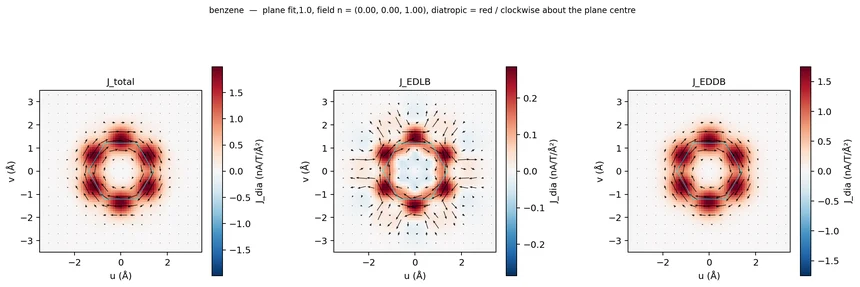
jcur2png.py --clip 3.5; red = diatropic). The weak paratropic loop inside the ring belongs to the
localized (EDLB) electrons; the delocalized current is diatropic throughout.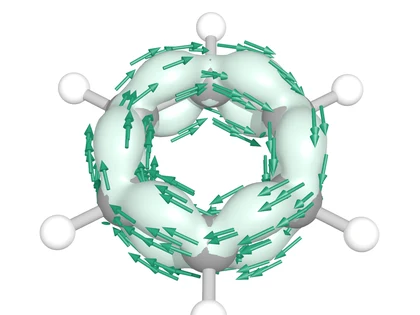
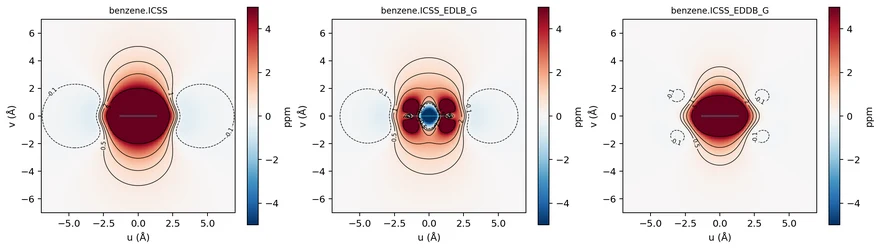
acid2pov.py).The classic ICSS picture is a section through the ring, perpendicular to it. For a ring in the xy plane (benzene below, B3LYP/def2-TZVPP, NMR=CSGT, 15 s on 16 cores):
$ runEDDB -i benzene.fchk --export-map icss,icss-edlb,icss-eddb --map-plane x=0 \
          --map-step 0.1 --cube-margin 7 -n 16
$ python3 ~/runEDDB/scripts/map2png.py benzene.ICSS.map.dat benzene.ICSS_EDLB_G.map.dat \
          benzene.ICSS_EDDB_G.map.dat --range 5 --levels 5,2,1,0.5,-0.1 --clip 7
- Field direction: by default the normal of NICS ring R1 (or the best-fit plane); the 2D maps use the
plane normal;
--field-axis(z | x | y,"ring N", or a vector) overrides both. For a macrocycle set it to the normal of the macrocycle. - Plane of a 2D map:
--map-planefit[,h](default, 1 Å above the best-fit plane),"ring N[,h]","atoms i,j,k[,h]"orz=V;--map-stepthe lattice step (0.25 Å). See Maps & files. - Grids: current maps 0.20 Å with a 4 Å margin; ICSS maps Kleinpeter's 0.5 Å lattice with a
10 Å margin (their 0.1 ppm surfaces reach 7–9 Å).
-c,--cube-margin,--cube-refchange them. - Long ICSS passes:
--icss-checkpoint [MIN]saves the pass every MIN minutes (10) and a rerun of the same command continues from it, with an identical result. - Viewing: open
.JCUR.vtkand.JCUR_atoms.vtkin ParaView (Slice + Glyph or Stream Tracer, colour byJ_EDDB_dia: red diatropic). Without ParaView the scripts installed with runEDDB render PNGs (jcur2png.py,map2png.py) and the AICD-style 3D picture with POV-Ray (acid2pov.py). - Scoped maps: with
-f,-p,-rthe maps show the current of the scoped delocalized density (J_EDDB_P, ...) and of the rest. For a cyclophane,-palong the macrocyclic path gives the perimeter's current without the local benzene circulations:runEDDB -i mol.fchk --nmr-log mol.log -p PATH --field-axis z --export-vtk jcur.
Reading the maps, and the GIAO caveat
Near the nuclei the maps show the nuclear shieldings (tens to hundreds of ppm): set the isosurface levels or the colour range by hand (±0.5 to ±5 ppm is the usual window). At a NICS probe the map value equals the table value, so the tables stay the reference for numbers. The parts of a partitioned current are not divergence-free (current passes between channels); their div J shows where. The total J is divergence-free up to the finite-basis error, which the div J table measures (watch the valence row). For partitioned maps prefer a CSGT .log: the GIAO J_total equals the CSGT one point by point, but its EDLB/EDDB split differs somewhat from the bond-current tables.
The ACID picture of benzene shows the classic σ/π story from the density partition alone: the inner paratropic loop sits entirely on the ACID_EDLB surface (σ framework), the ACID_EDDB torus is diatropic throughout.
Validation: ICSS against Kleinpeter, J flux against Ampère
Benzene ICSS, reach of the surfaces along the normal (Å), B3LYP/6-311G(d,p), GIAO, Kleinpeter's lattice: +5 ppm 2.04, +0.5 ppm 5.02, +0.1 ppm 8.77; Kleinpeter: 2.1, 5.1, 8.9. At every node the map value equals the NICS of a probe there to 10−12 ppm.
The flux of the J map through a bond plane reproduces the Ampère current of the table in a converged
basis (benzene B3LYP/def2-TZVP, CSGT: 11.97 vs 11.99 nA/T); in 6-31G or on the GFN2-xTB lane the maps are
qualitative (the approximate current does not conserve charge). RUNEDDB_JCUR_CHECK=1 prints
the comparison.
11. What a ring current is evidence of
Ring currents, NICS and the shifts they cause are magnetic response properties of a molecule in a field. Their sign is set by the symmetry of the frontier excitations (translational: diatropic; rotational: paratropic), their size largely by the HOMO–LUMO gap. They are not a measure of how delocalized the bonds are, nor of the stabilization that, together with cyclic delocalization, IUPAC requires of an aromatic molecule; the EDLB / EDDB split does not make them one. The link between 4n+2 / 4n electron counts and diatropic / paratropic currents holds for annulene-type rings and fails outside them: bond-alternated annulenes still sustain diatropic currents, and isoelectronic phenalenyl systems with the same delocalized perimeter have currents of opposite sign. Use EDDB and the CDI for delocalization, energies for stabilization, and the currents for the magnetic response.
12. Methods and references
--cite both adds these to <stem>.bib for any run with --table nmr.
| Method | Reference |
|---|---|
| GIAO shielding | K. Wolinski, J.F. Hinton, P. Pulay, J. Am. Chem. Soc. 112 (1990) 8251, doi:10.1021/ja00179a005 |
| Partition of the shielding over a density decomposition (the NCS idea) | J.A. Bohmann, F. Weinhold, T.C. Farrar, J. Chem. Phys. 107 (1997) 1173, doi:10.1063/1.474464 |
| CTOCD-DZ (ipsocentric) shielding and current | P. Lazzeretti, M. Malagoli, R. Zanasi, Chem. Phys. Lett. 220 (1994) 299, doi:10.1016/0009-2614(94)00158-8 |
| CSGT response densities | T.A. Keith, R.F.W. Bader, Chem. Phys. Lett. 210 (1993) 223, doi:10.1016/0009-2614(93)89127-4 |
| Orbital contributions and selection rules of ring currents | E. Steiner, P.W. Fowler, J. Phys. Chem. A 105 (2001) 9553, doi:10.1021/jp011955m |
| NICS | P.v.R. Schleyer, C. Maerker, A. Dransfeld, H. Jiao, N.J.R. van Eikema Hommes, J. Am. Chem. Soc. 118 (1996) 6317, doi:10.1021/ja960582d |
| ICSS maps and their protocol | S. Klod, E. Kleinpeter, J. Chem. Soc., Perkin Trans. 2 (2001) 1893, doi:10.1039/b009809o; E. Kleinpeter, A. Koch, Arkivoc 2024 (7) 202412263, doi:10.24820/ark.5550190.p012.263 |
| ACID | R. Herges, D. Geuenich, J. Phys. Chem. A 105 (2001) 3214, doi:10.1021/jp0034426 |
Exchange kernel of the approximate lane and of --xtb-coupled (sTDA) | S. Grimme, J. Chem. Phys. 138 (2013) 244104, doi:10.1063/1.4811331; S. Grimme, C. Bannwarth, J. Chem. Phys. 145 (2016) 054103, doi:10.1063/1.4959605 |
| Ring currents from the Ampère–Maxwell law | R.J.F. Berger, M. Dimitrova, R.T. Nasibullin et al., Phys. Chem. Chem. Phys. 24 (2022) 624, doi:10.1039/D1CP05061C |
| Loop current from the NICS profile (ARCS; the -v fit) | J. Jusélius, D. Sundholm, Phys. Chem. Chem. Phys. 1 (1999) 3429, doi:10.1039/a903847g |
| Bond current strengths (the GIMIC definition) | J. Jusélius, D. Sundholm, J. Gauss, J. Chem. Phys. 121 (2004) 3952, doi:10.1063/1.1773136 |