◼ Tutorial 7 — Phenalenyl, a magnetic chameleon: what a ring current can and cannot tell
Four molecules with one and the same delocalized perimeter, two of them with a diatropic ring current and two with a paratropic one. This tutorial walks the whole magnetic tool chain of runEDDB on them — the NICS partition, the equivalent loop current, the bond current strengths — three times: from a bare geometry (GFN2-xTB), from a DFT wavefunction file without an NMR job (the automatic approximate lane), and from the NMR job itself; it ends with the three levels side by side. Along the way it makes one point that matters more than any number: EDDB and CDI answer a question about the bonds, a ring current answers a question about the magnetic response, and the two questions have different answers here.
What you will learn
That EDDB and the CDI describe the bonding identity of a molecule (how far the low-energy covalent forms are degenerate along a cycle), while a ring current is a response property set by the symmetry of the frontier orbitals: neither unique to, nor an identifier of, the bonds.
How the same runEDDB tables give both: the delocalized population (EDDBP, CDI) and the ring current of the delocalized electrons (the NICS partition, I_bond, I_cyc).
How to read a bond-current table: outward bonds, shared bonds, the coherent cyclic current I_cyc, and why a current through a bond can be zero although the bond is delocalized.
The three levels at which runEDDB computes magnetic properties, what each one costs and how far each one can be trusted (--nmr-kernel, --nmr-log).
Why the 12-π cation and the 14-π anion of phenalenyl carry a diatropic perimeter current while their isoelectronic B- and N-centred analogues carry a paratropic one.
Before you start
Phenalenyl is three benzene rings fused around one central atom. The neutral species is a radical; its closed-shell cation (12 π-electrons) and anion (14 π-electrons) are the classical cases. Replacing the central C+ by boron gives a neutral 12-π molecule, replacing the central C− by nitrogen a neutral 14-π molecule: two isoelectronic pairs. The magnetic behaviour of this family was worked out in the ipsocentric picture by Cyrański, Havenith, Dobrowolski, Gray, Krygowski, Fowler and Jenneskens:
The phenalenyl motif: a magnetic chameleon M.K. Cyrański, R.W.A. Havenith, M.A. Dobrowolski, B.R. Gray, T.M. Krygowski, P.W. Fowler, L.W. Jenneskens, Chem. Eur. J. 13 (2007) 2201−2207. DOI: 10.1002/chem.200601619. URL
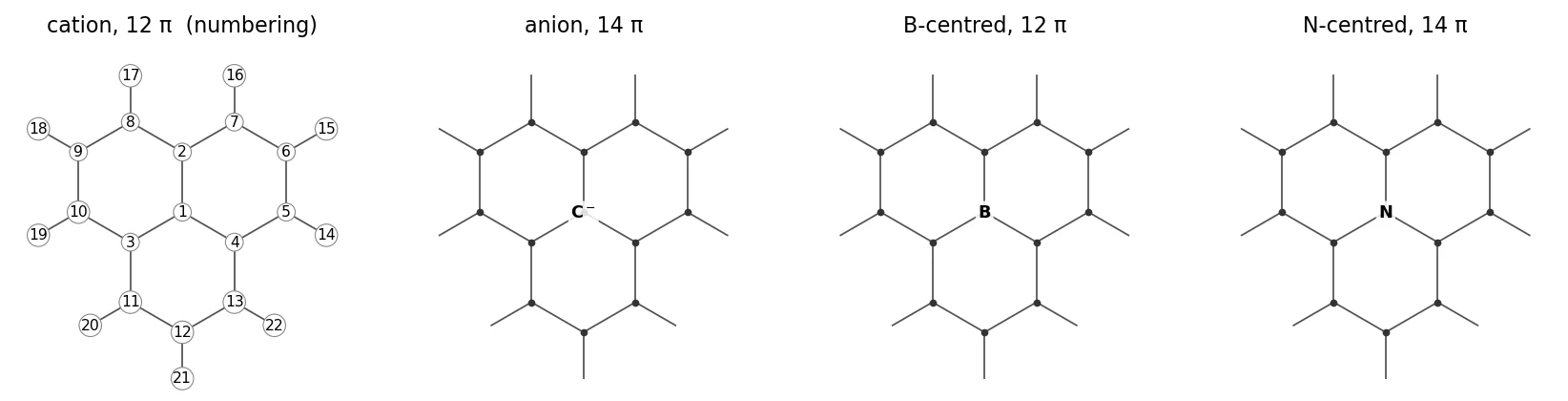
The four systems with the atom numbering used throughout: 1 = central atom, 2–4 = inner carbons, 5–13 = perimeter, 14–22 = hydrogens; rings R1 = 1-2-7-6-5-4-1, R2 = 1-2-8-9-10-3-1, R3 = 1-3-11-12-13-4-1; the perimeter is the 12-membered cycle 5-4-13-12-11-3-10-9-8-2-7-6-5.
Parts 1–3 use idealized D3h frames (every ring bond 1.40 Å) and the built-in GFN2-xTB engine, so the only input is a geometry; the charge of the carbon ions is given on the command line with --xyz-charge. Download the three frames:
⚠ Level of theory. The GFN2-xTB lane computes NICS and ring currents from a tight-binding wavefunction (uncoupled response, CTOCD-DZ gauge, minimal valence basis): a screening tool that gets signs and pairs right but not ratios, as Part 6 will show. Parts 4 and 5 repeat everything on B3LYP-D3(BJ)/def2-TZVP wavefunctions; the Gaussian inputs are on this page.
Part 1 — How much is delocalized: EDDBP and CDI along the perimeter
terminal
$ runEDDB -i phen_C.xyz --xyz-charge 1 -p 5-4-13-12-11-3-10-9-8-2-7-6-5 -a
terminal (excerpt)
        Total EDDB_P population:            7.23768    per atom:     0.60314

    Cyclic Delocal. Index (CDI):            0.47935
    Delocalized fraction (%del):              65.81 %
    Cyclic coherence (%cyc):                  52.30 %
The same command for the other three systems (the anion with --xyz-charge -1, the B- and N-centred molecules without a charge):
cation C+
anion C−
B (neutral)
N (neutral)
π electrons
12
14
12
14
EDDBP (perimeter)
7.24
8.63
7.75
8.53
CDI (perimeter)
0.479
0.483
0.517
0.527
EDDBP (one ring)
3.15
3.63
2.83
3.40
GFN2-xTB lane, idealized frames, π NOBDs only.
All four have the same bonding identity: a delocalized 12-membered perimeter with a central node, CDI 0.48–0.53, seven to nine electrons of the perimeter in delocalized bonds (the B and N members even slightly above the carbon ions). This is the resonance structure of the phenalenyl motif, and it is common to the whole family. Whether that structure sustains a diatropic or a paratropic current is a question about the magnetic response, not about the bonds: the exchange of the central atom changes the symmetry of the frontier orbitals, not the network of delocalized bonds.
Part 2 — The magnetic response: NICS partitioned, loop and bond currents
What the options do: --nics-rings 6 finds every six-membered ring and puts NICS probes at its centroid and 1 Å above and below; --bcs LIST integrates the current through a plane on every bond of the listed cycles (the three rings and the perimeter; without a LIST every bond of every NICS ring is taken); 792 probes, about ten seconds on four cores. The NICS table of the cation:
NICS(0) of the cation is positive (+5.0 ppm). The partition shows why: the delocalized electrons shield the ring centre (EDDB −6.8), but the localized density (EDLB +11.9: the σ circulations around the central atom and the three bonds to it) deshields it more. Only the EDDB column speaks about the ring current; NICS(1)zz, away from the σ framework, is −7.3 ppm with −8.3 from EDDB. The ring currents:
terminal (excerpt; the R4 bond rows of the perimeter cut, its I_cyc kept)
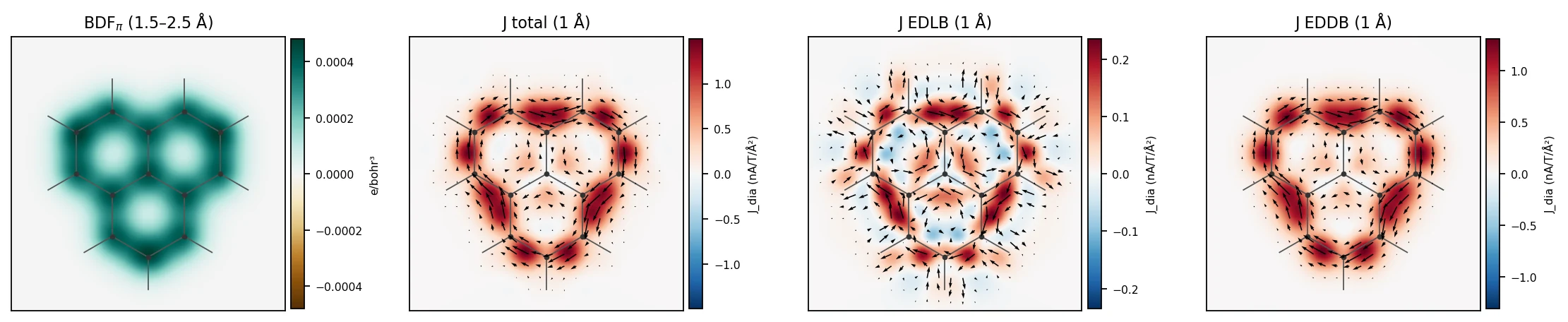
The two bonds of every ring that lead to the central atom carry 0.00 nA/T: the plane between two ring centres measures the difference of the two ring currents, and there is none, so the net current flows around the perimeter. Zero net current through a bond does not mean that there are no π electrons on it (EDDBP of one ring is 3.15 electrons; the central bond of naphthalene is the classical case): two circulations cancel there. A current is not a measure of the bonding structure.
Every outward bond, whichever ring it is assigned to, carries the same 4.07 nA/T of delocalized current (spread 0.02), and so I_cyc of the perimeter, the largest current that can circulate coherently around the whole 12-membered cycle, is 4.07 nA/T.
I_cyc of each six-membered ring (R1–R3) is the same 4.07 nA/T: the weakest plane of every ring is an outward bond, so the three ring currents are the perimeter current seen from three centres. I_bond and I_cyc are measured flux; a loop-current model fitted to the NICS profile (I_loop) is printed only in the -v diagnostics file and is not to be mixed with them (Manual, NMR & currents).
The cation at level A: BDFπ (mean of the planes 1.5–2.5 Å above the molecule; positive = delocalized) and the current 1 Å above, total and split into EDLB and EDDB (colour = diatropic component, red +, blue −; each panel on its own scale). Where the current flows: the outward bonds of the perimeter carry the same flux, the three radial bonds carry none (two circulations cancel), although every bond holds delocalized electrons.
Restricting the analysis to the π NOBDs (-a) changes nothing in the EDDB column (I_cyc 4.09 vs 4.07 nA/T): the delocalized current is the π current.
Show the complete xTB output of the cation
xtb_cation.out
────────────────────────────────────────────────────────────────────────────────────────
▄▄▄▄▄▄▄▄▄▄▄▄▄▄▄▄▄▄▄▄▄▄▄▄▄ Build date:
r █▄ ▄▄ █▄ ▄▄▀█▄ ▄▄▀█▄ ▄ ▀█ 2026-Oct-29
u ██ ▄█▀██ ██ ██ ██ ██ ▄ ▀█
n █▄▄▄▄▄█▄▄▄▄██▄▄▄▄██▄▄▄▄██
Electron Density of Delocalized Bonds Analysis
(https://aromaticity.uj.edu.pl/runeddb)
────────────────────────────────────────────────────────────────────────────────────────
▶ Loading and parsing input file... 0s
▶ Modelling one-electron density at the GFN2-xTB/vSTO-nG level... 0s
▶ Building the uncoupled GFN2-xTB magnetic response (L, p)... 0s
▶ Building natural atomic orbitals (NAO, frozen-NMB two-cycle)... 0s
▶ Performing multicenter bond-orbital projections (BOP)... 0s
▶ Computing natural orbitals for bond delocalization (NOBD)... 0s
▶ Computing NMR shielding partition (CTOCD-DZ)... 12s
▶ Printing analysis details:
┌────────────────────────────────────────────────────────────────────────────────────┐
  │           NICS = -σ (ppm) AT RING CENTROIDS AND PROBE POINTS (GFN2-xTB)            │
  └────────────────────────────────────────────────────────────────────────────────────┘
    R1  1-2-7-6-5-4-1
    R2  1-2-8-9-10-3-1
    R3  1-3-11-12-13-4-1
    Probe              NICS      EDLB_G      EDDB_G       other
   ────────     ═══════════ ─────────── ─────────── ───────────
  R1 NICS(0)        5.02155    11.86344    -6.84189    -0.00000
  R1 NICS(0)zz     -0.87112    10.09421   -10.96533     0.00000
  R1 NICS(1)       -2.48184     1.17858    -3.66042     0.00000
  R1 NICS(1)zz     -7.25572     1.06915    -8.32486    -0.00000
  R2 NICS(0)        5.02155    11.86344    -6.84189    -0.00000
  R2 NICS(0)zz     -0.87112    10.09421   -10.96533    -0.00000
  R2 NICS(1)       -2.48184     1.17858    -3.66042    -0.00000
R2 NICS(1)zz -7.25572 1.06915 -8.32486 -0.00000
R3 NICS(0) 5.02156 11.86345 -6.84189 0.00000
R3 NICS(0)zz -0.87112 10.09423 -10.96535 0.00000
R3 NICS(1) -2.48184 1.17859 -3.66043 -0.00000
R3 NICS(1)zz -7.25572 1.06915 -8.32488 -0.00000
──────── ═══════════ ─────────── ─────────── ───────────
NICS = -σ; zz = along the ring normal; NICS(1) = mean of the +-1 A probes
┌────────────────────────────────────────────────────────────────────────────────────┐
│ RING CURRENT STRENGTHS (nA/T) │
└────────────────────────────────────────────────────────────────────────────────────┘
R4 5-4-13-12-11-3-10-9-8-2-7-6-5
Ring Item total EDLB_G EDDB_G
──── ──────────────────────── ═══════════ ─────────── ───────────
R1 I_bond 1-2 (R2) 0.00000 -0.00000 0.00000
R1 I_bond 2-7 3.51481 -0.55255 4.06736
R1 I_bond 7-6 3.53967 -0.52810 4.06777
R1 I_bond 6-5 3.53967 -0.52810 4.06777
R1 I_bond 5-4 3.51481 -0.55255 4.06736
R1 I_bond 4-1 (R3) -0.00000 0.00000 -0.00000
R1 I_cyc 3.51481 -0.55255 4.06736
R2 I_bond 1-2 (R1) -0.00000 0.00000 -0.00000
R2 I_bond 2-8 3.51481 -0.55255 4.06736
R2 I_bond 8-9 3.53967 -0.52810 4.06777
R2 I_bond 9-10 3.53967 -0.52810 4.06777
R2 I_bond 10-3 3.51481 -0.55255 4.06736
R2 I_bond 3-1 (R3) -0.00000 0.00000 -0.00000
R2 I_cyc 3.51481 -0.55255 4.06736
R3 I_bond 1-3 (R2) 0.00000 -0.00000 0.00000
R3 I_bond 3-11 3.51481 -0.55255 4.06737
R3 I_bond 11-12 3.53968 -0.52810 4.06778
R3 I_bond 12-13 3.53968 -0.52810 4.06778
R3 I_bond 13-4 3.51481 -0.55255 4.06737
R3 I_bond 4-1 (R1) 0.00000 -0.00000 0.00000
R3 I_cyc 3.51481 -0.55255 4.06737
R4 I_bond 5-4 in R1 3.51481 -0.55255 4.06736
R4 I_bond 13-4 in R3 3.51481 -0.55255 4.06737
R4 I_bond 12-13 in R3 3.53968 -0.52810 4.06778
R4 I_bond 11-12 in R3 3.53968 -0.52810 4.06778
R4 I_bond 3-11 in R3 3.51481 -0.55255 4.06737
R4 I_bond 10-3 in R2 3.51481 -0.55255 4.06736
R4 I_bond 9-10 in R2 3.53967 -0.52810 4.06777
R4 I_bond 8-9 in R2 3.53967 -0.52810 4.06777
R4 I_bond 2-8 in R2 3.51481 -0.55255 4.06736
R4 I_bond 2-7 in R1 3.51481 -0.55255 4.06736
R4 I_bond 7-6 in R1 3.53967 -0.52810 4.06777
R4 I_bond 6-5 in R1 3.53967 -0.52810 4.06777
R4 I_cyc 3.51481 -0.55255 4.06736
──── ──────────────────────── ═══════════ ─────────── ───────────
I_bond: Ampere flux; I_cyc: min flux centre->vacuum
▶ Printing summary of EDDB calculations:
Total ED_G population: 60.00000 per atom: 2.72727
Total EDLB_G population: 47.96558 per atom: 2.18025
Total EDDB_G population: 12.03442 per atom: 0.54702
▶ Calculation completed on 2026-10-29. Total time: 12s.
Part 3 — The chameleon
The same two commands for the anion, the B- and the N-centred molecule:
cation C+
anion C−
B (neutral)
N (neutral)
π electrons
12
14
12
14
CDI (perimeter)
0.479
0.483
0.517
0.527
NICS(0) total
+5.02
+1.29
+21.27
+14.21
NICS(0) EDDB
−6.84
−6.08
+7.22
+6.00
NICS(1)zz EDDB
−8.33
−8.18
+25.97
+18.75
Icyc EDDB (perimeter)
+4.07
+3.55
−9.84
−7.86
Icyc EDDB, π only
+4.09
+3.57
−9.82
−7.83
Icyc total
+3.51
+3.00
−12.77
−9.33
GFN2-xTB lane; NICS in ppm, currents in nA/T (positive = diatropic).
Same bonding structure, opposite magnetic response: the cation and the anion sustain a diatropic perimeter current, the B- and N-centred molecules a paratropic one, in each isoelectronic pair. The lesson is about the current, not about EDDB: the sign and size of a ring current do not decide whether a ring is aromatic in the IUPAC sense (cyclic delocalization and stabilization). Report the current as what it is, a magnetic property of the molecule in a field; assess delocalization with EDDB/CDI and stabilization with energies.
Show the xTB outputs of the anion, the B- and the N-centred molecule
xtb_anion.out
────────────────────────────────────────────────────────────────────────────────────────
                                ▄▄▄▄▄▄▄▄▄▄▄▄▄▄▄▄▄▄▄▄▄▄▄▄▄                    Build date:
                              r █▄ ▄▄ █▄ ▄▄▀█▄ ▄▄▀█▄ ▄ ▀█                    2026-Oct-29
                              u ██ ▄█▀██ ██ ██ ██ ██ ▄ ▀█
                              n █▄▄▄▄▄█▄▄▄▄██▄▄▄▄██▄▄▄▄██

                     Electron Density of Delocalized Bonds Analysis
                        (https://aromaticity.uj.edu.pl/runeddb)
────────────────────────────────────────────────────────────────────────────────────────

▶ Loading and parsing input file...                                                   0s
▶ Modelling one-electron density at the GFN2-xTB/vSTO-nG level...                     0s
▶ Building the uncoupled GFN2-xTB magnetic response (L, p)...                         0s
▶ Building natural atomic orbitals (NAO, frozen-NMB two-cycle)...                     0s
▶ Performing multicenter bond-orbital projections (BOP)...                            0s
▶ Computing natural orbitals for bond delocalization (NOBD)...                        0s
▶ Computing NMR shielding partition (CTOCD-DZ)...                                    12s
▶ Printing analysis details:

  ┌────────────────────────────────────────────────────────────────────────────────────┐
  │           NICS = -σ (ppm) AT RING CENTROIDS AND PROBE POINTS (GFN2-xTB)            │
  └────────────────────────────────────────────────────────────────────────────────────┘
    R1  1-2-7-6-5-4-1
    R2  1-2-8-9-10-3-1
    R3  1-3-11-12-13-4-1
    Probe              NICS      EDLB_G      EDDB_G       other
   ────────     ═══════════ ─────────── ─────────── ───────────
  R1 NICS(0)        1.28771     7.36416    -6.07645     0.00000
  R1 NICS(0)zz     -0.70442     9.36440   -10.06883    -0.00000
  R1 NICS(1)       -3.26038     0.17946    -3.43985     0.00000
  R1 NICS(1)zz     -7.21173     0.96712    -8.17885     0.00000
  R2 NICS(0)        1.28771     7.36416    -6.07645     0.00000
  R2 NICS(0)zz     -0.70442     9.36440   -10.06883    -0.00000
  R2 NICS(1)       -3.26038     0.17946    -3.43985    -0.00000
  R2 NICS(1)zz     -7.21173     0.96712    -8.17885     0.00000
  R3 NICS(0)        1.28773     7.36417    -6.07645     0.00000
  R3 NICS(0)zz     -0.70439     9.36442   -10.06881     0.00000
  R3 NICS(1)       -3.26038     0.17947    -3.43984    -0.00000
  R3 NICS(1)zz     -7.21171     0.96713    -8.17884    -0.00000
   ────────     ═══════════ ─────────── ─────────── ───────────
    NICS = -σ; zz = along the ring normal; NICS(1) = mean of the +-1 A probes

  ┌────────────────────────────────────────────────────────────────────────────────────┐
  │                           RING CURRENT STRENGTHS (nA/T)                            │
  └────────────────────────────────────────────────────────────────────────────────────┘
    R4  5-4-13-12-11-3-10-9-8-2-7-6-5
     Ring  Item                          total      EDLB_G      EDDB_G
     ────  ──────────────────────── ═══════════ ─────────── ───────────
     R1    I_bond 1-2 (R2)             -0.00000     0.00000    -0.00000
     R1    I_bond 2-7                   2.99790    -0.55172     3.54962
     R1    I_bond 7-6                   3.02770    -0.52663     3.55433
     R1    I_bond 6-5                   3.02770    -0.52664     3.55433
     R1    I_bond 5-4                   2.99790    -0.55172     3.54962
     R1    I_bond 4-1 (R3)              0.00001     0.00000     0.00000
     R1    I_cyc                        2.99790    -0.55172     3.54962
     R2    I_bond 1-2 (R1)              0.00000    -0.00000     0.00000
     R2    I_bond 2-8                   2.99790    -0.55172     3.54962
     R2    I_bond 8-9                   3.02770    -0.52663     3.55433
     R2    I_bond 9-10                  3.02770    -0.52664     3.55433
     R2    I_bond 10-3                  2.99790    -0.55172     3.54962
     R2    I_bond 3-1 (R3)              0.00001     0.00000     0.00000
     R2    I_cyc                        2.99790    -0.55172     3.54962
     R3    I_bond 1-3 (R2)             -0.00001    -0.00000    -0.00000
     R3    I_bond 3-11                  2.99789    -0.55173     3.54962
     R3    I_bond 11-12                 3.02769    -0.52664     3.55433
     R3    I_bond 12-13                 3.02769    -0.52664     3.55433
     R3    I_bond 13-4                  2.99789    -0.55173     3.54962
     R3    I_bond 4-1 (R1)             -0.00001    -0.00000    -0.00000
     R3    I_cyc                        2.99789    -0.55173     3.54962
     R4    I_bond 5-4 in R1             2.99790    -0.55172     3.54962
     R4    I_bond 13-4 in R3            2.99789    -0.55173     3.54962
     R4    I_bond 12-13 in R3           3.02769    -0.52664     3.55433
     R4    I_bond 11-12 in R3           3.02769    -0.52664     3.55433
     R4    I_bond 3-11 in R3            2.99789    -0.55173     3.54962
     R4    I_bond 10-3 in R2            2.99790    -0.55172     3.54962
     R4    I_bond 9-10 in R2            3.02770    -0.52664     3.55433
     R4    I_bond 8-9 in R2             3.02770    -0.52663     3.55433
     R4    I_bond 2-8 in R2             2.99790    -0.55172     3.54962
     R4    I_bond 2-7 in R1             2.99790    -0.55172     3.54962
     R4    I_bond 7-6 in R1             3.02770    -0.52663     3.55433
     R4    I_bond 6-5 in R1             3.02770    -0.52664     3.55433
     R4    I_cyc                        2.99789    -0.55173     3.54962
     ────  ──────────────────────── ═══════════ ─────────── ───────────
    I_bond: Ampere flux; I_cyc: min flux centre->vacuum

▶ Printing summary of EDDB calculations:

        Total   ED_G population:           62.00000    per atom:     2.81818
        Total EDLB_G population:           48.17151    per atom:     2.18961
        Total EDDB_G population:           13.82849    per atom:     0.62857

▶ Calculation completed on 2026-10-29. Total time: 12s.
xtb_boron.out
────────────────────────────────────────────────────────────────────────────────────────
                                ▄▄▄▄▄▄▄▄▄▄▄▄▄▄▄▄▄▄▄▄▄▄▄▄▄                    Build date:
                              r █▄ ▄▄ █▄ ▄▄▀█▄ ▄▄▀█▄ ▄ ▀█                    2026-Oct-29
                              u ██ ▄█▀██ ██ ██ ██ ██ ▄ ▀█
                              n █▄▄▄▄▄█▄▄▄▄██▄▄▄▄██▄▄▄▄██

                     Electron Density of Delocalized Bonds Analysis
                        (https://aromaticity.uj.edu.pl/runeddb)
────────────────────────────────────────────────────────────────────────────────────────

▶ Loading and parsing input file...                                                   0s
▶ Modelling one-electron density at the GFN2-xTB/vSTO-nG level...                     0s
▶ Building the uncoupled GFN2-xTB magnetic response (L, p)...                         0s
▶ Building natural atomic orbitals (NAO, frozen-NMB two-cycle)...                     0s
▶ Performing multicenter bond-orbital projections (BOP)...                            0s
▶ Computing natural orbitals for bond delocalization (NOBD)...                        0s
▶ Computing NMR shielding partition (CTOCD-DZ)...                                    12s
▶ Printing analysis details:

  ┌────────────────────────────────────────────────────────────────────────────────────┐
  │           NICS = -σ (ppm) AT RING CENTROIDS AND PROBE POINTS (GFN2-xTB)            │
  └────────────────────────────────────────────────────────────────────────────────────┘
    R1  1-2-7-6-5-4-1
    R2  1-2-8-9-10-3-1
    R3  1-3-11-12-13-4-1
    Probe              NICS      EDLB_G      EDDB_G       other
   ────────     ═══════════ ─────────── ─────────── ───────────
  R1 NICS(0)       21.26628    14.04243     7.22385     0.00000
  R1 NICS(0)zz     48.26880    16.75662    31.51218     0.00000
  R1 NICS(1)       10.19246     2.56341     7.62905     0.00000
  R1 NICS(1)zz     33.17655     7.20811    25.96845    -0.00000
  R2 NICS(0)       21.26628    14.04243     7.22385    -0.00000
  R2 NICS(0)zz     48.26880    16.75662    31.51218     0.00000
  R2 NICS(1)       10.19246     2.56341     7.62905    -0.00000
  R2 NICS(1)zz     33.17655     7.20811    25.96845    -0.00000
  R3 NICS(0)       21.26652    14.04250     7.22402    -0.00000
  R3 NICS(0)zz     48.26937    16.75669    31.51268     0.00000
  R3 NICS(1)       10.19261     2.56343     7.62918     0.00000
  R3 NICS(1)zz     33.17700     7.20816    25.96884     0.00000
   ────────     ═══════════ ─────────── ─────────── ───────────
    NICS = -σ; zz = along the ring normal; NICS(1) = mean of the +-1 A probes

  ┌────────────────────────────────────────────────────────────────────────────────────┐
  │                           RING CURRENT STRENGTHS (nA/T)                            │
  └────────────────────────────────────────────────────────────────────────────────────┘
    R4  5-4-13-12-11-3-10-9-8-2-7-6-5
     Ring  Item                          total      EDLB_G      EDDB_G
     ────  ──────────────────────── ═══════════ ─────────── ───────────
     R1    I_bond 1-2 (R2)              0.00000    -0.00000     0.00000
     R1    I_bond 2-7                 -12.76901    -2.95549    -9.81352
     R1    I_bond 7-6                 -12.72915    -2.89305    -9.83610
     R1    I_bond 6-5                 -12.72915    -2.89305    -9.83611
     R1    I_bond 5-4                 -12.76901    -2.95549    -9.81352
     R1    I_bond 4-1 (R3)              0.00015     0.00002     0.00013
     R1    I_cyc                      -12.76901    -2.95549    -9.83611
     R2    I_bond 1-2 (R1)             -0.00000     0.00000    -0.00000
     R2    I_bond 2-8                 -12.76901    -2.95549    -9.81352
     R2    I_bond 8-9                 -12.72915    -2.89305    -9.83610
     R2    I_bond 9-10                -12.72915    -2.89305    -9.83611
     R2    I_bond 10-3                -12.76901    -2.95549    -9.81352
     R2    I_bond 3-1 (R3)              0.00015     0.00002     0.00013
     R2    I_cyc                      -12.76901    -2.95549    -9.83611
     R3    I_bond 1-3 (R2)             -0.00015    -0.00002    -0.00013
     R3    I_bond 3-11                -12.76916    -2.95551    -9.81365
     R3    I_bond 11-12               -12.72930    -2.89306    -9.83624
     R3    I_bond 12-13               -12.72930    -2.89306    -9.83624
     R3    I_bond 13-4                -12.76916    -2.95551    -9.81365
     R3    I_bond 4-1 (R1)             -0.00015    -0.00002    -0.00013
     R3    I_cyc                      -12.76916    -2.95551    -9.83624
     R4    I_bond 5-4 in R1           -12.76901    -2.95549    -9.81352
     R4    I_bond 13-4 in R3          -12.76916    -2.95551    -9.81365
     R4    I_bond 12-13 in R3         -12.72930    -2.89306    -9.83624
     R4    I_bond 11-12 in R3         -12.72930    -2.89306    -9.83624
     R4    I_bond 3-11 in R3          -12.76916    -2.95551    -9.81365
     R4    I_bond 10-3 in R2          -12.76901    -2.95549    -9.81352
     R4    I_bond 9-10 in R2          -12.72915    -2.89305    -9.83611
     R4    I_bond 8-9 in R2           -12.72915    -2.89305    -9.83610
     R4    I_bond 2-8 in R2           -12.76901    -2.95549    -9.81352
     R4    I_bond 2-7 in R1           -12.76901    -2.95549    -9.81352
     R4    I_bond 7-6 in R1           -12.72915    -2.89305    -9.83610
     R4    I_bond 6-5 in R1           -12.72915    -2.89305    -9.83611
     R4    I_cyc                      -12.76916    -2.95551    -9.83624
     ────  ──────────────────────── ═══════════ ─────────── ───────────
    I_bond: Ampere flux; I_cyc: min flux centre->vacuum

▶ Printing summary of EDDB calculations:

        Total   ED_G population:           60.00000    per atom:     2.72727
        Total EDLB_G population:           47.81006    per atom:     2.17318
        Total EDDB_G population:           12.18994    per atom:     0.55409

▶ Calculation completed on 2026-10-29. Total time: 12s.
xtb_nitrogen.out
────────────────────────────────────────────────────────────────────────────────────────
                                ▄▄▄▄▄▄▄▄▄▄▄▄▄▄▄▄▄▄▄▄▄▄▄▄▄                    Build date:
                              r █▄ ▄▄ █▄ ▄▄▀█▄ ▄▄▀█▄ ▄ ▀█                    2026-Oct-29
                              u ██ ▄█▀██ ██ ██ ██ ██ ▄ ▀█
                              n █▄▄▄▄▄█▄▄▄▄██▄▄▄▄██▄▄▄▄██

                     Electron Density of Delocalized Bonds Analysis
                        (https://aromaticity.uj.edu.pl/runeddb)
────────────────────────────────────────────────────────────────────────────────────────

▶ Loading and parsing input file...                                                   0s
▶ Modelling one-electron density at the GFN2-xTB/vSTO-nG level...                     0s
▶ Building the uncoupled GFN2-xTB magnetic response (L, p)...                         0s
▶ Building natural atomic orbitals (NAO, frozen-NMB two-cycle)...                     0s
▶ Performing multicenter bond-orbital projections (BOP)...                            0s
▶ Computing natural orbitals for bond delocalization (NOBD)...                        0s
▶ Computing NMR shielding partition (CTOCD-DZ)...                                    12s
▶ Printing analysis details:

  ┌────────────────────────────────────────────────────────────────────────────────────┐
  │           NICS = -σ (ppm) AT RING CENTROIDS AND PROBE POINTS (GFN2-xTB)            │
  └────────────────────────────────────────────────────────────────────────────────────┘
    R1  1-2-7-6-5-4-1  [pi-donor N-H/O]
    R2  1-2-8-9-10-3-1  [pi-donor N-H/O]
    R3  1-3-11-12-13-4-1  [pi-donor N-H/O]
    Probe              NICS      EDLB_G      EDDB_G       other
   ────────     ═══════════ ─────────── ─────────── ───────────
  R1 NICS(0)       14.20673     8.20680     5.99993    -0.00000
  R1 NICS(0)zz     36.79285    12.12631    24.66654    -0.00000
  R1 NICS(1)        6.95826     1.29974     5.65852     0.00000
  R1 NICS(1)zz     21.78062     3.03544    18.74518    -0.00000
  R2 NICS(0)       14.20673     8.20680     5.99993     0.00000
  R2 NICS(0)zz     36.79285    12.12631    24.66654    -0.00000
  R2 NICS(1)        6.95826     1.29974     5.65852     0.00000
  R2 NICS(1)zz     21.78062     3.03544    18.74518     0.00000
  R3 NICS(0)       14.20671     8.20681     5.99990     0.00000
  R3 NICS(0)zz     36.79277    12.12632    24.66645     0.00000
  R3 NICS(1)        6.95824     1.29975     5.65850    -0.00000
  R3 NICS(1)zz     21.78056     3.03544    18.74512     0.00000
   ────────     ═══════════ ─────────── ─────────── ───────────
    NICS = -σ; zz = along the ring normal; NICS(1) = mean of the +-1 A probes

  ┌────────────────────────────────────────────────────────────────────────────────────┐
  │                           RING CURRENT STRENGTHS (nA/T)                            │
  └────────────────────────────────────────────────────────────────────────────────────┘
    R4  5-4-13-12-11-3-10-9-8-2-7-6-5
     Ring  Item                          total      EDLB_G      EDDB_G
     ────  ──────────────────────── ═══════════ ─────────── ───────────
     R1    I_bond 1-2 (R2)              0.00000    -0.00000     0.00000
     R1    I_bond 2-7                  -9.33349    -1.47225    -7.86124
     R1    I_bond 7-6                  -9.30659    -1.44566    -7.86093
     R1    I_bond 6-5                  -9.30659    -1.44565    -7.86093
     R1    I_bond 5-4                  -9.33349    -1.47225    -7.86124
     R1    I_bond 4-1 (R3)             -0.00002     0.00000    -0.00002
     R1    I_cyc                       -9.33349    -1.47225    -7.86124
     R2    I_bond 1-2 (R1)             -0.00000     0.00000    -0.00000
     R2    I_bond 2-8                  -9.33349    -1.47225    -7.86124
     R2    I_bond 8-9                  -9.30659    -1.44566    -7.86093
     R2    I_bond 9-10                 -9.30659    -1.44565    -7.86093
     R2    I_bond 10-3                 -9.33349    -1.47225    -7.86124
     R2    I_bond 3-1 (R3)             -0.00002     0.00000    -0.00002
     R2    I_cyc                       -9.33349    -1.47225    -7.86124
     R3    I_bond 1-3 (R2)              0.00002    -0.00000     0.00002
     R3    I_bond 3-11                 -9.33347    -1.47225    -7.86122
     R3    I_bond 11-12                -9.30657    -1.44566    -7.86091
     R3    I_bond 12-13                -9.30657    -1.44566    -7.86091
     R3    I_bond 13-4                 -9.33347    -1.47225    -7.86122
     R3    I_bond 4-1 (R1)              0.00002    -0.00000     0.00002
     R3    I_cyc                       -9.33347    -1.47225    -7.86122
     R4    I_bond 5-4 in R1            -9.33349    -1.47225    -7.86124
     R4    I_bond 13-4 in R3           -9.33347    -1.47225    -7.86122
     R4    I_bond 12-13 in R3          -9.30657    -1.44566    -7.86091
     R4    I_bond 11-12 in R3          -9.30657    -1.44566    -7.86091
     R4    I_bond 3-11 in R3           -9.33347    -1.47225    -7.86122
     R4    I_bond 10-3 in R2           -9.33349    -1.47225    -7.86124
     R4    I_bond 9-10 in R2           -9.30659    -1.44565    -7.86093
     R4    I_bond 8-9 in R2            -9.30659    -1.44566    -7.86093
     R4    I_bond 2-8 in R2            -9.33349    -1.47225    -7.86124
     R4    I_bond 2-7 in R1            -9.33349    -1.47225    -7.86124
     R4    I_bond 7-6 in R1            -9.30659    -1.44566    -7.86093
     R4    I_bond 6-5 in R1            -9.30659    -1.44565    -7.86093
     R4    I_cyc                       -9.33349    -1.47225    -7.86124
     ────  ──────────────────────── ═══════════ ─────────── ───────────
    I_bond: Ampere flux; I_cyc: min flux centre->vacuum

▶ Printing summary of EDDB calculations:

        Total   ED_G population:           62.00000    per atom:     2.81818
        Total EDLB_G population:           48.25274    per atom:     2.19331
        Total EDDB_G population:           13.74726    per atom:     0.62488

▶ Calculation completed on 2026-10-29. Total time: 12s.
Part 4 — The same tables from a DFT wavefunction, without an NMR job
Parts 1–3 needed nothing but coordinates. The next level is an ordinary DFT wavefunction file: here a B3LYP-D3(BJ)/def2-TZVP optimisation of each system (Gaussian, then formchk; any SCF-level .fchk, ORCA .json or .molden, Turbomole .tmol or GAMESS log works the same way). Such a file carries the orbitals but no NMR response, and runEDDB does not stop: it builds the response itself as the sum over states of the orbitals, adds the exchange kernel of the method it finds in the file (B3LYP here, ax = 0.20; Manual, NMR & currents) and prints the same tables, marked APPROXIMATE everywhere. The Gaussian inputs and the optimised geometries:
▶ Building the coupled response of the input MOs (NMB kernel)...                      0s
▶ Computing APPROXIMATE NMR partition from the input MOs (CTOCD-DZ, B3LYP)...        90s
  WARNING: APPROXIMATE lane: the input has no NMR response data; the response
           is the sum over states of the input MOs (B3LYP),
           coupled by the sTDA-type exchange kernel (a_x = 0.20): hybrid ring currents
           within ~3 %, HF ~10 % low, pi-donor rings 5-20 % low; manual, section 7.
  WARNING: NMR data missing: the .fchk route reads 'nmr=csgt': the CSGT response is
           written to the Gaussian .log only, and neither phen_cat.log nor phen_cat.out
           sits next to the .fchk. Put the .log there (IOp(10/33=2) output) or pass
           --nmr-log FILE to get the exact CSGT lane instead of this approximation.
  WARNING: CTOCD-DZ translational sum rule  74.5 % < 90 %: the shieldings at the nuclei
           are not converged in this basis (NICS away from the nuclei is fine).
Three warnings, all expected here. The first says what the lane is. The second appears because the .fchk used in this tutorial comes from the NMR job itself (the second step of the .gjf: its route reads nmr=csgt) and its .log is not next to it: runEDDB never falls back to the approximation silently. Put the .log beside the .fchk and you are in Part 5; a .fchk of a plain SCF or optimisation job gives only the first warning. The third (translational sum rule) concerns the shieldings at the nuclei in a finite basis; NICS probes away from the nuclei are not affected. The tables of the cation:
Two things change with respect to the xTB level: the geometry is the real one (the bonds to the central atom relax: 1.415 Å in the cation, 1.437 Å in the anion, 1.499 Å for B–C and 1.408 Å for N–C; the perimeter bonds 1.38–1.40 Å) and the response is that of a DFT wavefunction in a triple-zeta basis with the exchange coupling of B3LYP. The cation's perimeter current is now 7.8 nA/T of delocalized electrons (xTB: 4.1), the NICS(0) of its rings is negative (−3.0 ppm; the localized σ term +10.4 no longer outweighs the delocalized −13.4), and the pattern of Part 2 is unchanged: zero net current through the bonds to the centre, the same current on every outward bond.
If runEDDB cannot tell the method (a .molden without its output next to it, a functional missing from its table), the line under the caption reads exchange kernel: default DFT a_x = 0.20, method not identified (--nmr-kernel NAME|hf). Then say it yourself: --nmr-kernel b3lyp (or pbe0, hf, …; --nmr-kernel @list prints the table). Pure functionals need no kernel at all: for them the sum over states is exact.
Show the complete approximate-lane output of the cation
approx_phen_cat.out
────────────────────────────────────────────────────────────────────────────────────────
                                ▄▄▄▄▄▄▄▄▄▄▄▄▄▄▄▄▄▄▄▄▄▄▄▄▄                    Build date:
                              r █▄ ▄▄ █▄ ▄▄▀█▄ ▄▄▀█▄ ▄ ▀█                    2026-Oct-29
                              u ██ ▄█▀██ ██ ██ ██ ██ ▄ ▀█
                              n █▄▄▄▄▄█▄▄▄▄██▄▄▄▄██▄▄▄▄██

                     Electron Density of Delocalized Bonds Analysis
                        (https://aromaticity.uj.edu.pl/runeddb)
────────────────────────────────────────────────────────────────────────────────────────

▶ Loading and parsing input file...                                                   0s
▶ Building natural atomic orbitals (NAO, frozen-NMB two-cycle)...                     0s
▶ Performing multicenter bond-orbital projections (BOP)...                            0s
▶ Computing natural orbitals for bond delocalization (NOBD)...                        0s
▶ Building the coupled response of the input MOs (NMB kernel)...                      0s
▶ Computing APPROXIMATE NMR partition from the input MOs (CTOCD-DZ, B3LYP)...        90s
  WARNING: APPROXIMATE lane: the input has no NMR response data; the response
           is the sum over states of the input MOs (B3LYP),
           coupled by the sTDA-type exchange kernel (a_x = 0.20): hybrid ring currents
           within ~3 %, HF ~10 % low, pi-donor rings 5-20 % low; manual, section 7.
  WARNING: NMR data missing: the .fchk route reads 'nmr=csgt': the CSGT response is
           written to the Gaussian .log only, and neither phen_cat.log nor phen_cat.out
           sits next to the .fchk. Put the .log there (IOp(10/33=2) output) or pass
           --nmr-log FILE to get the exact CSGT lane instead of this approximation.
  WARNING: CTOCD-DZ translational sum rule  74.5 % < 90 %: the shieldings at the nuclei
           are not converged in this basis (NICS away from the nuclei is fine).
▶ Printing analysis details:

  ┌────────────────────────────────────────────────────────────────────────────────────┐
  │   NMR ISOTROPIC SHIELDING PARTITION (CTOCD-DZ) IN NVB BASIS [APPROX., UNCOUPLED]   │
  └────────────────────────────────────────────────────────────────────────────────────┘
    exchange kernel: B3LYP a_x = 0.20 (.fchk header)
     Atom            σ_iso      EDLB_G      EDDB_G       other
   ────────     ═══════════ ─────────── ─────────── ───────────
      1 C         -90.47739  -139.17706   -16.29714    64.99681
      2 C         -99.77840  -144.69503   -17.79654    62.71316
      3 C         -99.77840  -144.69504   -17.79653    62.71316
      4 C         -99.77840  -144.69502   -17.79654    62.71316
      5 C        -126.66202  -165.20102   -17.83347    56.37247
      6 C        -105.90163  -144.03827   -17.63106    55.76770
      7 C        -126.66202  -165.20098   -17.83351    56.37247
      8 C        -126.66202  -165.20082   -17.83367    56.37247
      9 C        -105.90163  -144.03789   -17.63144    55.76770
     10 C        -126.66202  -165.20083   -17.83366    56.37247
     11 C        -126.66202  -165.20075   -17.83374    56.37247
     12 C        -105.90162  -144.03774   -17.63159    55.76770
     13 C        -126.66202  -165.20083   -17.83366    56.37247
     14 H          18.97650    18.11108     0.98565    -0.12023
     15 H          19.55356    18.30386     1.36767    -0.11797
     16 H          18.97650    18.11108     0.98565    -0.12023
     17 H          18.97650    18.11108     0.98564    -0.12023
     18 H          19.55356    18.30387     1.36766    -0.11797
     19 H          18.97650    18.11108     0.98564    -0.12023
     20 H          18.97650    18.11109     0.98564    -0.12023
     21 H          19.55356    18.30388     1.36766    -0.11797
     22 H          18.97650    18.11108     0.98564    -0.12023
   ────────     ═══════════ ─────────── ─────────── ───────────
    other = core + Rydberg share of the occupied space (0 with -b nao)

  ┌────────────────────────────────────────────────────────────────────────────────────┐
  │      NICS = -σ (ppm) AT RING CENTROIDS AND PROBE POINTS [APPROX., UNCOUPLED]       │
  └────────────────────────────────────────────────────────────────────────────────────┘
    R1  1-2-7-6-5-4-1
    R2  1-2-8-9-10-3-1
    R3  1-3-11-12-13-4-1
    Probe              NICS      EDLB_G      EDDB_G       other
   ────────     ═══════════ ─────────── ─────────── ───────────
  R1 NICS(0)       -3.04865    10.43498   -13.36024    -0.12339
  R1 NICS(0)zz     -1.07132    18.08820   -18.65535    -0.50417
  R1 NICS(1)       -6.42499     0.24738    -6.39825    -0.27412
  R1 NICS(1)zz    -17.06510    -1.16022   -15.18059    -0.72429
  R2 NICS(0)       -3.04865    10.43498   -13.36024    -0.12339
  R2 NICS(0)zz     -1.07132    18.08822   -18.65537    -0.50417
  R2 NICS(1)       -6.42499     0.24739    -6.39825    -0.27412
  R2 NICS(1)zz    -17.06510    -1.16021   -15.18061    -0.72429
  R3 NICS(0)       -3.04865    10.43497   -13.36024    -0.12339
  R3 NICS(0)zz     -1.07132    18.08822   -18.65537    -0.50417
  R3 NICS(1)       -6.42499     0.24739    -6.39825    -0.27412
  R3 NICS(1)zz    -17.06510    -1.16021   -15.18061    -0.72429
   ────────     ═══════════ ─────────── ─────────── ───────────
    NICS = -σ; zz = along the ring normal; NICS(1) = mean of the +-1 A probes

  ┌────────────────────────────────────────────────────────────────────────────────────┐
  │                 RING CURRENT STRENGTHS (nA/T) [APPROX., UNCOUPLED]                 │
  └────────────────────────────────────────────────────────────────────────────────────┘
    R4  5-4-13-12-11-3-10-9-8-2-7-6-5
     Ring  Item                          total      EDLB_G      EDDB_G
     ────  ──────────────────────── ═══════════ ─────────── ───────────
     R1    I_bond 1-2 (R2)             -0.00000     0.00000    -0.00000
     R1    I_bond 2-7                   9.48825     1.29326     7.77586
     R1    I_bond 7-6                   9.49464     1.30122     7.78361
     R1    I_bond 6-5                   9.49464     1.30122     7.78361
     R1    I_bond 5-4                   9.48825     1.29326     7.77586
     R1    I_bond 4-1 (R3)              0.00000     0.00000    -0.00000
     R1    I_cyc                        9.48825     1.29326     7.77586
     R2    I_bond 1-2 (R1)              0.00000    -0.00000     0.00000
     R2    I_bond 2-8                   9.48825     1.29325     7.77586
     R2    I_bond 8-9                   9.49464     1.30122     7.78361
     R2    I_bond 9-10                  9.49464     1.30121     7.78361
     R2    I_bond 10-3                  9.48825     1.29325     7.77587
     R2    I_bond 3-1 (R3)              0.00000     0.00000    -0.00000
     R2    I_cyc                        9.48825     1.29325     7.77586
     R3    I_bond 1-3 (R2)             -0.00000    -0.00000     0.00000
     R3    I_bond 3-11                  9.48825     1.29325     7.77587
     R3    I_bond 11-12                 9.49464     1.30121     7.78361
     R3    I_bond 12-13                 9.49464     1.30121     7.78361
     R3    I_bond 13-4                  9.48825     1.29325     7.77586
     R3    I_bond 4-1 (R1)             -0.00000    -0.00000     0.00000
     R3    I_cyc                        9.48825     1.29325     7.77586
     R4    I_bond 5-4 in R1             9.48825     1.29326     7.77586
     R4    I_bond 13-4 in R3            9.48825     1.29325     7.77586
     R4    I_bond 12-13 in R3           9.49464     1.30121     7.78361
     R4    I_bond 11-12 in R3           9.49464     1.30121     7.78361
     R4    I_bond 3-11 in R3            9.48825     1.29325     7.77587
     R4    I_bond 10-3 in R2            9.48825     1.29325     7.77587
     R4    I_bond 9-10 in R2            9.49464     1.30121     7.78361
     R4    I_bond 8-9 in R2             9.49464     1.30122     7.78361
     R4    I_bond 2-8 in R2             9.48825     1.29325     7.77586
     R4    I_bond 2-7 in R1             9.48825     1.29326     7.77586
     R4    I_bond 7-6 in R1             9.49464     1.30122     7.78361
     R4    I_bond 6-5 in R1             9.49464     1.30122     7.78361
     R4    I_cyc                        9.48825     1.29325     7.77586
     ────  ──────────────────────── ═══════════ ─────────── ───────────
    I_bond: Ampere flux; I_cyc: min flux centre->vacuum

    Reference file for --nmr-ref written: phen_cat.nmrref

▶ Printing summary of EDDB calculations:

        Total   ED_G population:           59.79396    per atom:     2.71791
        Total EDLB_G population:           47.69838    per atom:     2.16811
        Total EDDB_G population:           12.09558    per atom:     0.54980

▶ Calculation completed (with 3 warnings!) on 2026-10-29. Total time: 91s.
Part 5 — The reference: the NMR job itself
The last level is the coupled response computed by the quantum-chemistry program. For the CTOCD-DZ lane Gaussian needs NMR=CSGT with IOp(10/33=2), which writes the six response blocks to the log (the second step of the .gjf files above); runEDDB reads them from the .log next to the .fchk (or from --nmr-log FILE):
▶ Computing NMR shielding partition (CTOCD-DZ)...                                    90s
  WARNING: CTOCD-DZ translational sum rule  80.4 % < 90 %: the shieldings at the nuclei
           are not converged in this basis (NICS away from the nuclei is fine).
   ...
  │                 NICS = -σ (ppm) AT RING CENTROIDS AND PROBE POINTS                 │
  └────────────────────────────────────────────────────────────────────────────────────┘
    R1  1-2-7-6-5-4-1
    R2  1-2-8-9-10-3-1
    R3  1-3-11-12-13-4-1
    Probe              NICS      EDLB_G      EDDB_G       other
   ────────     ═══════════ ─────────── ─────────── ───────────
  R1 NICS(0)       -2.94380    10.82071   -13.69351    -0.07100
  R1 NICS(0)zz     -1.05461    18.63017   -19.15465    -0.53013
  R1 NICS(1)       -6.57919     0.10914    -6.42142    -0.26691
  R1 NICS(1)zz    -17.95730    -1.61045   -15.60020    -0.74664
   ...
  │                           RING CURRENT STRENGTHS (nA/T)                            │
  └────────────────────────────────────────────────────────────────────────────────────┘
    R4  5-4-13-12-11-3-10-9-8-2-7-6-5
     Ring  Item                          total      EDLB_G      EDDB_G
     ────  ──────────────────────── ═══════════ ─────────── ───────────
     R1    I_bond 1-2 (R2)             -0.00000     0.00000    -0.00000
     R1    I_bond 2-7                  10.00591     1.57092     8.00476
     R1    I_bond 7-6                  10.01064     1.57823     8.01221
     R1    I_bond 6-5                  10.01065     1.57825     8.01221
     R1    I_bond 5-4                  10.00597     1.57098     8.00476
     R1    I_bond 4-1 (R3)              0.00004     0.00005    -0.00001
     R1    I_cyc                       10.00591     1.57092     8.00476
The same tables without the APPROXIMATE marks (of the three warnings only the sum-rule one remains), and with the nuclear shieldings above them (the xTB lane has no core electrons, so it prints NICS only; --nmr-ref would turn the shieldings into chemical shifts). For the cation the approximate lane was within 3 % of these numbers (I_cyc EDDB 7.78 vs 8.00 nA/T, NICS(1)zz EDDB −15.18 vs −15.60 ppm).
Show the complete exact-lane output of the cation
csgt_phen_cat.out
────────────────────────────────────────────────────────────────────────────────────────
                                ▄▄▄▄▄▄▄▄▄▄▄▄▄▄▄▄▄▄▄▄▄▄▄▄▄                    Build date:
                              r █▄ ▄▄ █▄ ▄▄▀█▄ ▄▄▀█▄ ▄ ▀█                    2026-Oct-29
                              u ██ ▄█▀██ ██ ██ ██ ██ ▄ ▀█
                              n █▄▄▄▄▄█▄▄▄▄██▄▄▄▄██▄▄▄▄██

                     Electron Density of Delocalized Bonds Analysis
                        (https://aromaticity.uj.edu.pl/runeddb)
────────────────────────────────────────────────────────────────────────────────────────

▶ Loading and parsing input file...                                                   1s
▶ Building natural atomic orbitals (NAO, frozen-NMB two-cycle)...                     0s
▶ Performing multicenter bond-orbital projections (BOP)...                            0s
▶ Computing natural orbitals for bond delocalization (NOBD)...                        0s
▶ Computing NMR shielding partition (CTOCD-DZ)...                                    90s
  WARNING: CTOCD-DZ translational sum rule  80.4 % < 90 %: the shieldings at the nuclei
           are not converged in this basis (NICS away from the nuclei is fine).
▶ Printing analysis details:

  ┌────────────────────────────────────────────────────────────────────────────────────┐
  │             NMR ISOTROPIC SHIELDING PARTITION (CTOCD-DZ) IN NVB BASIS              │
  └────────────────────────────────────────────────────────────────────────────────────┘
     Atom            σ_iso      EDLB_G      EDDB_G       other
   ────────     ═══════════ ─────────── ─────────── ───────────
      1 C         -90.75695  -141.09972   -15.87364    66.21641
      2 C        -100.24829  -145.97450   -18.00685    63.73305
      3 C        -100.24843  -145.97474   -18.00670    63.73301
      4 C        -100.24843  -145.97472   -18.00671    63.73301
      5 C        -128.72296  -167.28235   -18.60695    57.16634
      6 C        -105.57277  -144.01958   -18.10734    56.55414
      7 C        -128.72292  -167.28224   -18.60711    57.16643
      8 C        -128.72292  -167.28208   -18.60727    57.16643
      9 C        -105.57277  -144.01918   -18.10773    56.55414
     10 C        -128.72296  -167.28216   -18.60715    57.16634
     11 C        -128.72278  -167.28134   -18.60715    57.16570
     12 C        -105.57254  -144.01834   -18.10761    56.55341
     13 C        -128.72278  -167.28142   -18.60706    57.16570
     14 H          20.28974    19.36248     1.13295    -0.20569
     15 H          20.95934    19.58017     1.57245    -0.19329
     16 H          20.28975    19.36251     1.13296    -0.20572
     17 H          20.28975    19.36251     1.13295    -0.20572
     18 H          20.95934    19.58018     1.57244    -0.19329
     19 H          20.28974    19.36249     1.13294    -0.20569
     20 H          20.28966    19.36242     1.13294    -0.20570
     21 H          20.95923    19.58013     1.57244    -0.19334
     22 H          20.28966    19.36242     1.13294    -0.20570
   ────────     ═══════════ ─────────── ─────────── ───────────
    other = core + Rydberg share of the occupied space (0 with -b nao)

  ┌────────────────────────────────────────────────────────────────────────────────────┐
  │                 NICS = -σ (ppm) AT RING CENTROIDS AND PROBE POINTS                 │
  └────────────────────────────────────────────────────────────────────────────────────┘
    R1  1-2-7-6-5-4-1
    R2  1-2-8-9-10-3-1
    R3  1-3-11-12-13-4-1
    Probe              NICS      EDLB_G      EDDB_G       other
   ────────     ═══════════ ─────────── ─────────── ───────────
  R1 NICS(0)       -2.94380    10.82071   -13.69351    -0.07100
  R1 NICS(0)zz     -1.05461    18.63017   -19.15465    -0.53013
  R1 NICS(1)       -6.57919     0.10914    -6.42142    -0.26691
  R1 NICS(1)zz    -17.95730    -1.61045   -15.60020    -0.74664
  R2 NICS(0)       -2.94380    10.82071   -13.69351    -0.07100
  R2 NICS(0)zz     -1.05461    18.63019   -19.15467    -0.53013
  R2 NICS(1)       -6.57919     0.10915    -6.42142    -0.26691
  R2 NICS(1)zz    -17.95730    -1.61044   -15.60021    -0.74664
  R3 NICS(0)       -2.94376    10.82076   -13.69349    -0.07103
  R3 NICS(0)zz     -1.05453    18.63035   -19.15467    -0.53021
  R3 NICS(1)       -6.57917     0.10918    -6.42142    -0.26692
  R3 NICS(1)zz    -17.95726    -1.61037   -15.60022    -0.74667
   ────────     ═══════════ ─────────── ─────────── ───────────
    NICS = -σ; zz = along the ring normal; NICS(1) = mean of the +-1 A probes

  ┌────────────────────────────────────────────────────────────────────────────────────┐
  │                           RING CURRENT STRENGTHS (nA/T)                            │
  └────────────────────────────────────────────────────────────────────────────────────┘
    R4  5-4-13-12-11-3-10-9-8-2-7-6-5
     Ring  Item                          total      EDLB_G      EDDB_G
     ────  ──────────────────────── ═══════════ ─────────── ───────────
     R1    I_bond 1-2 (R2)             -0.00000     0.00000    -0.00000
     R1    I_bond 2-7                  10.00591     1.57092     8.00476
     R1    I_bond 7-6                  10.01064     1.57823     8.01221
     R1    I_bond 6-5                  10.01065     1.57825     8.01221
     R1    I_bond 5-4                  10.00597     1.57098     8.00476
     R1    I_bond 4-1 (R3)              0.00004     0.00005    -0.00001
     R1    I_cyc                       10.00591     1.57092     8.00476
     R2    I_bond 1-2 (R1)              0.00000    -0.00000     0.00000
     R2    I_bond 2-8                  10.00591     1.57092     8.00476
     R2    I_bond 8-9                  10.01064     1.57823     8.01222
     R2    I_bond 9-10                 10.01065     1.57824     8.01222
     R2    I_bond 10-3                 10.00597     1.57097     8.00476
     R2    I_bond 3-1 (R3)              0.00004     0.00005    -0.00000
     R2    I_cyc                       10.00591     1.57092     8.00476
     R3    I_bond 1-3 (R2)             -0.00004    -0.00005     0.00000
     R3    I_bond 3-11                 10.00590     1.57090     8.00476
     R3    I_bond 11-12                10.01068     1.57824     8.01222
     R3    I_bond 12-13                10.01068     1.57825     8.01222
     R3    I_bond 13-4                 10.00590     1.57090     8.00476
     R3    I_bond 4-1 (R1)             -0.00004    -0.00005     0.00001
     R3    I_cyc                       10.00590     1.57090     8.00476
     R4    I_bond 5-4 in R1            10.00597     1.57098     8.00476
     R4    I_bond 13-4 in R3           10.00590     1.57090     8.00476
     R4    I_bond 12-13 in R3          10.01068     1.57825     8.01222
     R4    I_bond 11-12 in R3          10.01068     1.57824     8.01222
     R4    I_bond 3-11 in R3           10.00590     1.57090     8.00476
     R4    I_bond 10-3 in R2           10.00597     1.57097     8.00476
     R4    I_bond 9-10 in R2           10.01065     1.57824     8.01222
     R4    I_bond 8-9 in R2            10.01064     1.57823     8.01222
     R4    I_bond 2-8 in R2            10.00591     1.57092     8.00476
     R4    I_bond 2-7 in R1            10.00591     1.57092     8.00476
     R4    I_bond 7-6 in R1            10.01064     1.57823     8.01221
     R4    I_bond 6-5 in R1            10.01065     1.57825     8.01221
     R4    I_cyc                       10.00590     1.57090     8.00476
     ────  ──────────────────────── ═══════════ ─────────── ───────────
    I_bond: Ampere flux; I_cyc: min flux centre->vacuum

    Reference file for --nmr-ref written: phen_cat.nmrref

▶ Printing summary of EDDB calculations:

        Total   ED_G population:           59.79396    per atom:     2.71791
        Total EDLB_G population:           47.69838    per atom:     2.16811
        Total EDDB_G population:           12.09558    per atom:     0.54980

▶ Calculation completed (with 1 warning!) on 2026-10-29. Total time: 92s.
Part 6 — The three levels side by side
cation C+ (12 π)
anion C− (14 π)
A
B
C
A
B
C
CDI (perimeter, π)
0.479
0.487
0.487
0.483
0.468
0.468
NICS(0) EDDB (ppm)
−6.84
−13.36
−13.69
−6.08
−8.17
−7.85
NICS(1)zz EDDB (ppm)
−8.33
−15.18
−15.60
−8.18
−6.19
−5.71
Icyc EDDB, perimeter
+4.07
+7.78
+8.00
+3.55
+2.34
+2.06
Icyc EDDB, π only
+4.09
+7.78
+8.01
+3.57
+2.35
+2.06
Icyc total, perimeter
+3.51
+9.49
+10.01
+3.00
+2.56
+2.35
B-centred (12 π)
N-centred (14 π)
A
B
C
A
B
C
CDI (perimeter, π)
0.517
0.572
0.572
0.527
0.512
0.512
NICS(0) EDDB (ppm)
+7.22
+5.75
+5.86
+6.00
+11.56
+13.14
NICS(1)zz EDDB (ppm)
+25.97
+33.04
+33.57
+18.75
+42.34
+46.05
Icyc EDDB, perimeter
−9.84
−11.97
−12.07
−7.86
−18.86
−20.57
Icyc EDDB, π only
−9.82
−11.96
−12.06
−7.83
−18.84
−20.55
Icyc total, perimeter
−12.77
−15.22
−15.46
−9.33
−21.90
−24.07
A = GFN2-xTB from the xyz (idealized frame); B = approximate CTOCD-DZ from the B3LYP-D3(BJ)/def2-TZVP .fchk, no NMR job; C = exact CTOCD-DZ from the same .fchk + NMR=CSGT log. CDI at B and C is one number (it is not a magnetic property). runEDDB wall time: A about 12 s on 4 cores (3 s on 16), B and C about 90 s each on 8 cores (792 probes); C additionally needs the NMR job (30 s on 16 cores here).
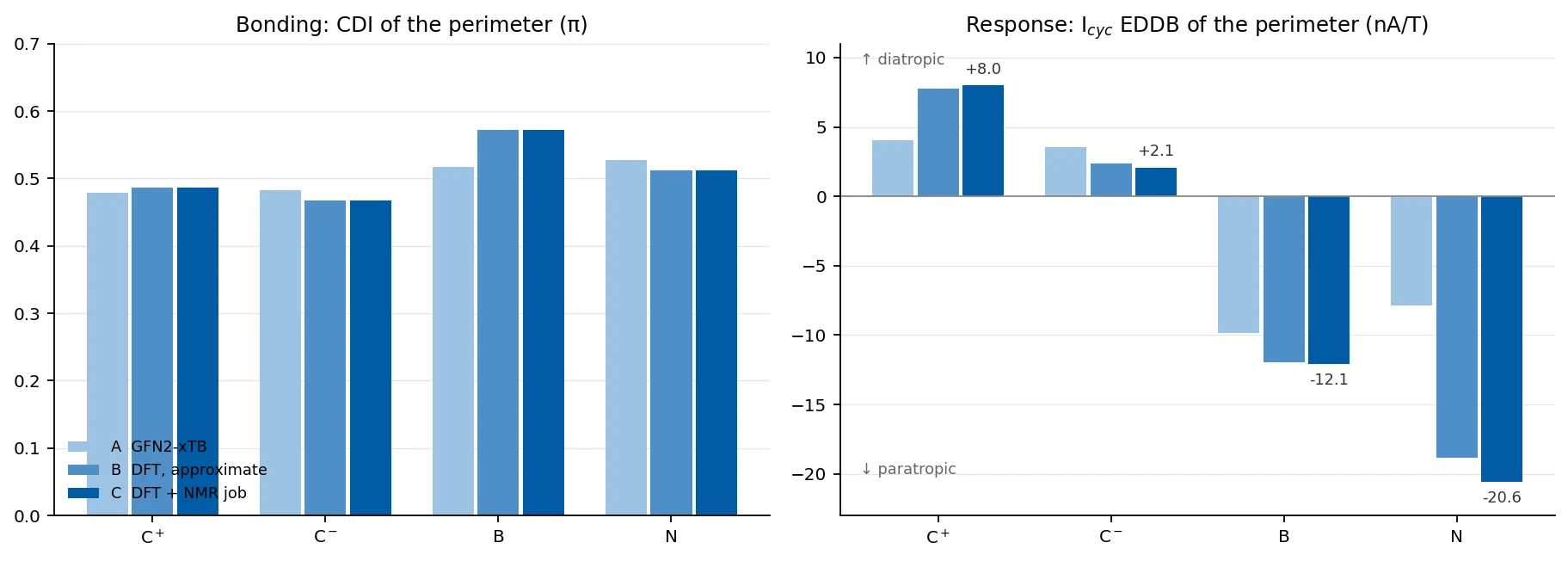
Bonding vs response at the three levels. Left: the CDI of the perimeter, nearly the same for all four molecules. Right: the perimeter current Icyc (EDDB), whose sign follows the π-count and the central atom; the signs and the pairing never change between the levels, the ratios do.
The same comparison as pictures. Export the maps of every system at level C and draw them (the map2png.py script is installed with the program; one file per panel):
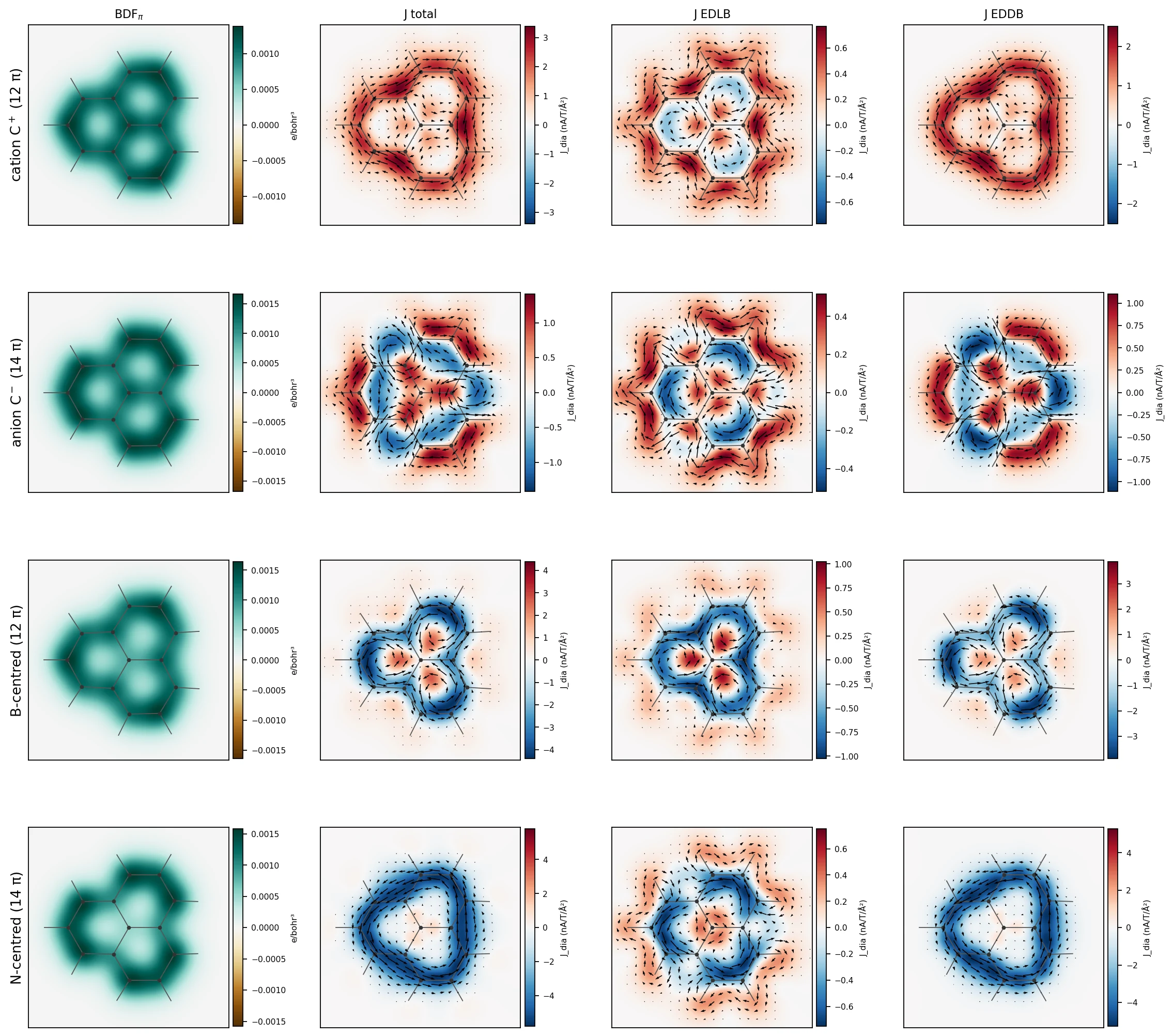
Level C (B3LYP-D3(BJ)/def2-TZVP, CSGT). Rows: cation, anion, B- and N-centred molecule. Columns: BDFπ (1.5–2.5 Å), and the current 1 Å above the molecule: total, EDLB, EDDB (red = diatropic, blue = paratropic; every panel on its own scale).
The bonds are the same four times. BDFπ is positive over the whole carbon framework in every molecule: one delocalized π-system, the bonding identity of the CDI column.
The currents are not. A diatropic perimeter in the cation, a weak patchwork of opposite circulations in the anion (Icyc 2.1 nA/T), a paratropic perimeter in the B- and N-centred molecules.
Who carries them. Wherever there is a strong perimeter current, it is JEDDB: the delocalized electrons. JEDLB is several times weaker and circulates locally — in the cation, for example, as small paratropic loops inside the three rings.
The radial bonds. They hold delocalized π-electrons in every BDF map, yet in the current maps the flow passes them by.
What the table shows:
The signs and the pairing never change between the levels: diatropic for the two carbon ions, paratropic for the B- and N-centred molecules, in each isoelectronic pair; the bonding identity (CDI 0.47–0.57) is the same at every level. The argument of this tutorial does not depend on the level.
Level A (xTB) gets the currents too small here, diatropic and paratropic alike (the tight-binding gap of the phenalenyl frame is not as small as in a 4n annulene), and it misses one real feature: at DFT the anion's current (2.1 nA/T) is much weaker than the cation's (8.0 nA/T), whereas xTB puts them at 3.6 and 4.1. Use level A for signs and pairs, not for ratios.
Level B reproduces level C within 3 % for the cation (7.78 vs 8.00 nA/T) and within 1 % for the B-centred molecule (−11.97 vs −12.07); it is 8 % short for the N-centred molecule (−18.86 vs −20.57: the nitrogen lone pair is where the monopole exchange kernel is weakest, Manual, NMR & currents) and 14 % too large for the anion (2.34 vs 2.06: a small current, 0.3 nA/T in absolute terms). Level B is the number to look at when there is no NMR job.
Only level C is a number to be quoted.
Why the “magnetic fingerprint” is a myth
Ring currents came to be read as the fingerprint of (anti)aromaticity because of one correspondence: 4n+2 electrons, diatropic; 4n electrons, paratropic. That correspondence is a property of free-electron (Hückel-type) annulene models, in which the electron count and the symmetry of the frontier excitation are the same thing. It is not a law of nature, and phenalenyl is where it breaks in plain sight: four molecules, two isoelectronic pairs, one delocalized perimeter, two signs of the current.
The physics behind the correspondence is also different from the usual picture. The π electrons of benzene are not more mobile than those of hexatriene; if anything they are less so. They are bound by the cyclic potential, and it is the degeneracy of the cyclic problem that enforces π-coherence around the whole ring and opens a wide HOMO–LUMO gap. That is the stabilization, and it comes with a moderate diatropic current. In a 4n annulene the gap is small, the response is large, and the symmetry makes the rotationally allowed excitations dominate: a strong paratropic current, which reflects the gap, not a destabilization. The strength of a current, diatropic or paratropic, therefore has nothing to do with the degree of localization or delocalization of the bonds, and even less with aromatic stabilization or destabilization; that correlations between them show up within families of analogues, or can be derived from Hückel theory, is a coincidence of a model whose π electrons pay no price for exchange correlation in a delocalized ring. Reading a current as evidence of aromaticity has led to over-interpretations down to the heaviest elements (the tri-thorium cluster: D.W. Szczepanik, Angew. Chem. Int. Ed. 2022, 61, e202204337; RSC Adv. 2023, 13, 34224). This tutorial is a counter-example one can run in seconds.
The result of Cyrański et al. explains the two signs: in the ipsocentric picture the HOMO → LUMO excitation of the carbon-centred ions is translationally allowed (diatropic), while the symmetry of the frontier orbitals of the B- and N-centred molecules makes it rotationally allowed (paratropic). You can look at that directly with --table nmr-homo1, the frontier-orbital shielding table (Steiner–Fowler analysis), which is left as an exercise.
Conclusions
Four molecules, one bonding identity (a delocalized 12-membered perimeter, CDI 0.47–0.57 at every level of theory), two signs of the ring current, decided by the symmetry of the frontier orbitals and not by the bonds. A ring current is a magnetic response property: it neither identifies the delocalized bonds (the radial bonds of phenalenyl carry π electrons and zero net current) nor decides aromaticity in the IUPAC sense. runEDDB gives both answers from the same run, at three levels of cost: signs and pairs from a bare geometry in seconds, numbers within a few per cent from any DFT wavefunction file without an NMR job, and the exact partition from the NMR job itself.
What to try next
Frontier orbitals. Run --table nmr-homo1 on the cation and on the B-centred molecule (levels B or C) and compare the HOMO → LUMO contributions to NICS(1)zz: translational vs rotational.
The neutral radical.runEDDB -i phen_C.xyz --xyz-mult 2 --nics-rings 6 --bcs: an open-shell 13-π system between the two ions.
Profiles.--nics-scan 4 along the normal of R1 for the cation and the B-centred molecule: the two profiles NICSzz(z), with opposite signs (add -v for the loop-current fit to them in the diagnostics file).
The method of the kernel. Repeat Part 4 with --nmr-kernel hf on the B3LYP file and watch the kernel overshoot; then with --nmr-kernel pbe (no kernel) and watch it undershoot: the exact-exchange fraction of the actual method is not a free parameter.
Where to go next. The NMR & currents page of the Manual describes the NMR/NICS partition, the ring and bond currents (--rcs, --bcs), the approximate lane and --nmr-kernel, and the GFN2-xTB lane; Tutorial 4 the CDI loop over many rings; Tutorial 8 draws the same currents as maps (current density, ACID) and splits them into EDLB and EDDB channels.


 The four systems with the atom numbering used throughout: 1 = central atom, 2–4 = inner carbons, 5–13 = perimeter, 14–22 = hydrogens; rings R1 = 1-2-7-6-5-4-1, R2 = 1-2-8-9-10-3-1, R3 = 1-3-11-12-13-4-1; the perimeter is the 12-membered cycle 5-4-13-12-11-3-10-9-8-2-7-6-5.
 The cation at level A: BDFπ (mean of the planes 1.5–2.5 Å above the molecule; positive = delocalized) and the current 1 Å above, total and split into EDLB and EDDB (colour = diatropic component, red +, blue −; each panel on its own scale). Where the current flows: the outward bonds of the perimeter carry the same flux, the three radial bonds carry none (two circulations cancel), although every bond holds delocalized electrons.
 Bonding vs response at the three levels. Left: the CDI of the perimeter, nearly the same for all four molecules. Right: the perimeter current Icyc (EDDB), whose sign follows the π-count and the central atom; the signs and the pairing never change between the levels, the ratios do.
 Level C (B3LYP-D3(BJ)/def2-TZVP, CSGT). Rows: cation, anion, B- and N-centred molecule. Columns: BDFπ (1.5–2.5 Å), and the current 1 Å above the molecule: total, EDLB, EDDB (red = diatropic, blue = paratropic; every panel on its own scale).