◼ Tutorial 4 — Aza-supernaphthalene: what oxidation does to Clar sextets
A big π-system, two oxidation states, one question: when four electrons are taken out of an 82-electron π-cloud, where does the positive charge go — and what happens to the aromatic sextets? The tools are the ones you already know from Tutorials 1–3, applied to a molecule with eleven rings and six nitrogen atoms; the new element is running runEDDB on a charged species.
What you will learn
Running EDDB calculations on charged molecules (the charge and spin line of the .xyz file).
Exporting and visualizing the BDFπ map of a large molecule, and reading it in terms of Clar’s rule.
Reading π-electron populations atom by atom, and following where the positive charge sits after oxidation.
Comparing the CDI of every ring in the neutral molecule and in the tetracation.
Before you start
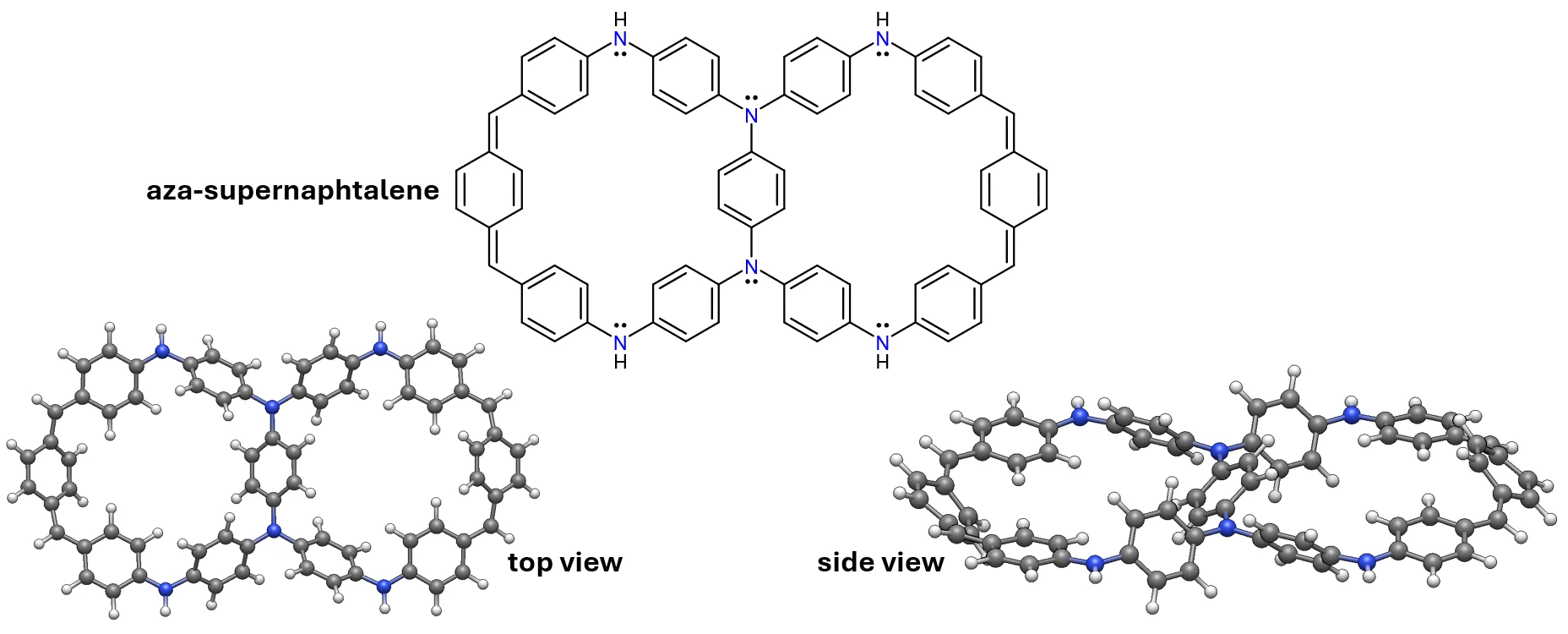
Aza-supernaphthalene is a bismacrocycle built from eleven six-membered rings joined by four methine bridges and six nitrogen atoms whose lone pairs take part in the conjugation. It is fully π-conjugated and carries 82 π-electrons. Two of the nitrogens are triarylamines (N–Ar3), four are diarylamine N–H groups. The molecule was synthesized and characterized in the neutral, 2+, 4+ and 6+ oxidation states by Ma, Han, Hou, Wu and Chi (Angew. Chem. Int. Ed. 2024, 63, e202407990); its BDF analysis across the whole series is the subject of our paper:
Decoding chemical resonance in π-conjugated systems D.W. Szczepanik, P.A. Wieczorkiewicz, ACS Physical Chemistry Au 6 (2026) 793−802. DOI: 10.1021/acsphyschemau.6c00031. URL
Aza-supernaphthalene: Lewis structure, top view and side view.
We analyse the neutral molecule and the 4+ state to see how the π-electronic structure changes on oxidation and how the excess positive charge is distributed. Download the two geometries:
⚠ Level of theory. Both runs take plain .xyz geometries, so runEDDB builds the wavefunction itself with its built-in GFN2-xTB engine. That lane is a qualitative screening tool: EDDB populations and indices come out roughly 10–20% high relative to range-separated hybrid DFT. Everything compared here is the difference between two states treated identically, which is exactly what the lane is good for. For numbers to quote against the literature, repeat the analysis on a DFT wavefunction (see the cheat-sheet).
--export-cube bdf — write the Bond Delocalization Function to asnt0.BDF_G.cube for visualization.
-a — select the π-type NOBDs automatically; the analysis is restricted to the π-system.
--table nobd,npa — print two tables: the NOBD occupancies and the natural population analysis. Both are π-only because of -a. Tables appear only when requested.
-n 4 — run on four CPU cores. Raise it to speed the cube export up; -n 0 uses every core available.
-c 150 — grid points per axis for exported cubes. The default is 100, which for a molecule this size gives a visibly coarse map; 150 costs a few seconds and a 45 MB file.
> eddb0.log — send the tables and the log to a file rather than the terminal (we will read the tables in Part 3).
eddb0.log (excerpt)
▶ Loading and parsing input file...                                                   0s
▶ Modelling one-electron density at the GFN2-xTB/vSTO-nG level...                     0s
▶ Building natural atomic orbitals (NAO, frozen-NMB two-cycle)...                     0s
▶ Performing multicenter bond-orbital projections (BOP)...                            0s
▶ Computing natural orbitals for bond delocalization (NOBD)...                        0s
▶ Exporting BDF_G to asnt0.BDF_G.cube...                                              7s
▶ Printing analysis details:

  ┌────────────────────────────────────────────────────────────────────────────────────┐
  │            NATURAL ORBITALS FOR BOND DELOCALIZATION (NOBD) IN NVB BASIS            │
  └────────────────────────────────────────────────────────────────────────────────────┘
    Index  Sel   Occupancy    s (l=0)  %s    p (l=1)  %p    d (l=2)  %d    f (l=3)  %f
   ─────── ───   ═════════   ───────── ───  ───────── ───  ───────── ───  ───────── ───
         1  *      1.72900     0.00068  0     1.72832 100    0.00000  0     0.00000  0
         2  *      1.72866     0.00069  0     1.72796 100    0.00000  0     0.00000  0
         3  *      1.72679     0.00117  0     1.72562 100    0.00000  0     0.00000  0
         4  *      1.72665     0.00127  0     1.72538 100    0.00000  0     0.00000  0
         5  *      1.72101     0.00041  0     1.72060 100    0.00000  0     0.00000  0
         6  *      1.72101     0.00041  0     1.72059 100    0.00000  0     0.00000  0
         7  *      1.72083     0.00046  0     1.72037 100    0.00000  0     0.00000  0
         8  *      1.72080     0.00046  0     1.72034 100    0.00000  0     0.00000  0
         9  *      1.71605     0.00019  0     1.71586 100    0.00000  0     0.00000  0
        10  *      1.70908     0.00181  0     1.70727 100    0.00000  0     0.00000  0
         ⋯ 171 more NOBDs; the first 41 are starred (π-type): 41 orbitals for the 82 π-electrons ⋯
  ┌────────────────────────────────────────────────────────────────────────────────────┐
  │          NATURAL POPULATION ANALYSIS IN CONDENSED-ATOMIC (NVB) RESOLUTION          │
  └────────────────────────────────────────────────────────────────────────────────────┘
     Atom      Charge       ED_G        α         β        EDDB_G       α         β
   ────────   ─────────   ───────── ───────── ─────────   ═════════ ───────── ─────────
       1 C    -0.01572     1.00903      -         -        0.83964      -         -
       2 C    +0.00887     1.01024      -         -        0.78206      -         -
       3 C    -0.01362     1.00091      -         -        0.83288      -         -
       4 C    -0.05828     1.05790      -         -        0.88358      -         -
       5 C    +0.11744     1.00963      -         -        0.76627      -         -
       6 C    -0.05786     1.06422      -         -        0.88422      -         -
       7 N    -0.21010     1.71998      -         -        0.64608      -         -
       8 C    +0.10689     1.01946      -         -        0.83120      -         -
       9 C    -0.03262     1.02042      -         -        0.40447      -         -
      10 C    +0.01961     0.99024      -         -        0.36043      -         -
      11 C    -0.01984     1.00740      -         -        0.28190      -         -
      12 C    -0.01984     1.00740      -         -        0.28190      -         -
         ⋯ 116 more atoms (full table in eddb0.log) ⋯
▶ Printing summary of EDDB calculations:

        Total   ED_G population:           82.00000    per atom:     0.64063
        Total EDLB_G population:           26.80446    per atom:     0.20941
        Total EDDB_G population:           55.19554    per atom:     0.43122

▶ Calculation completed on 2026-09-17. Total time: 8s.
The Bond Delocalization Function is the difference between the delocalized and localized electron densities produced by the EDDB decomposition. Restricted to π-electrons:
BDFπ = EDDBπ − EDLBπ
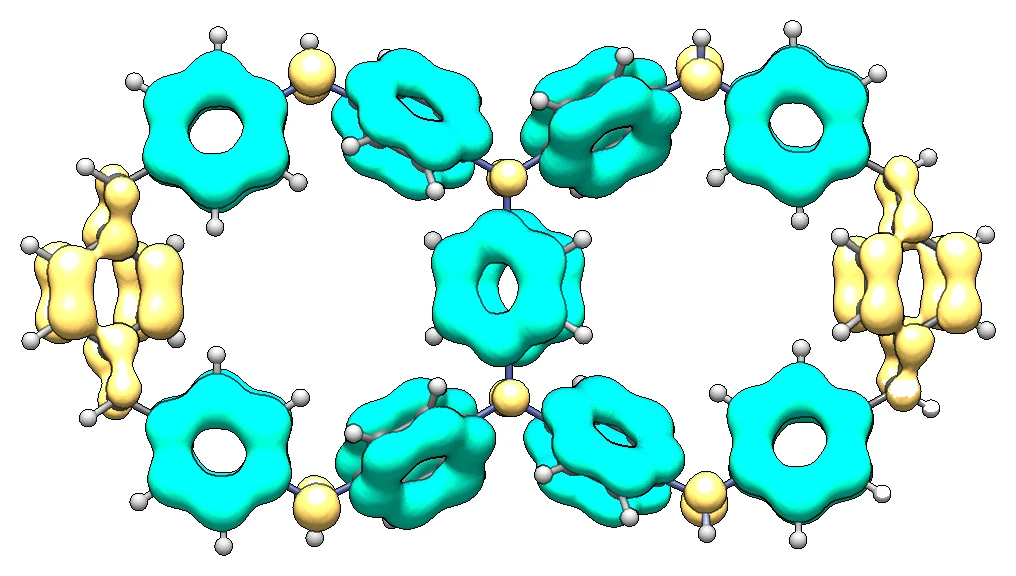
BDF is a 3D function that shows the balance between delocalized and localized bonding at every point in space: BDF > 0 marks regions where delocalization dominates, BDF < 0 localized regions, and BDF ≈ 0 means the two are comparable. Open asnt0.BDF_G.cube in Avogadro2 (Analyze → Create Surfaces, isovalue 0.010, two contrasting colours for the two signs, as in Tutorial 2). Here BDFπ > 0 is turquoise and BDFπ < 0 yellow:
BDFπ of neutral aza-supernaphthalene, isosurface 0.010.
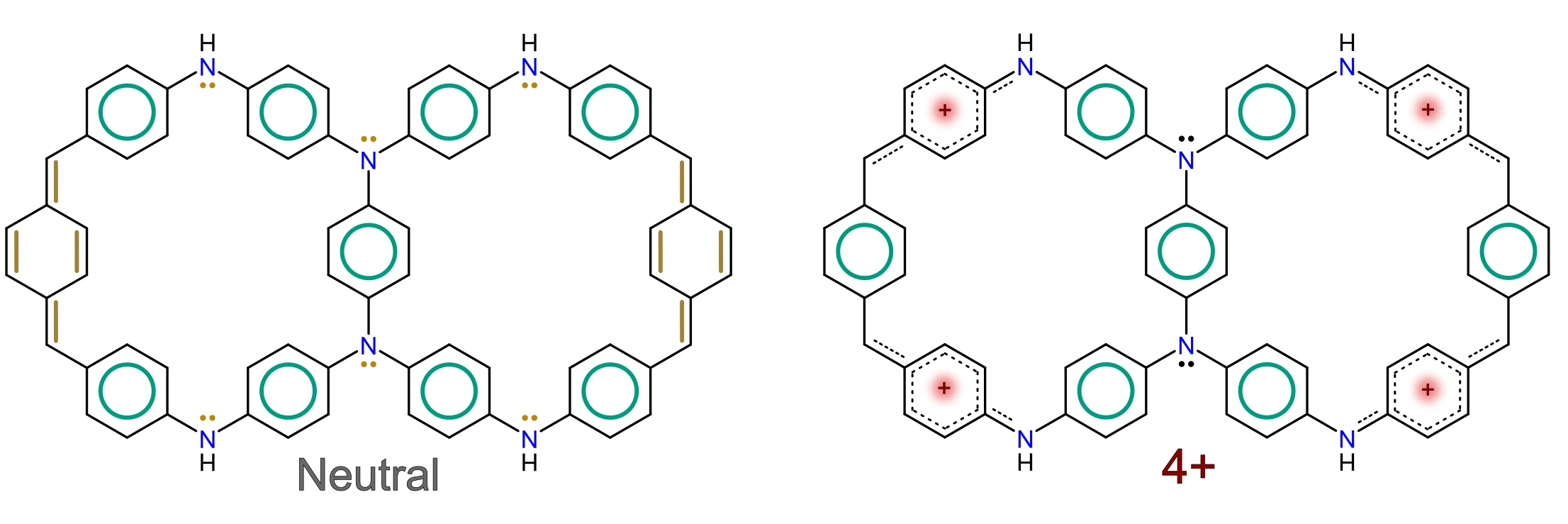
The map shows the 82 π-electrons organised into nine delocalized benzenoid Clar domains, separated by localized nitrogen lone pairs — the small yellow lobes at each nitrogen — plus two olefinic, quinoid-like domains at the extreme left and right of the molecule, which come out yellow, i.e. localized. This distribution is associated with a large local aromatic stabilization from nine separate Clar π-sextets.
Part 2 — The BDFπ map of the tetracation
The 4+ state has 78 π-electrons, and adds Coulomb repulsion between the excess positive charges as a second factor to weigh against aromatic stabilization.
Setting the charge. The first line of asnt4.xyz reads 128 4 1: the number of atoms, the charge (4) and the spin multiplicity (1, a singlet). This is how the charge and spin state are defined for the built-in xTB calculation. Both tokens are optional and default to 0 and 1, so a plain .xyz is treated as a neutral closed-shell singlet; --xyz-charge and --xyz-mult override them from the command line. Check that it was read: the summary should report Total ED_G = 78.000, four electrons fewer than the neutral.
eddb4.log (excerpt)
  ┌────────────────────────────────────────────────────────────────────────────────────┐
  │          NATURAL POPULATION ANALYSIS IN CONDENSED-ATOMIC (NVB) RESOLUTION          │
  └────────────────────────────────────────────────────────────────────────────────────┘
     Atom      Charge       ED_G        α         β        EDDB_G       α         β
         ⋯
       7 N    -0.11140     1.54715      -         -        0.72857      -         -
      23 N    -0.11193     1.68478      -         -        0.82760      -         -
      41 N    -0.11140     1.54715      -         -        0.72857      -         -
      43 N    -0.11193     1.68478      -         -        0.82760      -         -
      46 N    -0.11140     1.54715      -         -        0.72856      -         -
      64 N    -0.11139     1.54715      -         -        0.72856      -         -
         ⋯ (only the nitrogen rows shown; full table in eddb4.log) ⋯
▶ Printing summary of EDDB calculations:

        Total   ED_G population:           78.00000    per atom:     0.60938
        Total EDLB_G population:           27.02766    per atom:     0.21115
        Total EDDB_G population:           50.97234    per atom:     0.39822

▶ Calculation completed on 2026-09-17. Total time: 8s.
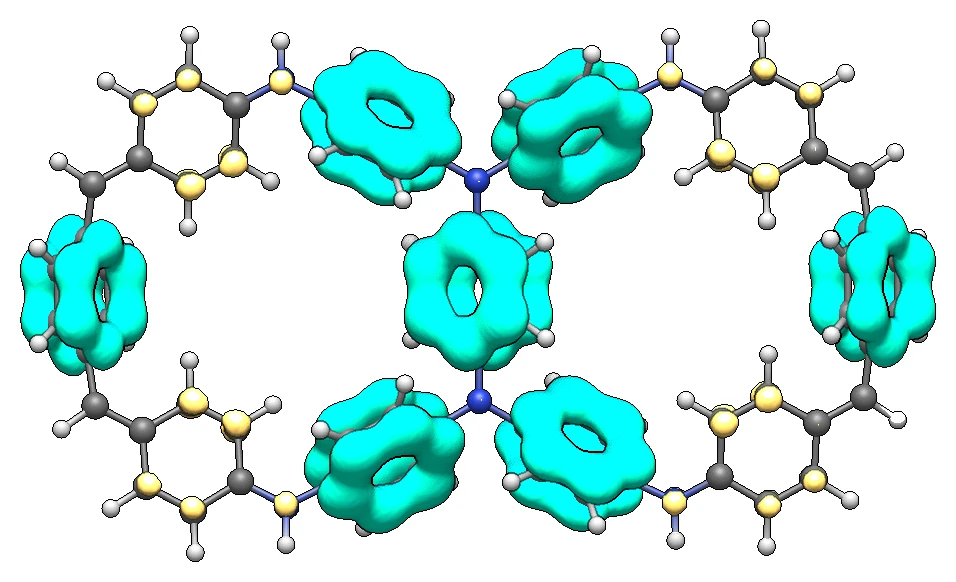
BDFπ of the tetracation, same isosurface value.
Highly delocalized Clar domains survive the oxidation largely untouched, but there are now seven of them rather than nine. Two changes account for the difference:
The two extreme rings switch character. Localized and quinoid (yellow) in the neutral molecule, they become highly delocalized (turquoise) in the tetracation.
Four fragments — each a ring together with its two adjacent bonds — become intermediate between delocalized and localized, with a slight preference towards localization, BDFπ < 0.
Part 3 — Where the excess positive charge sits
To see how the excess charge is distributed across the π-cloud we read the natural population analysis tables written to eddb0.log and eddb4.log (Part 1 shows the head of the first one). The ED_G column is the π-electron population on each atom, so it directly shows how the π-electrons are spread over the molecule.
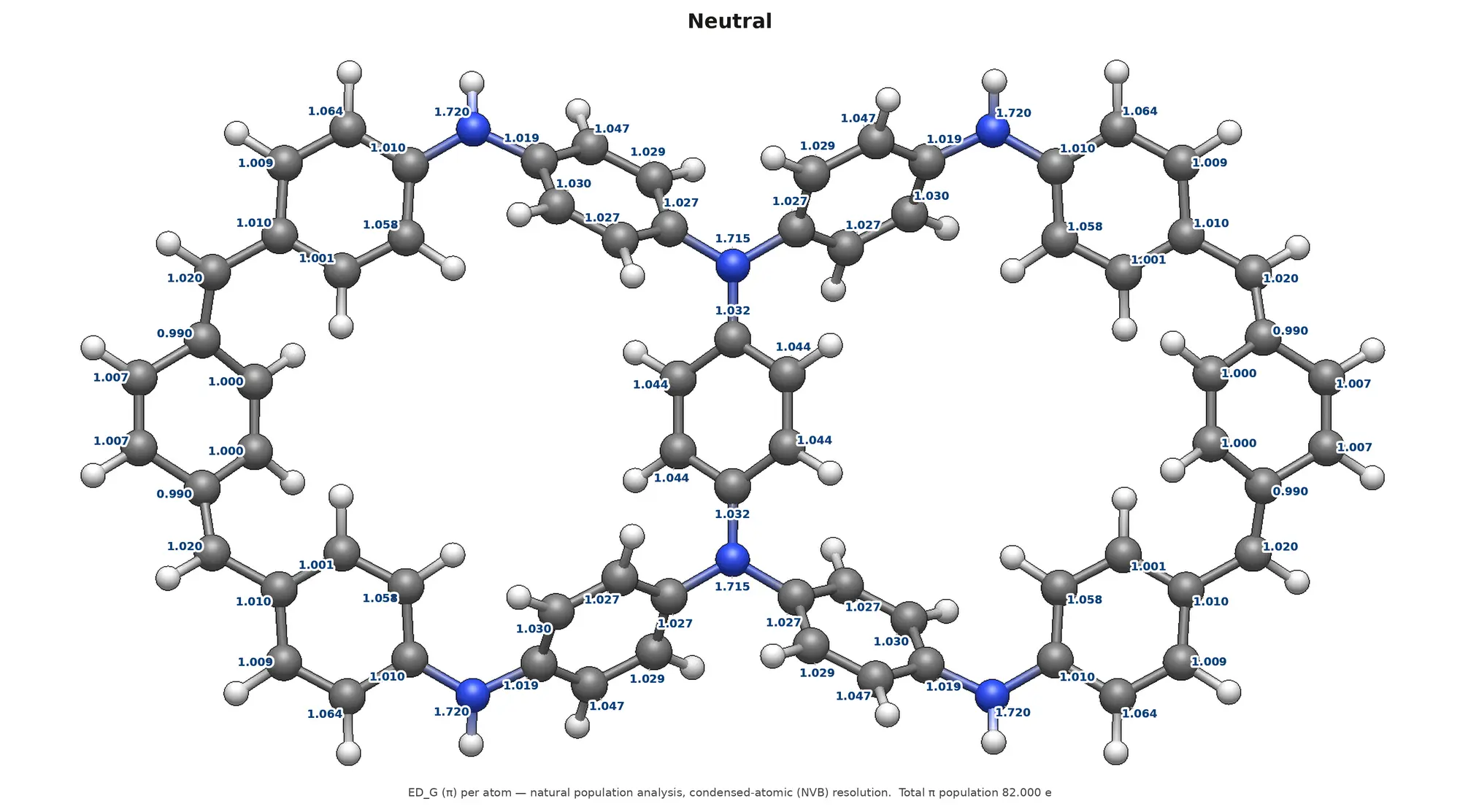
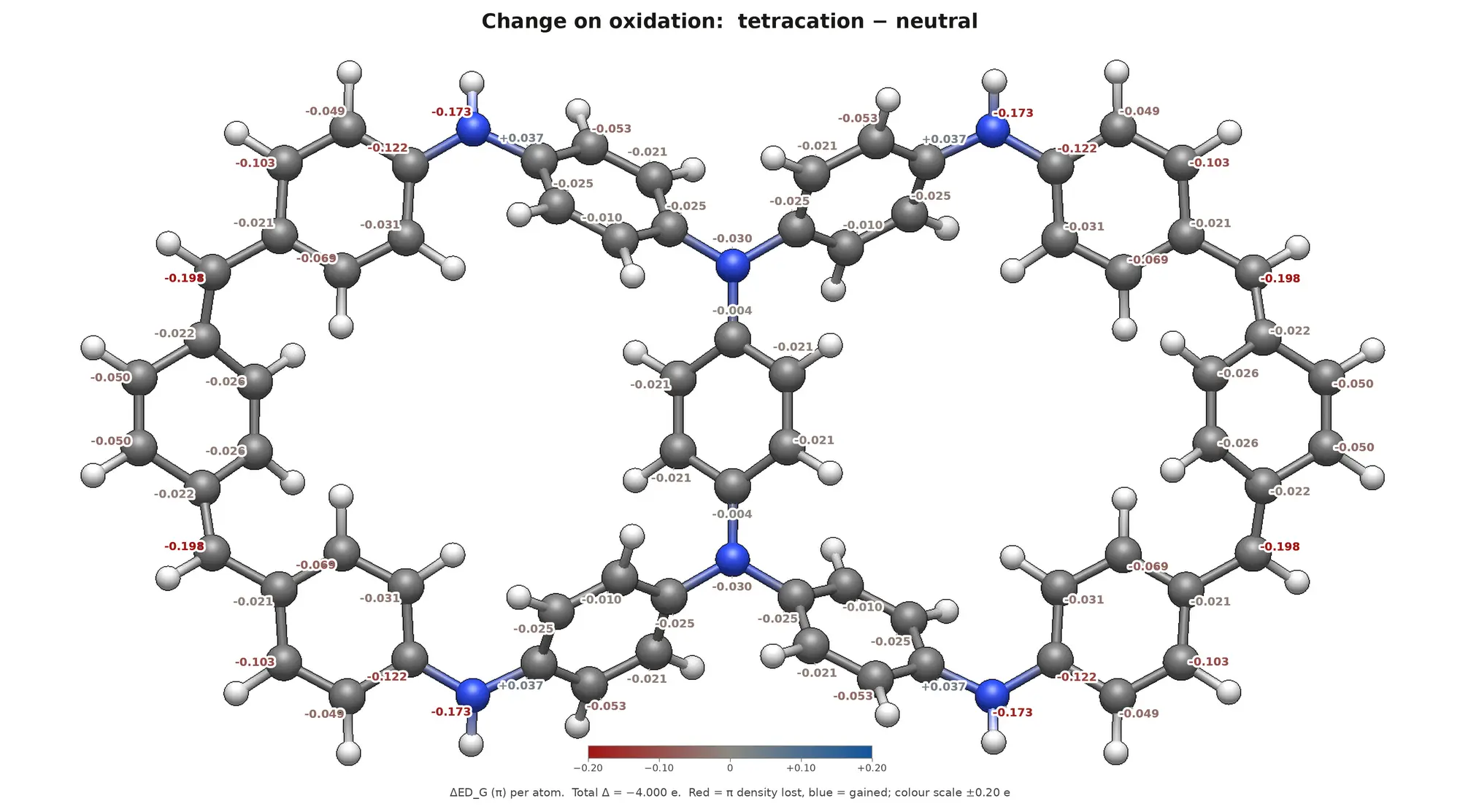
The figure below maps every ED_G value from that table onto the neutral structure. If the lone pairs were fully localized on the nitrogen atoms (as in a single Lewis structure) their population would be exactly 2.000 — two electrons in the nitrogen 2pz orbital — and every carbon exactly 1.000. Deviations from these ideal occupations therefore measure the contribution of charge-transfer resonance structures: population flows off the nitrogens, whose occupancies fall below 2.000, onto the carbons, most of which rise above 1.000.
In the neutral molecule the nitrogens sit at 1.715–1.720, so each has released about 0.28 e into the ring system. Of the 70 carbons, 62 are above 1.000; the remaining eight fall only marginally below it, the lowest at 0.990.
π-electron populations (ED_G) of neutral aza-supernaphthalene. Hydrogens carry ≤ 0.003 e and are omitted.
The next figure shows how the atomic π-populations change on oxidation to 4+. Electrons are removed to the greatest extent from the same four fragments — ring plus two adjacent bonds — that the tetracation BDFπ map flagged as intermediate in character. The majority of the excess positive charge therefore sits in those fragments, where it resonates with the adjacent π-bonds, resulting in the intermediate delocalization visible in the map. Note that charge and bond delocalization is in this case less effective than aromatic delocalization in Clar sextets.
Change in π-electron population on oxidation, ΔED_G = ED_G(4+) − ED_G(neutral). Red: electrons lost, blue: gained.
Summing the change over each fragment makes the point quantitative. The four charged fragments — corner ring, its N–H nitrogen and its methine bridge — account for −3.06 e between them, about 77% of the four electrons removed; the remaining 23% is spread thinly over the rest of the molecule. The Clar domains visible in the BDFπ map thus aggregate much less positive charge that could otherwise disturb their aromatic character.
Fragment
count
ED_G neutral
ED_G 4+
Δ
corner ring (1 N–H + 1 methine)
4
24.608
23.026
−1.582
its N–H nitrogen
4
6.880
6.189
−0.691
its methine bridge
4
4.082
3.291
−0.791
inner ring (1 N–H + 1 NAr3)
4
24.720
24.332
−0.389
extreme ring (2 methine)
2
11.990
11.601
−0.389
central ring (2 NAr3)
1
6.241
6.150
−0.091
triarylamine nitrogens
2
3.430
3.370
−0.060
total
82.000
78.000
−4.000
π-electron population by structural fragment (sums over all atoms of the fragment). The three rows shaded orange are the charged fragments.
The two classes of nitrogen behave quite differently. Each of the four N–H nitrogens loses 0.173 e (1.720 → 1.547), whereas the two triarylamine nitrogens lose only 0.030 e (1.715 → 1.685). Oxidation draws π-density off the diarylamine nitrogens and leaves the triarylamine lone pairs essentially intact — which is why the latter are still drawn as lone pairs in the resonance structures of Part 5.
Part 4 — The CDI of every ring, before and after
The BDF map is a picture; the Cyclic Delocalization Index puts a number on each ring. As in Tutorial 2, let runEDDB find the rings and loop over them — once for each state. The ring detection gives the same eleven pathways for both files (the atom order is identical), so the two logs can be compared line by line:
terminal
$ runEDDB -i asnt0.xyz -r 6
$ grep -v '^#' asnt0.rings | while read -r r; do echo "== ring $r"; runEDDB -i asnt0.xyz -p "$r" -a -q -c 0; done &> cdi0.log
$ runEDDB -i asnt4.xyz -r 6
$ grep -v '^#' asnt4.rings | while read -r r; do echo "== ring $r"; runEDDB -i asnt4.xyz -p "$r" -a -q -c 0; done &> cdi4.log
== ring 1-2-3-4-5-6-1

────────────────────────────────────────────────────────────────────────────────────────
                                ▄▄▄▄▄▄▄▄▄▄▄▄▄▄▄▄▄▄▄▄▄▄▄▄▄                    Build date:
                              r █▄ ▄▄ █▄ ▄▄▀█▄ ▄▄▀█▄ ▄ ▀█                    2026-Sep-15
                              u ██ ▄█▀██ ██ ██ ██ ██ ▄ ▀█
                              n █▄▄▄▄▄█▄▄▄▄██▄▄▄▄██▄▄▄▄██

                     Electron Density of Delocalized Bonds Analysis
                        (https://aromaticity.uj.edu.pl/runeddb)
────────────────────────────────────────────────────────────────────────────────────────

▶ Printing summary of EDDB calculations:

        Total   ED_P population:            5.90719    per atom:     0.98453
        Total EDLB_P population:            1.63632    per atom:     0.27272
        Total EDDB_P population:            4.27087    per atom:     0.71181

    Cyclic Delocal. Index (CDI):            0.59967
    Delocalized fraction (%del):              72.30 %
    Cyclic coherence (%cyc):                  60.91 %

▶ Calculation completed on 2026-09-17. Total time: 1s.

== ring 8-16-17-18-19-20-8

────────────────────────────────────────────────────────────────────────────────────────
                                ▄▄▄▄▄▄▄▄▄▄▄▄▄▄▄▄▄▄▄▄▄▄▄▄▄                    Build date:
                              r █▄ ▄▄ █▄ ▄▄▀█▄ ▄▄▀█▄ ▄ ▀█                    2026-Sep-15
                              u ██ ▄█▀██ ██ ██ ██ ██ ▄ ▀█
                              n █▄▄▄▄▄█▄▄▄▄██▄▄▄▄██▄▄▄▄██

                     Electron Density of Delocalized Bonds Analysis
                        (https://aromaticity.uj.edu.pl/runeddb)
────────────────────────────────────────────────────────────────────────────────────────

▶ Printing summary of EDDB calculations:

        Total   ED_P population:            5.96488    per atom:     0.99415
        Total EDLB_P population:            1.38285    per atom:     0.23048
        Total EDDB_P population:            4.58203    per atom:     0.76367

    Cyclic Delocal. Index (CDI):            0.69136
    Delocalized fraction (%del):              76.82 %
    Cyclic coherence (%cyc):                  69.54 %

▶ Calculation completed on 2026-09-17. Total time: 1s.

== ring 10-11-12-13-14-15-10

────────────────────────────────────────────────────────────────────────────────────────
                                ▄▄▄▄▄▄▄▄▄▄▄▄▄▄▄▄▄▄▄▄▄▄▄▄▄                    Build date:
                              r █▄ ▄▄ █▄ ▄▄▀█▄ ▄▄▀█▄ ▄ ▀█                    2026-Sep-15
                              u ██ ▄█▀██ ██ ██ ██ ██ ▄ ▀█
                              n █▄▄▄▄▄█▄▄▄▄██▄▄▄▄██▄▄▄▄██

                     Electron Density of Delocalized Bonds Analysis
                        (https://aromaticity.uj.edu.pl/runeddb)
────────────────────────────────────────────────────────────────────────────────────────

▶ Printing summary of EDDB calculations:

        Total   ED_P population:            6.05039    per atom:     1.00840
        Total EDLB_P population:            5.27064    per atom:     0.87844
        Total EDDB_P population:            0.77975    per atom:     0.12996

    Cyclic Delocal. Index (CDI):            0.10156
    Delocalized fraction (%del):              12.89 %
    Cyclic coherence (%cyc):                  10.07 %

▶ Calculation completed on 2026-09-17. Total time: 1s.

== ring 22-36-37-38-39-40-22

────────────────────────────────────────────────────────────────────────────────────────
                                ▄▄▄▄▄▄▄▄▄▄▄▄▄▄▄▄▄▄▄▄▄▄▄▄▄                    Build date:
                              r █▄ ▄▄ █▄ ▄▄▀█▄ ▄▄▀█▄ ▄ ▀█                    2026-Sep-15
                              u ██ ▄█▀██ ██ ██ ██ ██ ▄ ▀█
                              n █▄▄▄▄▄█▄▄▄▄██▄▄▄▄██▄▄▄▄██

                     Electron Density of Delocalized Bonds Analysis
                        (https://aromaticity.uj.edu.pl/runeddb)
────────────────────────────────────────────────────────────────────────────────────────

▶ Printing summary of EDDB calculations:

        Total   ED_P population:            5.90719    per atom:     0.98453
        Total EDLB_P population:            1.63632    per atom:     0.27272
        Total EDDB_P population:            4.27087    per atom:     0.71181

    Cyclic Delocal. Index (CDI):            0.59967
    Delocalized fraction (%del):              72.30 %
    Cyclic coherence (%cyc):                  60.91 %

▶ Calculation completed on 2026-09-17. Total time: 1s.

== ring 24-31-32-33-34-35-24

────────────────────────────────────────────────────────────────────────────────────────
                                ▄▄▄▄▄▄▄▄▄▄▄▄▄▄▄▄▄▄▄▄▄▄▄▄▄                    Build date:
                              r █▄ ▄▄ █▄ ▄▄▀█▄ ▄▄▀█▄ ▄ ▀█                    2026-Sep-15
                              u ██ ▄█▀██ ██ ██ ██ ██ ▄ ▀█
                              n █▄▄▄▄▄█▄▄▄▄██▄▄▄▄██▄▄▄▄██

                     Electron Density of Delocalized Bonds Analysis
                        (https://aromaticity.uj.edu.pl/runeddb)
────────────────────────────────────────────────────────────────────────────────────────

▶ Printing summary of EDDB calculations:

        Total   ED_P population:            5.96488    per atom:     0.99415
        Total EDLB_P population:            1.38285    per atom:     0.23048
        Total EDDB_P population:            4.58203    per atom:     0.76367

    Cyclic Delocal. Index (CDI):            0.69136
    Delocalized fraction (%del):              76.82 %
    Cyclic coherence (%cyc):                  69.54 %

▶ Calculation completed on 2026-09-17. Total time: 1s.

== ring 25-26-27-28-29-30-25

────────────────────────────────────────────────────────────────────────────────────────
                                ▄▄▄▄▄▄▄▄▄▄▄▄▄▄▄▄▄▄▄▄▄▄▄▄▄                    Build date:
                              r █▄ ▄▄ █▄ ▄▄▀█▄ ▄▄▀█▄ ▄ ▀█                    2026-Sep-15
                              u ██ ▄█▀██ ██ ██ ██ ██ ▄ ▀█
                              n █▄▄▄▄▄█▄▄▄▄██▄▄▄▄██▄▄▄▄██

                     Electron Density of Delocalized Bonds Analysis
                        (https://aromaticity.uj.edu.pl/runeddb)
────────────────────────────────────────────────────────────────────────────────────────

▶ Printing summary of EDDB calculations:

        Total   ED_P population:            5.96412    per atom:     0.99402
        Total EDLB_P population:            1.51294    per atom:     0.25216
        Total EDDB_P population:            4.45118    per atom:     0.74186

    Cyclic Delocal. Index (CDI):            0.66159
    Delocalized fraction (%del):              74.63 %
    Cyclic coherence (%cyc):                  66.56 %

▶ Calculation completed on 2026-09-17. Total time: 1s.

== ring 42-54-53-45-56-55-42

────────────────────────────────────────────────────────────────────────────────────────
                                ▄▄▄▄▄▄▄▄▄▄▄▄▄▄▄▄▄▄▄▄▄▄▄▄▄                    Build date:
                              r █▄ ▄▄ █▄ ▄▄▀█▄ ▄▄▀█▄ ▄ ▀█                    2026-Sep-15
                              u ██ ▄█▀██ ██ ██ ██ ██ ▄ ▀█
                              n █▄▄▄▄▄█▄▄▄▄██▄▄▄▄██▄▄▄▄██

                     Electron Density of Delocalized Bonds Analysis
                        (https://aromaticity.uj.edu.pl/runeddb)
────────────────────────────────────────────────────────────────────────────────────────

▶ Printing summary of EDDB calculations:

        Total   ED_P population:            5.96488    per atom:     0.99415
        Total EDLB_P population:            1.38285    per atom:     0.23048
        Total EDDB_P population:            4.58203    per atom:     0.76367

    Cyclic Delocal. Index (CDI):            0.69136
    Delocalized fraction (%del):              76.82 %
    Cyclic coherence (%cyc):                  69.54 %

▶ Calculation completed on 2026-09-17. Total time: 1s.

== ring 44-57-58-59-60-61-44

────────────────────────────────────────────────────────────────────────────────────────
                                ▄▄▄▄▄▄▄▄▄▄▄▄▄▄▄▄▄▄▄▄▄▄▄▄▄                    Build date:
                              r █▄ ▄▄ █▄ ▄▄▀█▄ ▄▄▀█▄ ▄ ▀█                    2026-Sep-15
                              u ██ ▄█▀██ ██ ██ ██ ██ ▄ ▀█
                              n █▄▄▄▄▄█▄▄▄▄██▄▄▄▄██▄▄▄▄██

                     Electron Density of Delocalized Bonds Analysis
                        (https://aromaticity.uj.edu.pl/runeddb)
────────────────────────────────────────────────────────────────────────────────────────

▶ Printing summary of EDDB calculations:

        Total   ED_P population:            5.96488    per atom:     0.99415
        Total EDLB_P population:            1.38285    per atom:     0.23048
        Total EDDB_P population:            4.58203    per atom:     0.76367

    Cyclic Delocal. Index (CDI):            0.69136
    Delocalized fraction (%del):              76.82 %
    Cyclic coherence (%cyc):                  69.54 %

▶ Calculation completed on 2026-09-17. Total time: 1s.

== ring 47-48-49-50-51-52-47

────────────────────────────────────────────────────────────────────────────────────────
                                ▄▄▄▄▄▄▄▄▄▄▄▄▄▄▄▄▄▄▄▄▄▄▄▄▄                    Build date:
                              r █▄ ▄▄ █▄ ▄▄▀█▄ ▄▄▀█▄ ▄ ▀█                    2026-Sep-15
                              u ██ ▄█▀██ ██ ██ ██ ██ ▄ ▀█
                              n █▄▄▄▄▄█▄▄▄▄██▄▄▄▄██▄▄▄▄██

                     Electron Density of Delocalized Bonds Analysis
                        (https://aromaticity.uj.edu.pl/runeddb)
────────────────────────────────────────────────────────────────────────────────────────

▶ Printing summary of EDDB calculations:

        Total   ED_P population:            5.90719    per atom:     0.98453
        Total EDLB_P population:            1.63632    per atom:     0.27272
        Total EDDB_P population:            4.27087    per atom:     0.71181

    Cyclic Delocal. Index (CDI):            0.59967
    Delocalized fraction (%del):              72.30 %
    Cyclic coherence (%cyc):                  60.91 %

▶ Calculation completed on 2026-09-17. Total time: 1s.

== ring 63-73-74-72-75-76-63

────────────────────────────────────────────────────────────────────────────────────────
                                ▄▄▄▄▄▄▄▄▄▄▄▄▄▄▄▄▄▄▄▄▄▄▄▄▄                    Build date:
                              r █▄ ▄▄ █▄ ▄▄▀█▄ ▄▄▀█▄ ▄ ▀█                    2026-Sep-15
                              u ██ ▄█▀██ ██ ██ ██ ██ ▄ ▀█
                              n █▄▄▄▄▄█▄▄▄▄██▄▄▄▄██▄▄▄▄██

                     Electron Density of Delocalized Bonds Analysis
                        (https://aromaticity.uj.edu.pl/runeddb)
────────────────────────────────────────────────────────────────────────────────────────

▶ Printing summary of EDDB calculations:

        Total   ED_P population:            6.05039    per atom:     1.00840
        Total EDLB_P population:            5.27064    per atom:     0.87844
        Total EDDB_P population:            0.77975    per atom:     0.12996

    Cyclic Delocal. Index (CDI):            0.10156
    Delocalized fraction (%del):              12.89 %
    Cyclic coherence (%cyc):                  10.07 %

▶ Calculation completed on 2026-09-17. Total time: 1s.

== ring 65-66-67-68-69-70-65

────────────────────────────────────────────────────────────────────────────────────────
                                ▄▄▄▄▄▄▄▄▄▄▄▄▄▄▄▄▄▄▄▄▄▄▄▄▄                    Build date:
                              r █▄ ▄▄ █▄ ▄▄▀█▄ ▄▄▀█▄ ▄ ▀█                    2026-Sep-15
                              u ██ ▄█▀██ ██ ██ ██ ██ ▄ ▀█
                              n █▄▄▄▄▄█▄▄▄▄██▄▄▄▄██▄▄▄▄██

                     Electron Density of Delocalized Bonds Analysis
                        (https://aromaticity.uj.edu.pl/runeddb)
────────────────────────────────────────────────────────────────────────────────────────

▶ Printing summary of EDDB calculations:

        Total   ED_P population:            5.90719    per atom:     0.98453
        Total EDLB_P population:            1.63632    per atom:     0.27272
        Total EDDB_P population:            4.27087    per atom:     0.71181

    Cyclic Delocal. Index (CDI):            0.59967
    Delocalized fraction (%del):              72.30 %
    Cyclic coherence (%cyc):                  60.91 %

▶ Calculation completed on 2026-09-17. Total time: 1s.
cdi4.log
== ring 1-2-3-4-5-6-1

────────────────────────────────────────────────────────────────────────────────────────
                                ▄▄▄▄▄▄▄▄▄▄▄▄▄▄▄▄▄▄▄▄▄▄▄▄▄                    Build date:
                              r █▄ ▄▄ █▄ ▄▄▀█▄ ▄▄▀█▄ ▄ ▀█                    2026-Sep-15
                              u ██ ▄█▀██ ██ ██ ██ ██ ▄ ▀█
                              n █▄▄▄▄▄█▄▄▄▄██▄▄▄▄██▄▄▄▄██

                     Electron Density of Delocalized Bonds Analysis
                        (https://aromaticity.uj.edu.pl/runeddb)
────────────────────────────────────────────────────────────────────────────────────────

▶ Printing summary of EDDB calculations:

        Total   ED_P population:            5.77122    per atom:     0.96187
        Total EDLB_P population:            4.33940    per atom:     0.72323
        Total EDDB_P population:            1.43181    per atom:     0.23864

    Cyclic Delocal. Index (CDI):            0.16085
    Delocalized fraction (%del):              24.81 %
    Cyclic coherence (%cyc):                  16.72 %

▶ Calculation completed on 2026-09-17. Total time: 1s.

== ring 8-16-17-18-19-20-8

────────────────────────────────────────────────────────────────────────────────────────
                                ▄▄▄▄▄▄▄▄▄▄▄▄▄▄▄▄▄▄▄▄▄▄▄▄▄                    Build date:
                              r █▄ ▄▄ █▄ ▄▄▀█▄ ▄▄▀█▄ ▄ ▀█                    2026-Sep-15
                              u ██ ▄█▀██ ██ ██ ██ ██ ▄ ▀█
                              n █▄▄▄▄▄█▄▄▄▄██▄▄▄▄██▄▄▄▄██

                     Electron Density of Delocalized Bonds Analysis
                        (https://aromaticity.uj.edu.pl/runeddb)
────────────────────────────────────────────────────────────────────────────────────────

▶ Printing summary of EDDB calculations:

        Total   ED_P population:            5.92974    per atom:     0.98829
        Total EDLB_P population:            1.40610    per atom:     0.23435
        Total EDDB_P population:            4.52364    per atom:     0.75394

    Cyclic Delocal. Index (CDI):            0.67094
    Delocalized fraction (%del):              76.29 %
    Cyclic coherence (%cyc):                  67.89 %

▶ Calculation completed on 2026-09-17. Total time: 1s.

== ring 10-11-12-13-14-15-10

────────────────────────────────────────────────────────────────────────────────────────
                                ▄▄▄▄▄▄▄▄▄▄▄▄▄▄▄▄▄▄▄▄▄▄▄▄▄                    Build date:
                              r █▄ ▄▄ █▄ ▄▄▀█▄ ▄▄▀█▄ ▄ ▀█                    2026-Sep-15
                              u ██ ▄█▀██ ██ ██ ██ ██ ▄ ▀█
                              n █▄▄▄▄▄█▄▄▄▄██▄▄▄▄██▄▄▄▄██

                     Electron Density of Delocalized Bonds Analysis
                        (https://aromaticity.uj.edu.pl/runeddb)
────────────────────────────────────────────────────────────────────────────────────────

▶ Printing summary of EDDB calculations:

        Total   ED_P population:            5.74626    per atom:     0.95771
        Total EDLB_P population:            1.97545    per atom:     0.32924
        Total EDDB_P population:            3.77081    per atom:     0.62847

    Cyclic Delocal. Index (CDI):            0.55669
    Delocalized fraction (%del):              65.62 %
    Cyclic coherence (%cyc):                  58.13 %

▶ Calculation completed on 2026-09-17. Total time: 1s.

== ring 22-36-37-38-39-40-22

────────────────────────────────────────────────────────────────────────────────────────
                                ▄▄▄▄▄▄▄▄▄▄▄▄▄▄▄▄▄▄▄▄▄▄▄▄▄                    Build date:
                              r █▄ ▄▄ █▄ ▄▄▀█▄ ▄▄▀█▄ ▄ ▀█                    2026-Sep-15
                              u ██ ▄█▀██ ██ ██ ██ ██ ▄ ▀█
                              n █▄▄▄▄▄█▄▄▄▄██▄▄▄▄██▄▄▄▄██

                     Electron Density of Delocalized Bonds Analysis
                        (https://aromaticity.uj.edu.pl/runeddb)
────────────────────────────────────────────────────────────────────────────────────────

▶ Printing summary of EDDB calculations:

        Total   ED_P population:            5.77122    per atom:     0.96187
        Total EDLB_P population:            4.33940    per atom:     0.72323
        Total EDDB_P population:            1.43181    per atom:     0.23864

    Cyclic Delocal. Index (CDI):            0.16085
    Delocalized fraction (%del):              24.81 %
    Cyclic coherence (%cyc):                  16.72 %

▶ Calculation completed on 2026-09-17. Total time: 1s.

== ring 24-31-32-33-34-35-24

────────────────────────────────────────────────────────────────────────────────────────
                                ▄▄▄▄▄▄▄▄▄▄▄▄▄▄▄▄▄▄▄▄▄▄▄▄▄                    Build date:
                              r █▄ ▄▄ █▄ ▄▄▀█▄ ▄▄▀█▄ ▄ ▀█                    2026-Sep-15
                              u ██ ▄█▀██ ██ ██ ██ ██ ▄ ▀█
                              n █▄▄▄▄▄█▄▄▄▄██▄▄▄▄██▄▄▄▄██

                     Electron Density of Delocalized Bonds Analysis
                        (https://aromaticity.uj.edu.pl/runeddb)
────────────────────────────────────────────────────────────────────────────────────────

▶ Printing summary of EDDB calculations:

        Total   ED_P population:            5.92974    per atom:     0.98829
        Total EDLB_P population:            1.40610    per atom:     0.23435
        Total EDDB_P population:            4.52364    per atom:     0.75394

    Cyclic Delocal. Index (CDI):            0.67094
    Delocalized fraction (%del):              76.29 %
    Cyclic coherence (%cyc):                  67.89 %

▶ Calculation completed on 2026-09-17. Total time: 1s.

== ring 25-26-27-28-29-30-25

────────────────────────────────────────────────────────────────────────────────────────
                                ▄▄▄▄▄▄▄▄▄▄▄▄▄▄▄▄▄▄▄▄▄▄▄▄▄                    Build date:
                              r █▄ ▄▄ █▄ ▄▄▀█▄ ▄▄▀█▄ ▄ ▀█                    2026-Sep-15
                              u ██ ▄█▀██ ██ ██ ██ ██ ▄ ▀█
                              n █▄▄▄▄▄█▄▄▄▄██▄▄▄▄██▄▄▄▄██

                     Electron Density of Delocalized Bonds Analysis
                        (https://aromaticity.uj.edu.pl/runeddb)
────────────────────────────────────────────────────────────────────────────────────────

▶ Printing summary of EDDB calculations:

        Total   ED_P population:            5.94526    per atom:     0.99088
        Total EDLB_P population:            1.41758    per atom:     0.23626
        Total EDDB_P population:            4.52767    per atom:     0.75461

    Cyclic Delocal. Index (CDI):            0.69623
    Delocalized fraction (%del):              76.16 %
    Cyclic coherence (%cyc):                  70.26 %

▶ Calculation completed on 2026-09-17. Total time: 1s.

== ring 42-54-53-45-56-55-42

────────────────────────────────────────────────────────────────────────────────────────
                                ▄▄▄▄▄▄▄▄▄▄▄▄▄▄▄▄▄▄▄▄▄▄▄▄▄                    Build date:
                              r █▄ ▄▄ █▄ ▄▄▀█▄ ▄▄▀█▄ ▄ ▀█                    2026-Sep-15
                              u ██ ▄█▀██ ██ ██ ██ ██ ▄ ▀█
                              n █▄▄▄▄▄█▄▄▄▄██▄▄▄▄██▄▄▄▄██

                     Electron Density of Delocalized Bonds Analysis
                        (https://aromaticity.uj.edu.pl/runeddb)
────────────────────────────────────────────────────────────────────────────────────────

▶ Printing summary of EDDB calculations:

        Total   ED_P population:            5.92974    per atom:     0.98829
        Total EDLB_P population:            1.40610    per atom:     0.23435
        Total EDDB_P population:            4.52364    per atom:     0.75394

    Cyclic Delocal. Index (CDI):            0.67094
    Delocalized fraction (%del):              76.29 %
    Cyclic coherence (%cyc):                  67.89 %

▶ Calculation completed on 2026-09-17. Total time: 1s.

== ring 44-57-58-59-60-61-44

────────────────────────────────────────────────────────────────────────────────────────
                                ▄▄▄▄▄▄▄▄▄▄▄▄▄▄▄▄▄▄▄▄▄▄▄▄▄                    Build date:
                              r █▄ ▄▄ █▄ ▄▄▀█▄ ▄▄▀█▄ ▄ ▀█                    2026-Sep-15
                              u ██ ▄█▀██ ██ ██ ██ ██ ▄ ▀█
                              n █▄▄▄▄▄█▄▄▄▄██▄▄▄▄██▄▄▄▄██

                     Electron Density of Delocalized Bonds Analysis
                        (https://aromaticity.uj.edu.pl/runeddb)
────────────────────────────────────────────────────────────────────────────────────────

▶ Printing summary of EDDB calculations:

        Total   ED_P population:            5.92974    per atom:     0.98829
        Total EDLB_P population:            1.40610    per atom:     0.23435
        Total EDDB_P population:            4.52363    per atom:     0.75394

    Cyclic Delocal. Index (CDI):            0.67094
    Delocalized fraction (%del):              76.29 %
    Cyclic coherence (%cyc):                  67.89 %

▶ Calculation completed on 2026-09-17. Total time: 1s.

== ring 47-48-49-50-51-52-47

────────────────────────────────────────────────────────────────────────────────────────
                                ▄▄▄▄▄▄▄▄▄▄▄▄▄▄▄▄▄▄▄▄▄▄▄▄▄                    Build date:
                              r █▄ ▄▄ █▄ ▄▄▀█▄ ▄▄▀█▄ ▄ ▀█                    2026-Sep-15
                              u ██ ▄█▀██ ██ ██ ██ ██ ▄ ▀█
                              n █▄▄▄▄▄█▄▄▄▄██▄▄▄▄██▄▄▄▄██

                     Electron Density of Delocalized Bonds Analysis
                        (https://aromaticity.uj.edu.pl/runeddb)
────────────────────────────────────────────────────────────────────────────────────────

▶ Printing summary of EDDB calculations:

        Total   ED_P population:            5.77122    per atom:     0.96187
        Total EDLB_P population:            4.33941    per atom:     0.72323
        Total EDDB_P population:            1.43181    per atom:     0.23864

    Cyclic Delocal. Index (CDI):            0.16085
    Delocalized fraction (%del):              24.81 %
    Cyclic coherence (%cyc):                  16.72 %

▶ Calculation completed on 2026-09-17. Total time: 1s.

== ring 63-73-74-72-75-76-63

────────────────────────────────────────────────────────────────────────────────────────
                                ▄▄▄▄▄▄▄▄▄▄▄▄▄▄▄▄▄▄▄▄▄▄▄▄▄                    Build date:
                              r █▄ ▄▄ █▄ ▄▄▀█▄ ▄▄▀█▄ ▄ ▀█                    2026-Sep-15
                              u ██ ▄█▀██ ██ ██ ██ ██ ▄ ▀█
                              n █▄▄▄▄▄█▄▄▄▄██▄▄▄▄██▄▄▄▄██

                     Electron Density of Delocalized Bonds Analysis
                        (https://aromaticity.uj.edu.pl/runeddb)
────────────────────────────────────────────────────────────────────────────────────────

▶ Printing summary of EDDB calculations:

        Total   ED_P population:            5.74626    per atom:     0.95771
        Total EDLB_P population:            1.97545    per atom:     0.32924
        Total EDDB_P population:            3.77081    per atom:     0.62847

    Cyclic Delocal. Index (CDI):            0.55669
    Delocalized fraction (%del):              65.62 %
    Cyclic coherence (%cyc):                  58.13 %

▶ Calculation completed on 2026-09-17. Total time: 1s.

== ring 65-66-67-68-69-70-65

────────────────────────────────────────────────────────────────────────────────────────
                                ▄▄▄▄▄▄▄▄▄▄▄▄▄▄▄▄▄▄▄▄▄▄▄▄▄                    Build date:
                              r █▄ ▄▄ █▄ ▄▄▀█▄ ▄▄▀█▄ ▄ ▀█                    2026-Sep-15
                              u ██ ▄█▀██ ██ ██ ██ ██ ▄ ▀█
                              n █▄▄▄▄▄█▄▄▄▄██▄▄▄▄██▄▄▄▄██

                     Electron Density of Delocalized Bonds Analysis
                        (https://aromaticity.uj.edu.pl/runeddb)
────────────────────────────────────────────────────────────────────────────────────────

▶ Printing summary of EDDB calculations:

        Total   ED_P population:            5.77122    per atom:     0.96187
        Total EDLB_P population:            4.33941    per atom:     0.72323
        Total EDDB_P population:            1.43181    per atom:     0.23863

    Cyclic Delocal. Index (CDI):            0.16085
    Delocalized fraction (%del):              24.81 %
    Cyclic coherence (%cyc):                  16.72 %

▶ Calculation completed on 2026-09-17. Total time: 1s.
Collecting the eleven CDI values by ring type (the labels are those of the fragment table above):
Ring type
pathways (atoms)
CDI neutral
CDI 4+
change
extreme ring (2 methine)
10–15, 63–76
0.102
0.557
+0.455
corner ring (1 N–H + 1 methine)
1–6, 22–40, 47–52, 65–70
0.600
0.161
−0.439
inner ring (1 N–H + 1 NAr3)
8–20, 24–35, 42–56, 44–61
0.691
0.671
−0.020
central ring (2 NAr3)
25–30
0.662
0.696
+0.034
CDI in electrons per atom (GFN2-xTB, π-only). Benzene at the same level: 0.889.
The numbers say exactly what the two maps showed. The two extreme rings are non-aromatic in the neutral molecule (CDI 0.10, the quinoid domains) and become aromatic in the tetracation (0.56). The four corner rings go the other way: from 0.60 to 0.16 — these are the fragments that host the positive charge. The inner and central rings, the Clar sextets that survive, barely move (0.69 → 0.67 and 0.66 → 0.70). Nine sextets before, seven after: two are lost at the corners, two are gained at the extremes, and the count goes from 4 + 4 + 1 to 2 + 4 + 1.
Part 5 — Clar resonance structures
Knowing both the positions of the Clar domains and the charge distribution in the tetracation, we can draw the main Clar resonance structures for the neutral molecule and its tetracation. The dotted lines represent resonance between the charge and the bonds in the non-aromatic, positively charged fragments.
Principal Clar resonance structures of neutral aza-supernaphthalene and its tetracation. Circles mark aromatic π-sextets.
Conclusions
Aza-supernaphthalene retains localized Clar-type aromatic islands even in the oxidized state, despite the competition between aromatic stabilization and Coulomb repulsion. The positive charge is not spread evenly over the macrocycle: most of it stays within four fragments where it locally resonates with adjacent bonds. The Clar sextet domains accumulate much less positive charge, which preserves their local aromatic stabilization. In our paper (DOI: 10.1021/acsphyschemau.6c00031) we show that global charge delocalization dominates over Clar domains only in the 8+ and 10+ forms of aza-supernaphthalene.
What to try next
Extend the series. Compute and visualize the BDF function for the 2+, 6+ and 8+ forms; run the CDI loop on each and watch the sextet count change. The geometries:
Export --export-cube eddb,edlb,bdf for the neutral molecule and compare the three maps — the lone-pair lobes on the nitrogens are visible only in EDLB and BDF.
Print --table nobd without -a and look how far down the list the 41 π-NOBDs reach before the first σ-type orbital appears.
The neutral molecule is also built into runEDDB as @asnt (a CAM-B3LYP geometry with a different atom order); runEDDB -i @asnt -r 6 finds the same eleven rings.
Where to go next. The cheat-sheet collects every command in one place; §3 of the Manual describes the scope modes and §6 the differential maps.