Szczepanik Research Group
Department of Theoretical Chemistry
Faculty of Chemistry, Jagiellonian University
Gronostajowa 2, 30-387 Krakow, Poland
Tel: (+48) 12 686 23 90
E-mail: dariusz.szczepanik@uj.edu.pl
HOME PROJECTS PUBLICATIONS runEDDB X
About us People Featured papers Featured posters
◼ About us
We develop modern theoretical approaches to assess chemical bonding structure and reactivity of π-conjugated systems, including:
- Correlation analysis of chemical bonds (CACB); URL
- Bond-orbital projection method (BOP); URL
- Electron density of delocalized bonds (EDDB); URL
- Bond delocalization function (BDF). URL
◼ People


|
Dr hab. Dariusz W. Szczepanik, Prof. UJ  Principal investigator Introducing Dariusz W. Szczepanik Position: Associate Professor Affiliation: Research Group of Thermodynamics and Dynamics of Chemical Reactions, Kazimierz Guminski Department of Theoretical Chemistry, Faculty of Chemistry, Jagiellonian University |
Senior researcher: ◼ Dr hab. Marcin Andrzejak Postdoc: ◼ Dr Ouissam El Bakouri Students: ◼ MSc Mikolaj Dratwinski ◼ MSc Pawel A. Wieczorkiewicz ◼ MSc Joanna Zams ◼ BSc Weronika Sitkowska |
◼ Featured papers
Decoding chemical resonance in π-conjugated systems
D.W. Szczepanik (), P. Wieczorkiewicz ()
ACS Physical Chemistry Au 6 (2026) 793−802. DOI: 10.1021/acsphyschemau.6c00031. URL
Abstract:
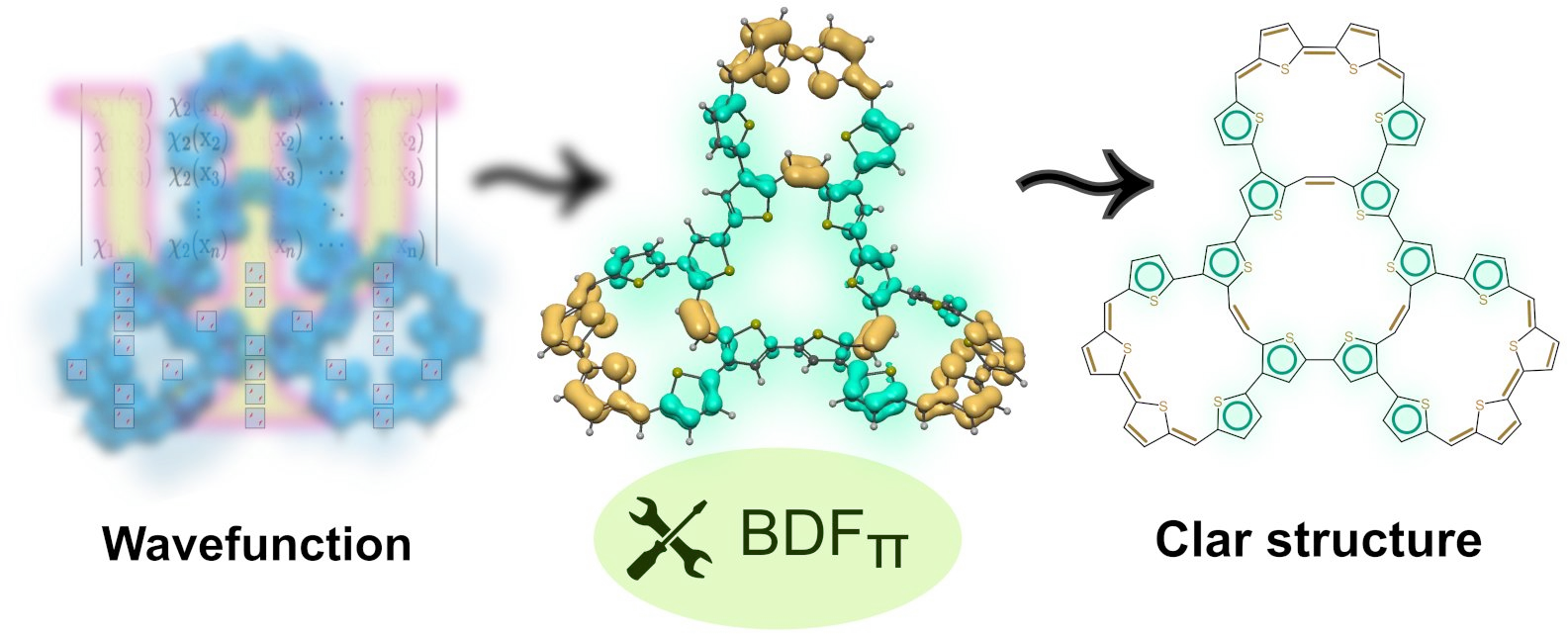
Understanding the electronic structure of (anti)aromatic poly- and macrocyclic π-conjugated systems remains a central challenge in contemporary chemistry, given their importance in materials science, molecular electronics, photophysics, and catalysis. While magnetically induced ring currents and NMR-based descriptors have long served as key indicators of (anti)aromatic character, the extent to which such magnetic observables reflect the full ground-state π-bonding architecture becomes less transparent in large and topologically complex systems. Here we introduce a wavefunction-based analytical protocol — the π-Bond Delocalization Function (BDFπ) — which maps the spatial organization of localized and delocalized π-bonding directly from the ground-state one-electron density matrix. Rather than relying on predefined resonance models or orbital localization schemes, the method extracts bonding topology from the complete occupied π-space. This enables a direct comparison between the global π-electron distribution and the more selective subset of frontier-orbital excitations that dominate magnetic response phenomena. Applied to representative poly- and macrocyclic systems frequently discussed in the context of global (anti)aromaticity, BDFπ reveals that magnetic ring currents and bonding delocalization need not coincide quantitatively in extended conjugated frameworks. Magnetic descriptors predominantly probe perturbative response channels, whereas the underlying resonance structure reflects the collective organization of the entire occupied π-manifold. By explicitly relating these two perspectives, the present framework provides a coherent and chemically transparent account of how resonance topology and experimentally observable magnetic behavior are connected — and where they may diverge — in large conjugated architectures.
D.W. Szczepanik (), P. Wieczorkiewicz ()
ACS Physical Chemistry Au 6 (2026) 793−802. DOI: 10.1021/acsphyschemau.6c00031. URL
Abstract:
Understanding the electronic structure of (anti)aromatic poly- and macrocyclic π-conjugated systems remains a central challenge in contemporary chemistry, given their importance in materials science, molecular electronics, photophysics, and catalysis. While magnetically induced ring currents and NMR-based descriptors have long served as key indicators of (anti)aromatic character, the extent to which such magnetic observables reflect the full ground-state π-bonding architecture becomes less transparent in large and topologically complex systems. Here we introduce a wavefunction-based analytical protocol — the π-Bond Delocalization Function (BDFπ) — which maps the spatial organization of localized and delocalized π-bonding directly from the ground-state one-electron density matrix. Rather than relying on predefined resonance models or orbital localization schemes, the method extracts bonding topology from the complete occupied π-space. This enables a direct comparison between the global π-electron distribution and the more selective subset of frontier-orbital excitations that dominate magnetic response phenomena. Applied to representative poly- and macrocyclic systems frequently discussed in the context of global (anti)aromaticity, BDFπ reveals that magnetic ring currents and bonding delocalization need not coincide quantitatively in extended conjugated frameworks. Magnetic descriptors predominantly probe perturbative response channels, whereas the underlying resonance structure reflects the collective organization of the entire occupied π-manifold. By explicitly relating these two perspectives, the present framework provides a coherent and chemically transparent account of how resonance topology and experimentally observable magnetic behavior are connected — and where they may diverge — in large conjugated architectures.
Three-dimensional fully π-conjugated macrocycles: when 3D-aromatic and when 2D-aromatic-in-3D?
O. El Bakouri, D.W. Szczepanik, K. Jorner, R. Ayub, P. Bultinck, M. Solà (), H. Ottosson ()
Journal of the Americal Chemical Society 144 (2022) 8560−8575. DOI: 10.1021/jacs.1c13478. URL
Abstract:
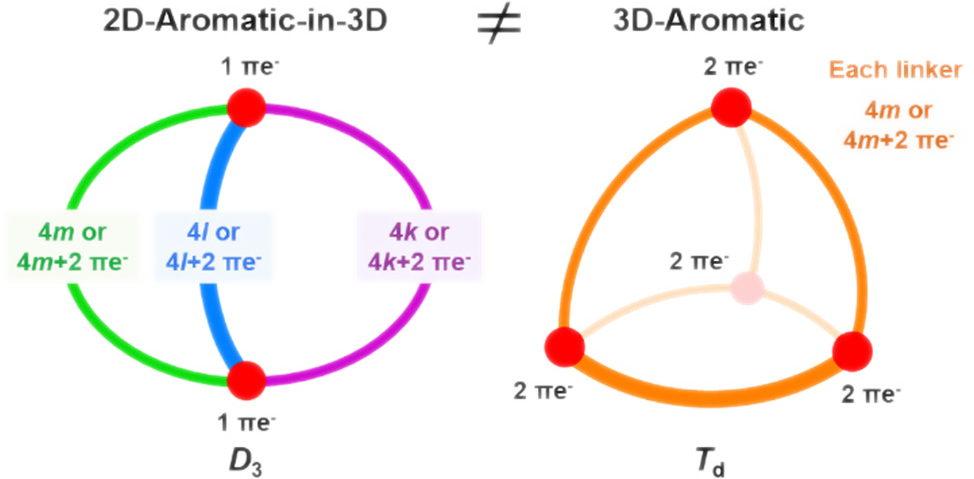
Several fully π-conjugated macrocycles with puckered or cage-type structures were recently found to exhibit aromatic character according to both experiments and computations. We examine their electronic structures and put them in relation to 3D-aromatic molecules (e.g., closo-boranes) and to 2D-aromatic polycyclic aromatic hydrocarbons. Using qualitative theory combined with quantum chemical calculations, we find that the macrocycles explored hitherto should be described as 2D-aromatic with three-dimensional molecular structures (abbr. 2D-aromatic-in-3D) and not as truly 3D-aromatic. 3D-aromatic molecules have highly symmetric structures (or nearly so), leading to (at least) triply degenerate molecular orbitals, and for tetrahedral or octahedral molecules, an aromatic closed-shell electronic structure with 6n + 2 electrons. Conversely, 2D-aromatic-in-3D structures exhibit aromaticity that results from the fulfillment of Hückel's 4n + 2 rule for each macrocyclic path, yet their π-electron counts are coincidentally 6n + 2 numbers for macrocycles with three tethers of equal lengths. It is notable that 2D-aromatic-in-3D macrocyclic cages can be aromatic with tethers of different lengths, i.e., with π-electron counts different from 6n + 2, and they are related to naphthalene. Finally, we identify tetrahedral and cubic π-conjugated molecules that fulfill the 6n + 2 rule and exhibit significant electron delocalization. Yet, their properties resemble those of analogous compounds with electron counts that differ from 6n + 2. Thus, despite the fact that these molecules show substantial π-electron delocalization, they cannot be classified as true 3D-aromatics.
O. El Bakouri, D.W. Szczepanik, K. Jorner, R. Ayub, P. Bultinck, M. Solà (), H. Ottosson ()
Journal of the Americal Chemical Society 144 (2022) 8560−8575. DOI: 10.1021/jacs.1c13478. URL
Abstract:
Several fully π-conjugated macrocycles with puckered or cage-type structures were recently found to exhibit aromatic character according to both experiments and computations. We examine their electronic structures and put them in relation to 3D-aromatic molecules (e.g., closo-boranes) and to 2D-aromatic polycyclic aromatic hydrocarbons. Using qualitative theory combined with quantum chemical calculations, we find that the macrocycles explored hitherto should be described as 2D-aromatic with three-dimensional molecular structures (abbr. 2D-aromatic-in-3D) and not as truly 3D-aromatic. 3D-aromatic molecules have highly symmetric structures (or nearly so), leading to (at least) triply degenerate molecular orbitals, and for tetrahedral or octahedral molecules, an aromatic closed-shell electronic structure with 6n + 2 electrons. Conversely, 2D-aromatic-in-3D structures exhibit aromaticity that results from the fulfillment of Hückel's 4n + 2 rule for each macrocyclic path, yet their π-electron counts are coincidentally 6n + 2 numbers for macrocycles with three tethers of equal lengths. It is notable that 2D-aromatic-in-3D macrocyclic cages can be aromatic with tethers of different lengths, i.e., with π-electron counts different from 6n + 2, and they are related to naphthalene. Finally, we identify tetrahedral and cubic π-conjugated molecules that fulfill the 6n + 2 rule and exhibit significant electron delocalization. Yet, their properties resemble those of analogous compounds with electron counts that differ from 6n + 2. Thus, despite the fact that these molecules show substantial π-electron delocalization, they cannot be classified as true 3D-aromatics.
Excited state character of Cibalackrot-type compounds interpreted in terms of Hückel-aromaticity: a rationale for singlet fission chromophore design
W. Zeng, O. El Bakouri, D.W. Szczepanik (), H. Bronstein (), H. Ottosson ()
Chemical Science 12 (2021) 6159−6171. DOI: 10.1039/D1SC00382H. URL
Abstract:
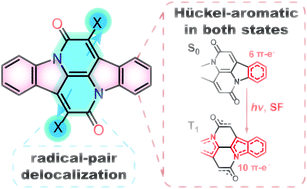
The exact energies of the lowest singlet and triplet excited states in organic chromophores are crucial to their performance in optoelectronic devices. The possibility of utilizing singlet fission to enhance the performance of photovoltaic devices has resulted in a wide demand for tuneable, stable organic chromophores with wide S1-T1 energy gaps (>1 eV). Cibalackrot-type compounds were recently considered to have favorably positioned excited state energies for singlet fission, and they were found to have a degree of aromaticity in the lowest triplet excited state (T1). This work reports on a revised and deepened theoretical analysis taking into account the excited state Hückel-aromatic (instead of Baird-aromatic) as well as diradical characters, with the aim to design new organic chromophores based on this scaffold in a rational way starting from qualitative theory. We demonstrate that the substituent strategy can effectively adjust the spin distribution on the chromophore and thereby manipulate the excited state energy levels. Additionally, the improved understanding of the aromatic characters enables us to demonstrate a feasible design strategy to vary the excited state energy levels by tuning the number and nature of Hückel-aromatic units in the excited state. Finally, our study elucidates the complications and pitfalls of the excited state aromaticity and antiaromaticity concepts, highlighting that quantitative results from quantum chemical calculations of various aromaticity indices must be linked with qualitative theoretical analysis of the character of the excited states.
W. Zeng, O. El Bakouri, D.W. Szczepanik (), H. Bronstein (), H. Ottosson ()
Chemical Science 12 (2021) 6159−6171. DOI: 10.1039/D1SC00382H. URL
Abstract:
The exact energies of the lowest singlet and triplet excited states in organic chromophores are crucial to their performance in optoelectronic devices. The possibility of utilizing singlet fission to enhance the performance of photovoltaic devices has resulted in a wide demand for tuneable, stable organic chromophores with wide S1-T1 energy gaps (>1 eV). Cibalackrot-type compounds were recently considered to have favorably positioned excited state energies for singlet fission, and they were found to have a degree of aromaticity in the lowest triplet excited state (T1). This work reports on a revised and deepened theoretical analysis taking into account the excited state Hückel-aromatic (instead of Baird-aromatic) as well as diradical characters, with the aim to design new organic chromophores based on this scaffold in a rational way starting from qualitative theory. We demonstrate that the substituent strategy can effectively adjust the spin distribution on the chromophore and thereby manipulate the excited state energy levels. Additionally, the improved understanding of the aromatic characters enables us to demonstrate a feasible design strategy to vary the excited state energy levels by tuning the number and nature of Hückel-aromatic units in the excited state. Finally, our study elucidates the complications and pitfalls of the excited state aromaticity and antiaromaticity concepts, highlighting that quantitative results from quantum chemical calculations of various aromaticity indices must be linked with qualitative theoretical analysis of the character of the excited states.
◼ Featured posters
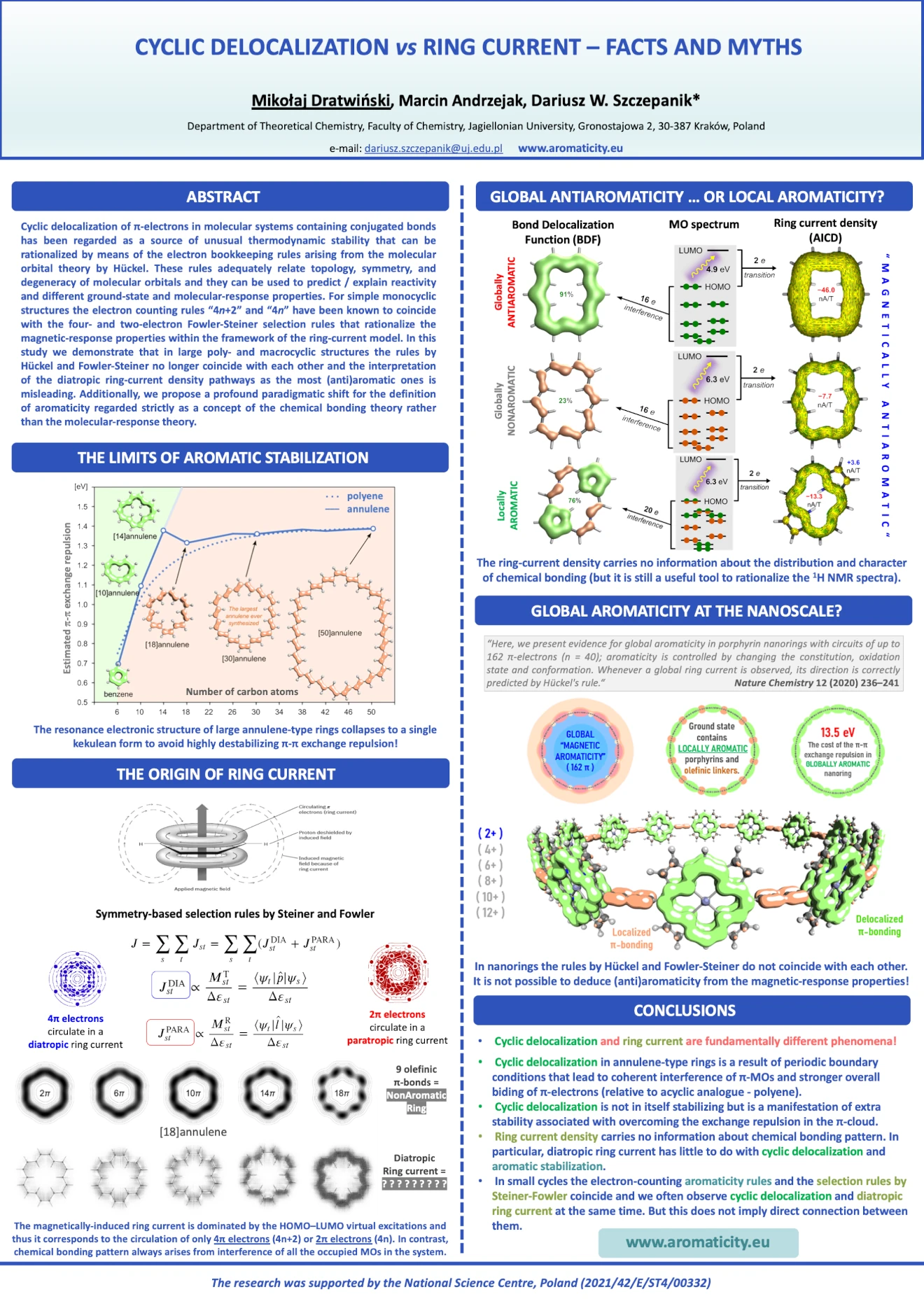
CTTC IX - Current Trends in Theoretical Chemistry IX (Kraków, Poland, 1-5.09.2024)
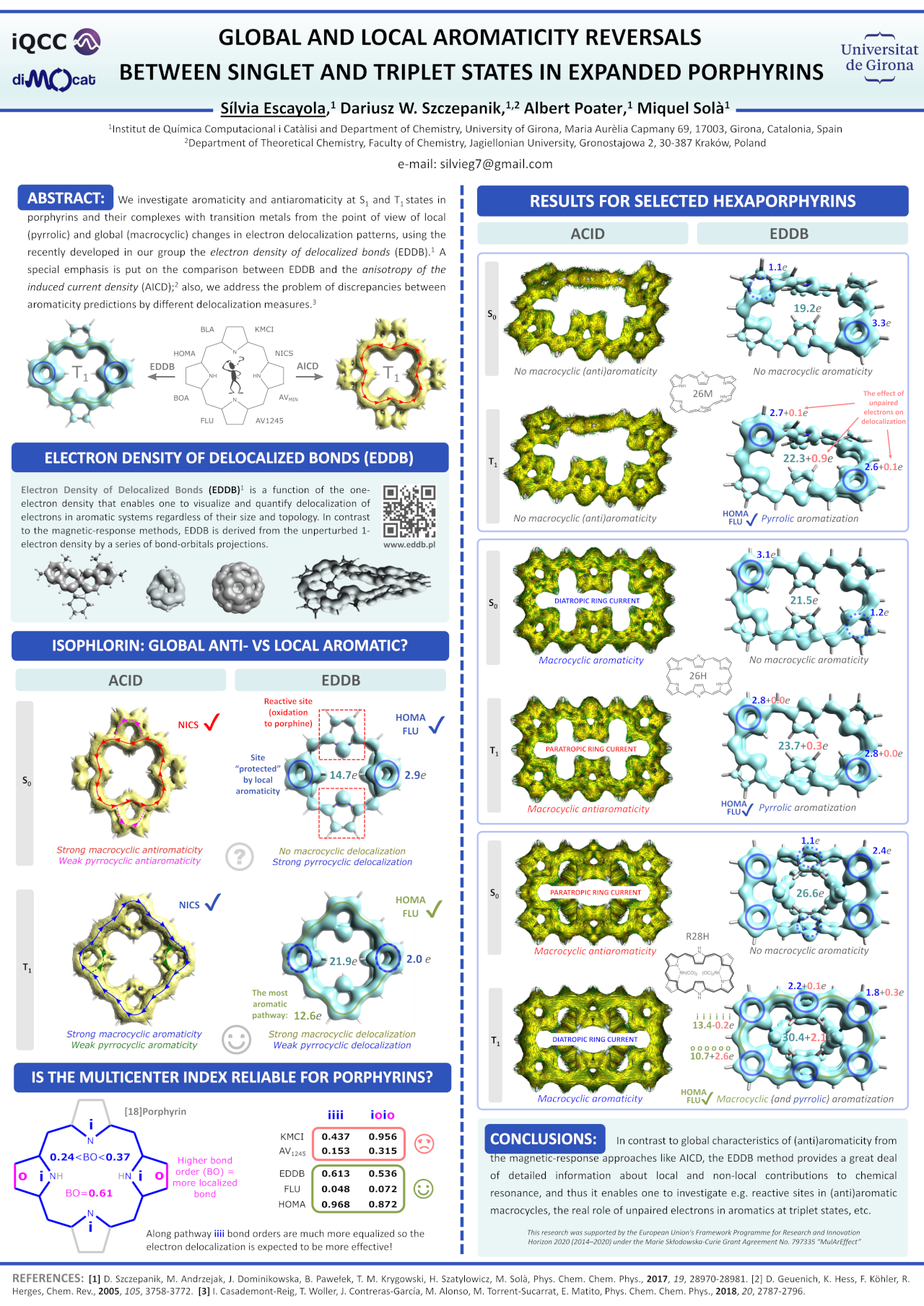
ICESAA - International Conference on Excited State Aromaticity and Antiaromaticity
(Sigtuna, Sweden, 30.07-02.08.2019)
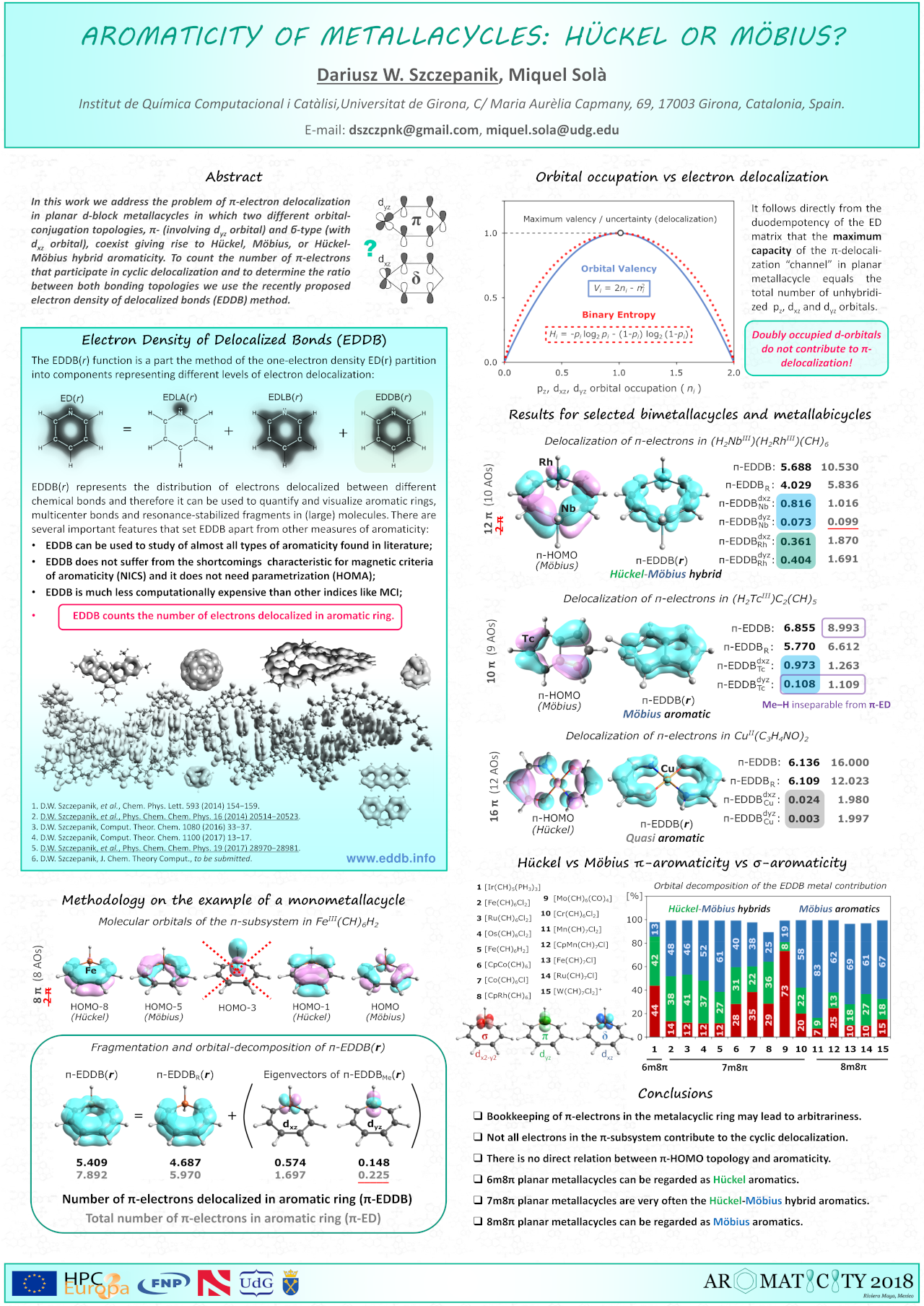
Aromaticity 2018 (Riviera Maya, Mexico, 28.11-01.12.2018)