
Szczepanik Research Group
Department of Theoretical Chemistry
Faculty of Chemistry, Jagiellonian University
Gronostajowa 2, 30-387 Krakow, Poland
Tel: (+48) 12 686 23 90
E-mail: dariusz.szczepanik@uj.edu.pl
HOME PROJECTS PUBLICATIONS runEDDB X
About EDDB Download Tutorials Manual

◼ Introduction — reading aromaticity from the chemical bond
Few concepts in chemistry are invoked as often, or defined as loosely, as aromaticity. The literature offers whole ecosystems of “aromaticity criteria”, most of them anchored in some measurable observable — the geometry of a ring, its energetic stabilization, or its response to an external magnetic field. Each such criterion is internally consistent and often beautifully calibrated against experiment. Yet the link between what is actually measured and what one really wants to know — the resonance structure of the chemical bonds, the way electron density is shared across a molecular framework — is subtle, indirect, and still only partially understood. Because that link is imperfect, different criteria applied to the very same molecule can disagree: sometimes mildly, sometimes to the point of contradiction. And the more topologically demanding the system — polycyclic, macrocyclic, open-shell — the more likely that disagreement becomes.
In our group we have taken a different route to the problem. Rather than adding one more observable-based index to the pile, we have developed a protocol for analysing the structure of conjugated, delocalized chemical bonds directly from the electronic wavefunction, grounded in a principle as fundamental as quantum mechanics itself — the superposition principle. We adapt that principle to genuinely chemical objects, the bond orbitals, and bring rigorous mathematical and physical criteria to bear on them, so that the electron density of a molecule can be interrogated — both quantitatively and qualitatively — through the prism of the structure and the nature of the chemical bonds that build it.
The defining feature of this approach is its completeness. Methods based on magnetic response — the familiar language of “aromatic ring currents” — are, by construction, sensitive only to the electrons a magnetic field can stir: a narrow, frontier subset of the whole. Our analysis instead resolves how every electron in the molecule is distributed over its bonds — the magnetically active and the magnetically silent alike. Working with the full one-electron density, we can say precisely which part of it shapes a molecule’s measurable response, and which part stays hidden — buried deep in the ground state, out of reach of this or that experiment. Only once the complete distribution and structure of the conjugated bonds is known can one ask, and answer, the questions that really matter: where the extraordinary stability of aromatic rings comes from, where their characteristic magnetic fingerprint comes from, and — most importantly — whether these two properties are genuinely intrinsic to the systems we call aromatic, independently of their topology, their size, or the number of rings they fuse together.
The Electron Density of Delocalized Bonds (EDDB) method, and the runEDDB program that implements it, were designed from the ground up around this philosophy. Nothing in EDDB is inherited from a pre-existing index; the method rests on quantitative criteria taken straight from the foundations of quantum mechanics — above all, the efficiency with which bond orbitals combine into coherent linear combinations. Our motivation in developing it is twofold: to understand the singular properties of aromatic molecules and trace them back to their true origin in the structure of the chemical bonds, and, at the same time, to chart the limits that response-based models inevitably meet when confronted with topologically complex systems — polycycles, macrocycles, and beyond.
One caveat is fundamental and worth stating plainly. EDDB does not observe a molecule directly — it reads the one-electron density matrix handed to it by a prior quantum-chemical calculation and analyses that. The bonding picture it returns is therefore only as trustworthy as the electronic-structure method that produced the density. This is no weakness peculiar to EDDB; it is the common condition of every property derived from a wavefunction. It does, however, come with a clear validation criterion. When the chosen method faithfully reproduces a molecule’s measurable observables — its equilibrium geometry, its NMR chemical shifts, its UV–vis excitations, and so on — we have solid grounds to regard the physics it encodes as sound, and hence its density matrix as a faithful representation of the real electron distribution. The EDDB results extracted from that matrix inherit exactly this standing: they are as reliable as the density they are built upon. Conversely, an EDDB analysis run on a poorly chosen or under-converged wavefunction deserves the same caution one would give to any other property computed at that level.
◼ What makes aromatic delocalization special
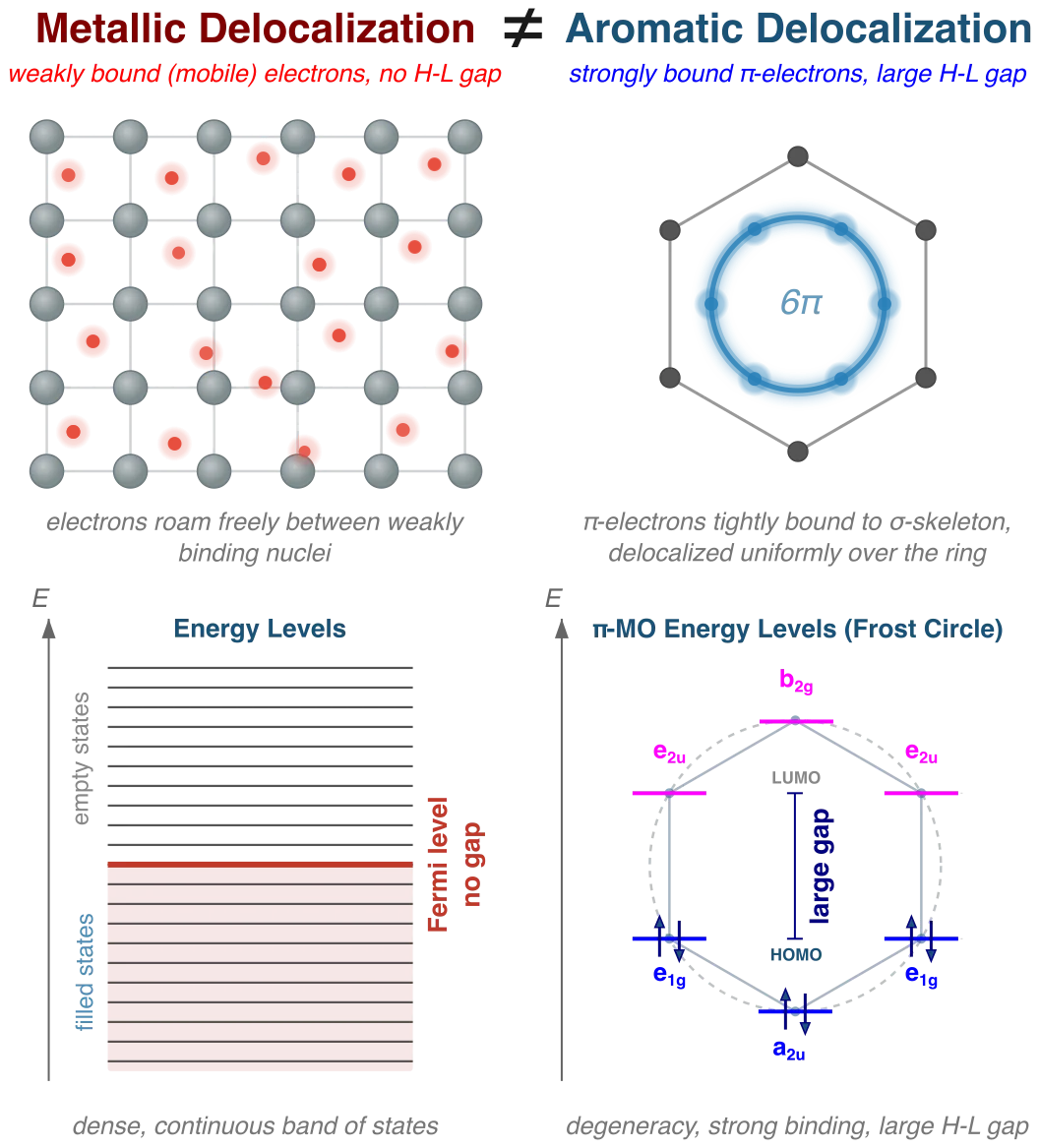
Electron delocalization is one of the most fundamental concepts in chemistry. In its broadest sense, it refers to the spreading of electron density over a region larger than a single atom or a single bond. Yet not all forms of delocalization are alike, and understanding the differences is essential if one wants to characterize aromatic and conjugated systems in a chemically meaningful way.
Before going further it is worth naming a confusion that the word “delocalization” quietly invites — and that the language of ring currents can reinforce. A picture one meets very often, in textbooks and research papers alike, runs like this: the π-electrons of benzene are mobile, free to circulate around the ring; that mobility is what makes them delocalized; the delocalization is what confers aromatic stability; and the ring current induced by a magnetic field is simply that circulation made visible. Every step sounds plausible, yet taken together they sit uneasily with the very property they set out to explain. If stability came from electrons being free to roam, benzene would behave like a minute scrap of metal — kinetically labile and easily perturbed — the exact opposite of its celebrated inertness. The paradox is genuine, and dissolving it is the whole point of this section: delocalization in a metal and delocalization in benzene are not two settings of a single dial, but two distinct phenomena that merely share a name. In the first, delocalization means kinetic mobility; in the second, as we shall see, it means something almost opposite — a coherent, uniform distribution of electrons that are bound more tightly than in any open-chain analogue, a coherence enforced not by freedom but by orbital degeneracy.
Consider, for example, the delocalization that occurs in metallic solids. The outermost valence electrons of a metal sit near the Fermi level and are only weakly bound to any particular nucleus. They move with relatively high kinetic energy through the lattice, hopping easily from site to site. It is precisely this high mobility—the ease with which electrons can be transferred through the network—that gives metals their characteristic electrical conductivity. In this regime, “delocalized” is essentially synonymous with “mobile” and “loosely bound.”
The π-electron system of benzene could hardly be more different. On a superficial level, it too is called delocalized: the six π-electrons are spread uniformly over the ring rather than being confined to three alternating double bonds. Yet the physical origin of this delocalization is not weak binding, but its opposite. The cyclic topology of the six carbon nuclei creates a pattern of one-electron energy levels that is qualitatively distinct from the pattern found in an open-chain analogue such as hexatriene. Specifically, the cyclic arrangement introduces a degeneracy of π-molecular-orbital levels (the well-known Frost–Musulin mnemonic makes this visible at a glance), which has three interrelated consequences:
- The π-electrons fill into levels that lie lower in energy than the corresponding levels of the open chain. A direct comparison of the orbital energies of benzene and hexatriene shows that the occupied π-levels of benzene are noticeably more stable, meaning that the π-electrons are more tightly bound to the nuclear framework.
- The highest occupied π-level (HOMO) is lowered while the lowest unoccupied level (LUMO) is raised, producing a larger HOMO–LUMO gap than in the open chain. A large gap implies high kinetic stability: the π-electrons sit in a deep potential well and are resistant to perturbation.
- The degeneracy of the occupied π-levels enforces a uniform distribution of π-bonding around the ring—what may be called π-coherence. No single C–C bond carries more or less π-character than any other. This uniformity is the structural signature of aromaticity and contrasts sharply with the bond-length alternation typical of non-aromatic conjugated chains.
Taken together, these features lead to a situation that may seem counterintuitive at first: the π-electrons of benzene are simultaneously more delocalized and less mobile than those of a comparable open-chain system. They are spread over a wider region of the molecule (delocalized), yet they are harder to excite, harder to remove, and harder to engage in addition reactions (less mobile). The low kinetic energy and strong binding of the π-cloud is what makes benzene so characteristically unreactive toward electrophilic addition—a textbook property that sets aromatic systems apart from ordinary polyenes.
This distinction has an important conceptual consequence. In metals, one speaks naturally of “delocalized electrons”—individual electrons that are free to roam. In benzene, a more precise language is called for. What is delocalized is not so much the electrons themselves as the bonds they form: each π-bond is shared equally among all adjacent C–C pairs, creating a closed circuit of partial bonds rather than a set of free-roaming charges. In other words, the characteristic feature of aromatic delocalization is the delocalization of π-bonds, not merely of π-electrons.
◼ Electron Density of Delocalized Bonds (EDDB)
Once we accept that what is characteristic of aromatic and conjugated systems is the delocalization of bonds rather than of individual electrons, a natural question follows: how do we measure this effect from a quantum-chemical calculation? A variety of strategies have been proposed over the past decades, and they broadly fall into two families. The first family constructs a particular set of bonding orbitals — natural bond orbitals (NBO), adaptive natural density partitioning (AdNDP), localized molecular orbitals, and the like — and then interprets the molecule through that chosen representation. The second family avoids orbitals altogether and works directly in three-dimensional physical space, analyzing the topology of the electron density itself (QTAIM, ELF, and related schemes). Both perspectives have been enormously productive, but each embeds a methodological choice that can blur the question at hand. Orbital-based approaches inevitably depend on the particular bonding representation one has decided to adopt; topological methods, in turn, describe where the density is but have difficulty quantifying which part of it is engaged in orbital conjugation.
The EDDB method takes a deliberately different stance. Its aim is not to define yet another orbital representation of bonding and not to classify points in space, but to isolate directly within the one-electron density matrix the fraction of the electron density that is participating in multi-centre, conjugated bonding. Bond orbitals still appear in the procedure, but only as auxiliary mathematical tools — a convenient probe used to interrogate the density matrix. The object that is finally reported — a density, visualizable in real space and integrable to an electron count — belongs unambiguously to the density itself and carries no arbitrariness inherited from a chosen orbital localization scheme. In this sense, EDDB sits at the intersection of the two traditions: it uses orbital logic where orbital logic is informative (namely, to detect conjugation), and returns a density where a density is more robust (namely, for visualization, population analysis, and comparison across methods).
The physical idea behind the method is simple. If a bond orbital between atoms A and X is genuinely coupled — through a shared atom X — to an adjacent bond orbital between X and B, then the two bonds share some of their electron density. If instead the relative phases of the two bond orbitals cancel out, the bonds are electronically independent in spite of being geometrically contiguous. The first situation is conjugation; the second is what one observes in a non-conjugated chain of isolated double bonds. The EDDB method diagnoses each bond orbital in the molecule, identifies the fraction that is coupled to its neighbours, and accumulates exactly that fraction into a new density matrix — the density of delocalized bonds. The remainder, by construction, carries the complementary electrons — those involved in localized bonds and lone pairs — and defines the Electron Density of Localized Bonds (EDLB).
◼ Numerical realization: the BOP algorithm
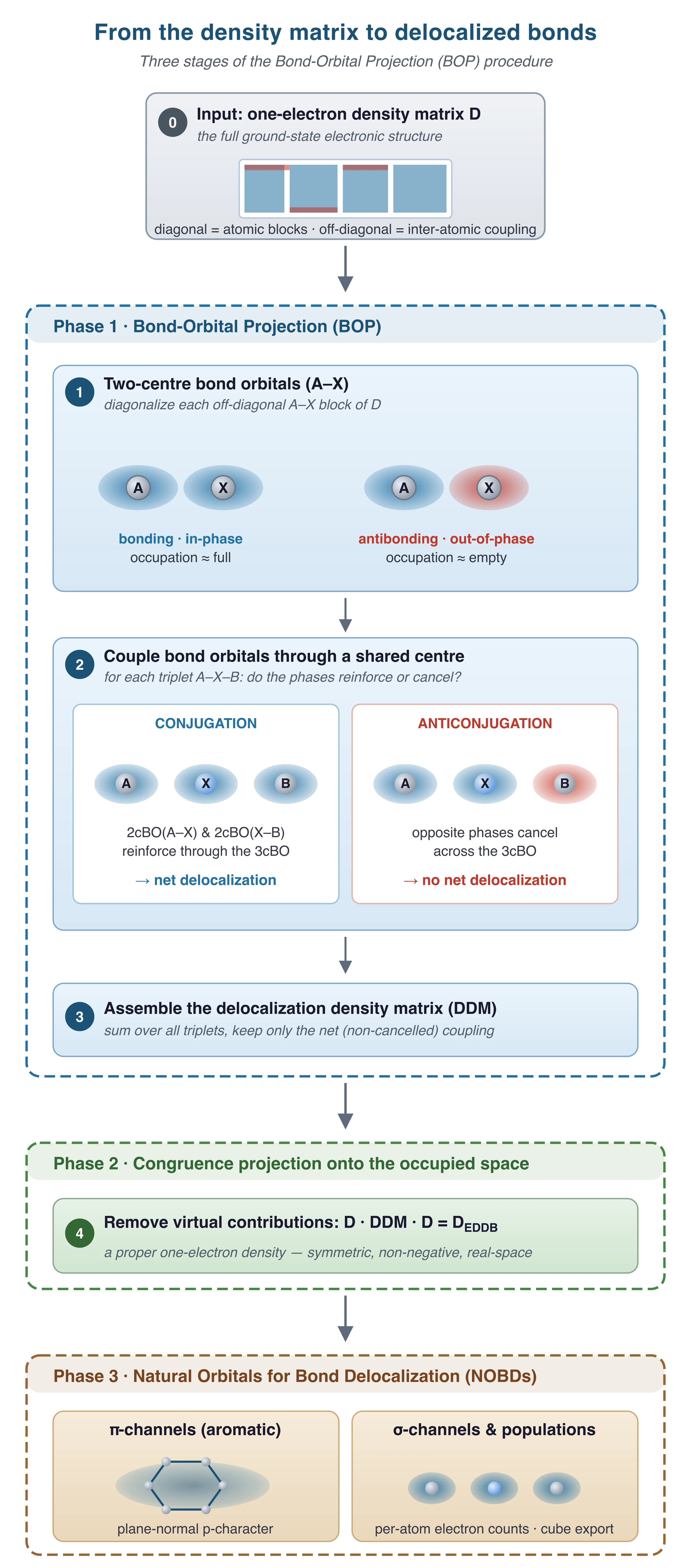
The practical machinery by which EDDB is extracted from the density matrix is the Bond-Orbital Projection (BOP) procedure. It proceeds in three logical stages, summarized in the figure on the right.
(i) Two-centre bond orbitals. For every pair of bonded atoms A and X the off-diagonal block of the one-electron density matrix, D(A,X), is diagonalized. The resulting eigenvectors form a set of two-centre bond orbitals (2cBOs), and their squared eigenvalues give the occupations of the bonding and anti-bonding components of the A–X bond. These orbitals play the role of “atomic orbitals” in the next step — they are the building blocks of bonding, one level up from AOs.
(ii) Three-centre coupling: conjugation versus anticonjugation. This is the defining step of the algorithm. For every triplet of bonded atoms A–X–B (where X is the shared centre), the corresponding triatomic block of D is diagonalized to yield a set of three-centre natural orbitals (3cBOs) spanning the A–X–B subspace. The two-centre orbitals built in stage (i) are then projected onto these 3cBOs, and the relative phases of the A–X and X–B projections are compared. When they reinforce each other the two bond orbitals conjugate (constructive interference — the essence of aromatic and polyenic delocalization). When they cancel, the bonds are effectively independent. This is the same logic that governs the formation of bonding and antibonding MOs in the diatomic case, only lifted one level higher: instead of atomic orbitals combining to form bonds, here bond orbitals combine to form delocalized conjugation channels. Summing over all triplets and keeping only the net, non-cancelled coupling yields a delocalization density matrix, DDM.
(iii) Projection onto the occupied space. DDM is defined in the full orbital space and in general contains contributions from virtual orbitals, which carry no physical electrons. A congruence transformation with the ground-state one-electron density matrix D,
projects the delocalization matrix onto the space of occupied orbitals and produces DEDDB, the Electron Density of Delocalized Bonds itself. It is a proper, symmetric, non-negative one-electron density, and its trace returns the total number of electrons engaged in multi-centre conjugation:
Diagonalization of DEDDB yields a small set of Natural Orbitals for Bond Delocalization (NOBDs) with occupations ni. A geometric test — fitting a local plane to the atoms that support each NOBD and measuring the p-character projected onto that plane’s normal — separates π-type channels from σ-type ones automatically, with no user input about the molecular orientation. The same symmetry-based logic detects δ-type channels relevant for transition-metal aromatic systems. Atomic EDDB populations — the number of delocalized electrons assigned to each atom — follow from the diagonal of DEDDB in the natural-atomic-orbital basis, and the density itself can be exported to a cube file for direct visualization in real space.
◼ Bond Delocalization Function (BDF)
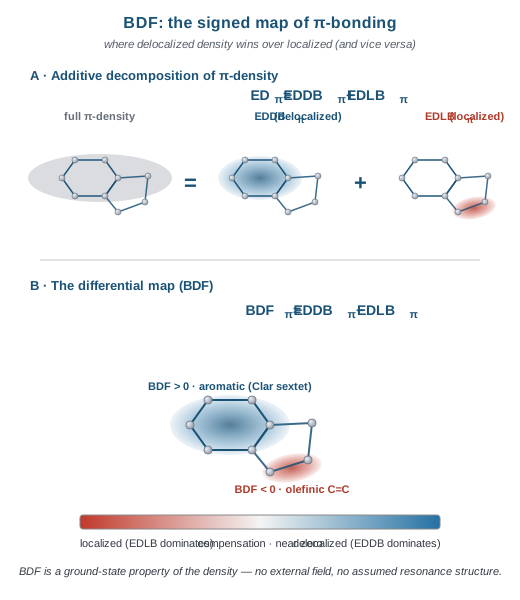
The EDDB method carries a natural partner. Together with the density of delocalized bonds, the same BOP machinery returns the density of localized bonds and lone pairs — the Electron Density of Localized Bonds (EDLB). The two densities are additive and exhaustive: for any chosen subspace of the one-electron density (for instance the π-manifold), their sum recovers the full density of that subspace,
Summing the two simply reproduces what we started with. Much more informative is their difference — a signed map that at each point in space tells us whether the π-density is dominated by delocalized, conjugated bonding or by localized, olefinic bonding. This is the Bond Delocalization Function:
The sign tells the story:
- Positive BDF — regions where delocalized π-density exceeds localized density. These are the aromatic circuits and Clar-type π-sextets, where electron density is genuinely shared across several bonds.
- Negative BDF — regions where localized density prevails. These are the olefinic double bonds, where a well-defined two-centre π-bond carries most of the density.
- Near-zero BDF — regions where the two components compensate. Far from being chemically uninteresting, these are the fingerprints of ionic resonance, charge-assisted delocalization, and competing bonding motifs (Kekulé vs.~quinoid, migrating π-sextets), phenomena that are notoriously hard to read off from the total π-density alone.
Visualized as a 3-D isosurface, BDFπ converts abstract talk of “resonance” into a concrete map one can inspect for any molecule: positive blue regions mark the aromatic domains, negative red regions mark the olefinic ones, and white gaps mark the compensation zones. No pre-specified resonance structure, no orbital localization choice, no arbitrary threshold: only the one-electron density matrix.
◼ Aromaticity and the response-theory detour
A word on why this matters. For several decades, aromaticity has been diagnosed almost exclusively by magnetic-response descriptors — NICS, ring currents, induced current densities (AICD, GIMIC) and their many variants. These techniques are elegant, experimentally well-calibrated, and extraordinarily useful. But they share one methodological feature that is rarely stated plainly: they do not describe the molecule’s ground state. They describe how the molecule responds to an external magnetic field.
Within the one-electron picture, that response is governed by a narrow subset of low-energy occupied-to-virtual excitations — typically a handful of frontier orbitals near the HOMO–LUMO gap. This was made quantitative by Fowler, Steiner and co-workers more than twenty years ago: the symmetry-based selection rules for ring currents pick out only a few frontier π-orbitals as current-carrying channels. The rest of the occupied π-manifold is essentially invisible to the magnetic probe. In short, magnetic descriptors measure a perturbative property of the electronic structure, filtered through a frontier-orbital lens.
This is not a criticism of magnetic-response methods — they are irreplaceable for what they do, and they are sensitive precisely because they focus on the most polarizable electrons. It is, however, a reason to be careful about what we mean when we say that a molecule “is aromatic”. By equating aromaticity with the strength of a ring current, the community has gradually transferred one of the oldest and most fundamental concepts of chemical bonding into the vocabulary of molecular response theory. The concept itself has thereby drifted away from its natural home — the theory of the chemical bond — and become an observable of molecular magnetochemistry.
In small, textbook-aromatic molecules like benzene the two perspectives agree: the frontier π-orbitals and the bulk of the π-density tell the same story. In large and topologically rich systems they need not. A porphyrin nanoring such as c-P12[b12] can support a global aromatic ring current (magnetic diagnosis: aromatic) while its ground-state π-density, revealed by BDFπ, is organized into twelve locally aromatic porphyrin subunits connected by olefinic linkers (bonding diagnosis: locally aromatic). Aza-supernaphthalene preserves nine Clar π-sextets even as oxidation progressively flips its magnetic classification. In the fused indacene dimer s-ID, the open-shell ground state trades one π-bond for two disjoint Clar sextets — a bonding reorganization that explains the OSS–CSS energy gap almost quantitatively, and that is visible in BDFπ but not in the current-density picture. The two descriptors are not contradictory; they are answering different questions.
In practice, runEDDB produces EDDBπ, EDLBπ and BDFπ as separate cube files, ready for visualization in VMD, Chimera, Avogadro or any other molecular-graphics package. The full (all-electron) variants are available through the same command-line switches, and the π / σ / δ partitioning of every channel is performed automatically from the ground-state geometry. No separate localization step, no orbital editor, no follow-up calculation: the three maps are obtained in a single pass through the density matrix.