◼ Tutorial 3 — A metallacycle: Hückel or Möbius aromatic?
This tutorial follows the planar metallacycle C7H7FeCl from a bare geometry to a verdict on its aromaticity. It uses the same tools as Tutorials 1 and 2 — the global map, the population table and the ring CDI — but on a molecule where a transition metal takes part in the ring. That makes it the right place to learn one habit: check what the automatic π-selection did before you trust the number. The whole tutorial runs on the built-in GFN2-xTB engine, so you can reproduce every step from the .xyz file below.
What you will learn
Reading the global delocalization summary and the EDDBG map of a metallacycle.
Reading natural charges and per-atom populations from the --table npa table.
Computing the CDI of an 8-membered ring that contains a metal atom — and comparing it with benzene.
Inspecting the selected π-NOBDs and overriding the automatic selection when a borderline orbital shows up.
This example comes from the original study:
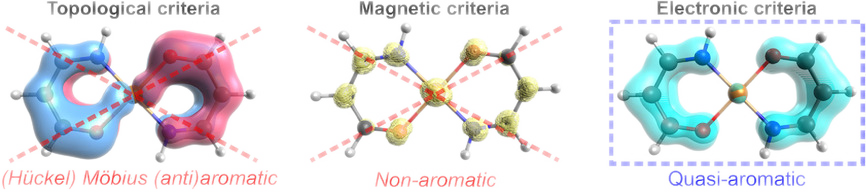
Electron delocalization in planar metallacycles: Hückel or Möbius aromatic?
D.W. Szczepanik (), M. Solà () ChemistryOpen 8 (2019) 219−227. DOI: 10.1002/open.201900014. URL
Abstract:
In this work the relationship between the formal number of π-electrons, d-orbital conjugation topology, π-electron delocalization and aromaticity in d-block metallacycles is investigated in the context of recent findings concerning the correlation of π-HOMO topology and the magnetic aromaticity indices in these species. It is demonstrated that for π-electron rich d-metallacycles the direct link between aromaticity, the number of π-electrons and the frontier π-orbital topology does not strictly hold and for such systems it is very difficult to unambiguously associate their aromaticity with the '4n+2' (Hückel) and '4n' (Möbius) rules. It is also shown that the recently proposed electron density of delocalized bonds (EDDB) method can successfully be used not only to quantify and visualize aromaticity in such difficult cases, but also – in contrast to magnetic aromaticity descriptors – to provide a great deal of information on the real role of d-orbitals in metallacycles without the ambiguity of bookkeeping of electrons in the π-subsystem of the molecular ring. Interestingly, some of the metallacycles studied cannot be classified exclusively as Hückel or Möbius because they have a hybrid Hückel-Möbius or even quasi-aromatic nature.
1. The molecule and its geometry
Everything below starts from a single plain-text geometry file, c7h7fecl.xyz — the 16 atoms of the metallacycle in Cartesian coordinates (Å). Copy the block below into a file, or download it directly:
c7h7fecl.xyz
16

Fe       -0.064251938266      0.000000000000      0.383381287583
C         0.102879051008      1.467437846806     -0.581782848285
C         0.102879051008     -1.467437846806     -0.581782848285
C         0.042058436784      1.945591795572     -1.877580721536
C         0.042058436784     -1.945591795572     -1.877580721535
C        -0.012197738912      1.304915633429     -3.124178523721
C        -0.012197738912     -1.304915633430     -3.124178523721
C        -0.022766917881      0.000000000000     -3.622055704846
H        -0.061079076601      0.000000000000     -4.715595953142
H         0.167516111578      2.281514394810      0.169634195203
H         0.167516111578     -2.281514394810      0.169634195204
H         0.029959638034      3.038668532273     -1.974142731372
H         0.029959638034     -3.038668532273     -1.974142731372
H        -0.055473924074      2.032073158396     -3.942519373400
H        -0.055473924074     -2.032073158396     -3.942519373400
Cl        1.502523783826      0.000000000000      1.822684376427
The atom order fixes the numbering used throughout: atom 1 is Fe, atom 16 is Cl, and atoms 2–8 are the seven carbons of the C7 ring — the labels you will feed to the ring --pathway in Section 4. runEDDB needs no wavefunction for this file: its built-in GFN2-xTB engine builds the one-electron density on the fly, as the next section shows.
2. Global delocalization pattern
runEDDB ships its own built-in GFN2-xTB engine, so it can go from the bare geometry above straight to an EDDB analysis — no external program required. The entire tutorial uses exactly this route; the equivalent ab-initio recipe for each quantum-chemistry package is collected in the cheat-sheet.
⚠ A note on the method. GFN2-xTB is a fast, approximate tight-binding model that tends to overestimate delocalization. Here that is useful: it tells you whether a delocalized cycle is possible at all for a given ring. Whether it survives is a question for a higher level of theory — DFT with a long-range-corrected functional such as CAM-B3LYP (see Szczepanik et al., J. Comput. Chem. 38 (2017) 1640; DOI:10.1002/jcc.24805). Section 7 shows how to run that check.
First, we investigate the distribution of the electron density of all delocalized bonds in the entire molecule using the EDDBG function (the subscript G stands for global: all atoms and bonds are included). When the input is a geometry rather than a wavefunction, runEDDB automatically builds the one-electron density with GFN2-xTB before running the analysis:
terminal
$ runEDDB --input c7h7fecl.xyz --quiet
The --quiet (or -q) option enables quiet mode: only the EDDBG summary populations are printed — useful for batch jobs where only the numerical result is needed:
output
▶ Printing summary of EDDB calculations:

        Total   ED_G population:           49.82313    per atom:     3.11395
        Total EDLB_G population:           40.56201    per atom:     2.53513
        Total EDDB_G population:            9.26112    per atom:     0.57882

▶ Calculation completed on 2026-07-27. Total time: 0s.
The default analysis basis is the Natural Valence Basis (NVB), which retains only the valence-shell Natural Atomic Orbitals (NAO). GFN2-xTB describes only the valence electrons (a 42-electron effective core potential removes the Fe/Cl/C cores), so of the ~49.8 valence electrons in the NVB about 40.6e are localized (lone pairs and two-center bonds) and ~9.3e are shared through the system of delocalized bonds.
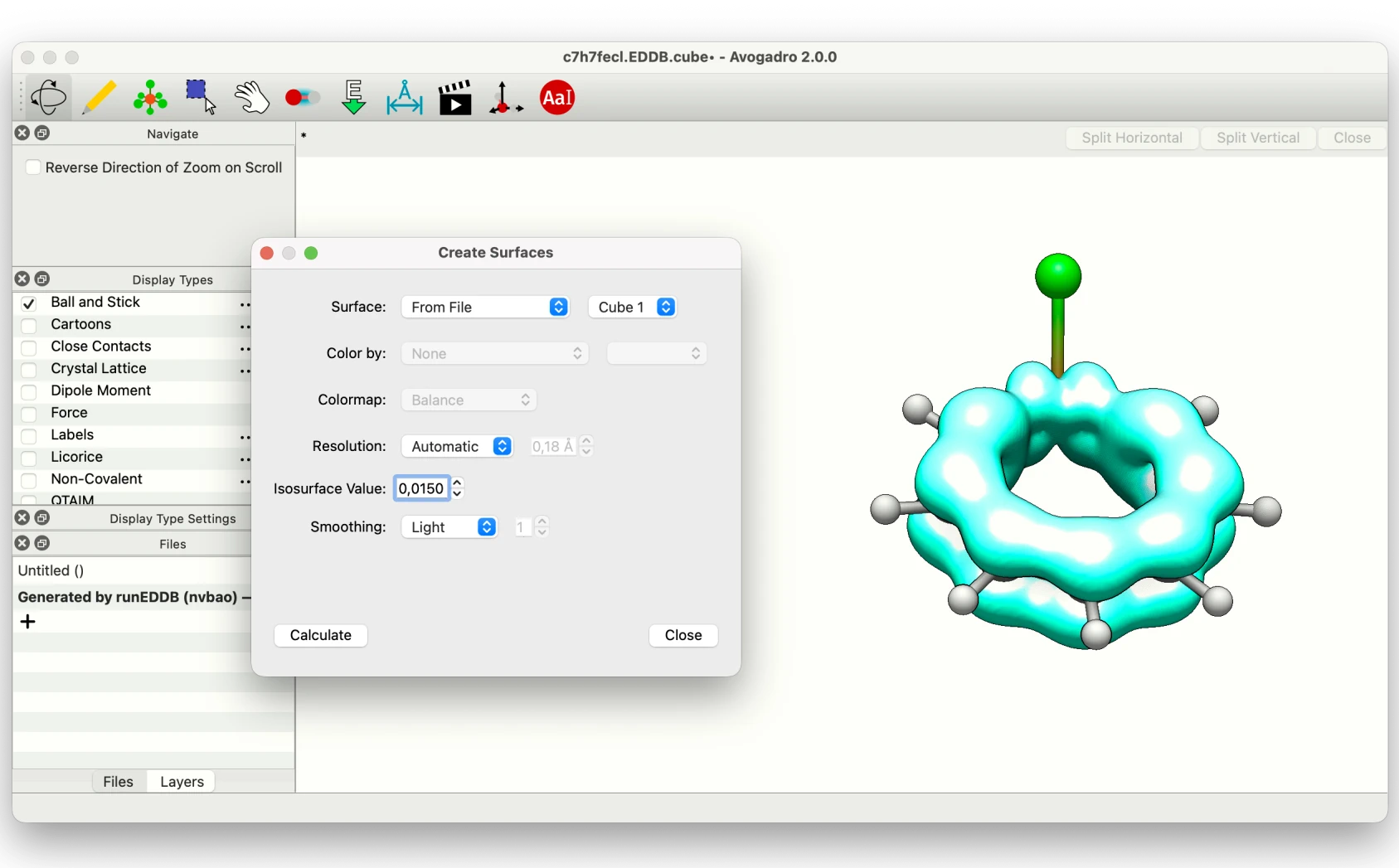
To quickly visualize the EDDBG-layer of the one-electron density, add the --export-cube eddb option:
▶ Exporting EDDB_G to c7h7fecl.EDDB_G.cube...                                         1s
▶ Printing summary of EDDB calculations:

        Total   ED_G population:           49.82313    per atom:     3.11395
        Total EDLB_G population:           40.56201    per atom:     2.53513
        Total EDDB_G population:            9.26112    per atom:     0.57882

▶ Calculation completed on 2026-07-27. Total time: 1s.
This generates a Gaussian cube file (c7h7fecl.EDDB_G.cube) for visualization in, e.g., Avogadro2, IQmol, GaussView, VMD, or Chemcraft; a typical isosurface value is 0.015-0.020. The --ncores (or -n) option parallelizes the grid evaluation, which is the most compute-intensive step; the grid quality is controlled by --cube-size (or -c, default: 100).
To visualize the generated cube file in Avogadro2, select in the program menu Analyze → Create Surfaces and set the parameters as in the figure below:
3. Atomic charges and populations
The most useful single table is the condensed-atomic natural population analysis: one row per atom with its natural charge (qN), its electron population (EDG) and the delocalized part of it (EDDBG). Tables are opt-in, so ask for it with --table:
terminal
$ runEDDB --input c7h7fecl.xyz --table npa
output
  ┌────────────────────────────────────────────────────────────────────────────────────┐
  │          NATURAL POPULATION ANALYSIS IN CONDENSED-ATOMIC (NVB) RESOLUTION          │
  └────────────────────────────────────────────────────────────────────────────────────┘
     Atom      Charge       ED_G        α         β        EDDB_G       α         β
   ────────   ─────────   ───────── ───────── ─────────   ═════════ ───────── ─────────
       1 Fe   +1.22153     6.60631      -         -        1.75000      -         -
       2 C    -0.31665     4.31665      -         -        1.07054      -         -
       3 C    -0.31665     4.31665      -         -        1.07054      -         -
       4 C    -0.02589     4.02589      -         -        0.98681      -         -
       5 C    -0.02589     4.02589      -         -        0.98681      -         -
       6 C    +0.01454     3.98546      -         -        0.89438      -         -
       7 C    +0.01454     3.98546      -         -        0.89438      -         -
       8 C    -0.03227     4.03227      -         -        0.97527      -         -
       9 H    +0.01810     0.98190      -         -        0.02363      -         -
      10 H    -0.00186     1.00186      -         -        0.04202      -         -
      11 H    -0.00186     1.00186      -         -        0.04202      -         -
      12 H    +0.02389     0.97611      -         -        0.04584      -         -
      13 H    +0.02389     0.97611      -         -        0.04584      -         -
      14 H    +0.01783     0.98217      -         -        0.02017      -         -
      15 H    +0.01783     0.98217      -         -        0.02017      -         -
      16 Cl   -0.63108     7.62637      -         -        0.39271      -         -
   ────────   ─────────   ───────── ───────── ─────────   ═════════ ───────── ─────────
The numbers confirm that only Fe and the ring C atoms contribute significantly to the global delocalization, while the Fe center carries a sizeable positive charge (~+1.2) and the Cα atoms (2, 3) are the most negative (~−0.32). A condensed-atomic table like this one is the starting point for most discussions and is sufficient for many quick assessments.
4. Cyclic delocalization of π-electrons
Aromatic stabilization in molecular rings with π-conjugated bonds is associated with cyclic delocalization of π-electrons, whereas cross-ring orbital interactions are often locally destabilizing (cf. the antibonding interaction between para-related carbon atoms in benzene). To assess the effect of cyclic π-electron delocalization in the 8-membered ring (8MR) of the C7H7FeCl system, we perform an EDDBP calculation (the subscript P stands for pathway):
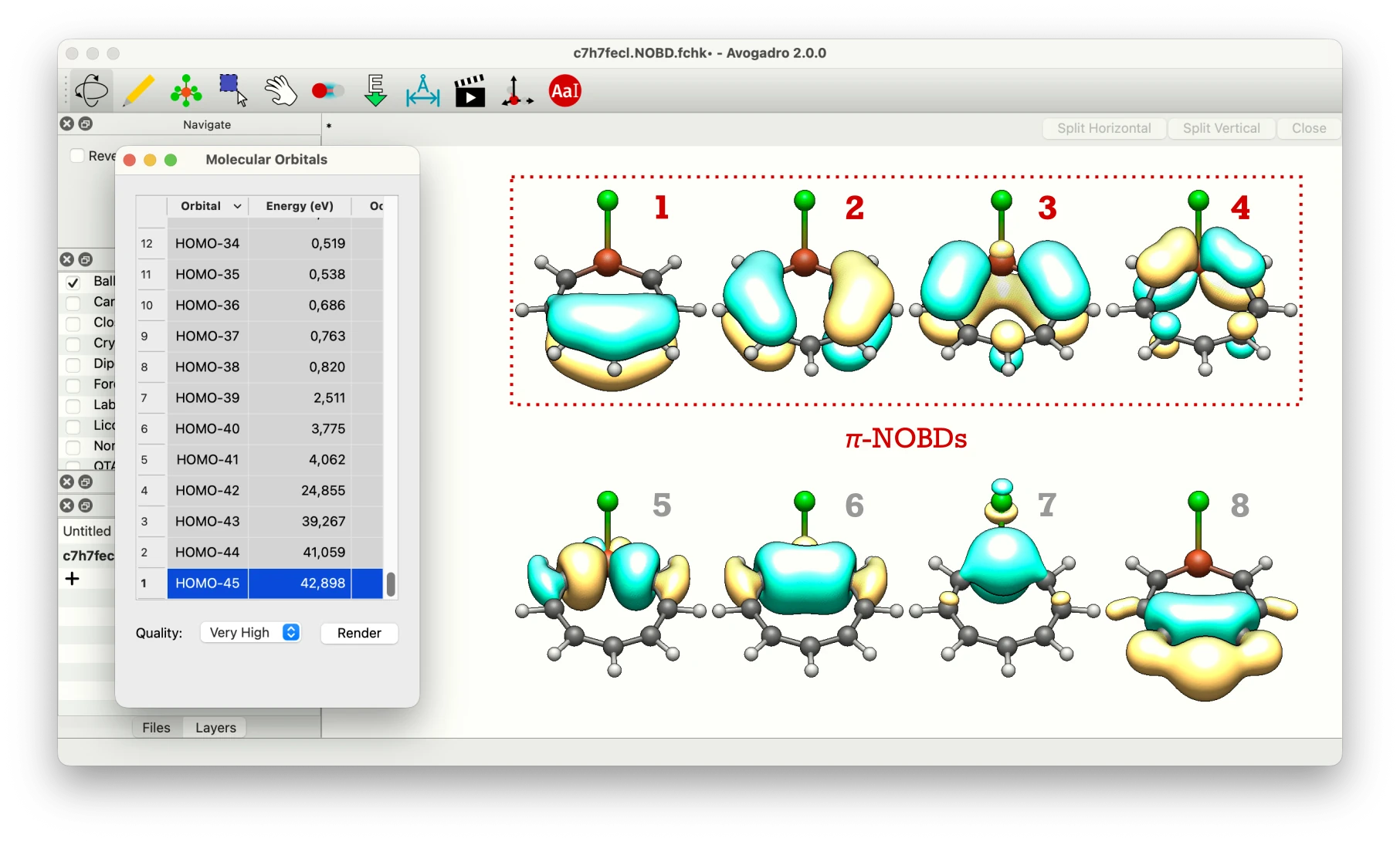
The --pathway (or -p) option specifies the bond connectivity along the ring. The --export-fchk nobd option generates a new Gaussian FCHK file (c7h7fecl.NOBD_P.fchk) in which the Alpha MO coefficients are replaced by the spinless NOBDs. The --auto-pi (or -a) option automatically selects only π-type NOBDs based on their orbital composition (marked with * in the Sel column):
The --auto-pi option identifies the first five NOBDs as π-orbitals; together they account for ~9.9e of π-electrons, of which ~5.97e is cyclically delocalized. To visually inspect the NOBDs and verify the automatic π-NOBD selection, open the generated c7h7fecl.NOBD_P.fchk file in Avogadro2 and select a particular NOBD in the Molecular Orbitals window (in the generated file the α-MOs ordered by increasing energy are replaced by NOBDs ordered by decreasing occupation number):
As follows from the summary, the average per-atom population of cyclically delocalized π-electrons in the 8MR is 0.74610e. However, the EDDBP atomic populations reveal that the distribution is not uniform: a noticeable π-deficiency on atoms 2 and 3 (~0.635e vs ~0.78e on atom 8) is a fingerprint of high-energy ionic resonance structures contributing to the wavefunction and reducing the aromatic stabilization energy.
A word of caution:--auto-pi is a fast automatic screen based on orbital composition, not the last word. Here the fifth selected NOBD is only weakly occupied (~0.35 e) and heavily d-type (~88% d), so it sits on the borderline between the π- and the σ/d-subsystems. Good practice is to look at the exported c7h7fecl.NOBD_P.fchk and, if you disagree with the selection, override it — Section 6 shows how. For this molecule the verdict does not change.
The Cyclic Delocalization Index (CDI), printed at the end of the summary, equals the smallest per-atom EDDBP value — the maximum population of π-electrons (per atom) that can be uniformly delocalized around the cycle. Here the CDI is ~0.635; for comparison, the CDI of benzene at the same GFN2-xTB level is ~0.889 (run runEDDB -i @benzene -p 1-2-3-4-5-6-1 -a -q to reproduce it), so the relative π-aromaticity in the 8MR of C7H7FeCl can be estimated as ~70%.
5. Conclusion
The EDDB analysis at the GFN2-xTB level reveals that the model C7H7FeCl metallacycle (in its ground-state configuration) can be classified as a Möbius-Craig aromatic species with a predominating δ-conjugation topology involving the 3dXY (Fe) orbital. The effectiveness of cyclic delocalization of π-bonds in this 8-membered ring is relatively high — about 70% of the one in the archetypal π-aromatic benzene evaluated at the same level of theory. Bear in mind, however, that this GFN2-xTB result is a fast, first-pass approximation and should be verified with ab initio calculations (long-range-corrected DFT or higher).
6. Going further (optional)
Two follow-up questions for readers who want to look under the hood. Neither is needed for the black-box use of runEDDB.
Show the two optional analyses
6a · Overriding the automatic π-selection. Keeping only the four dominant π-NOBDs recovers the textbook 8π picture:
▶ Loading and parsing input file...                                                   0s
▶ Modelling one-electron density at the GFN2-xTB/vSTO-nG level...                     0s
▶ Building natural atomic orbitals (NAO, frozen-NMB two-cycle)...                     0s
▶ Performing multicenter bond-orbital projections (BOP)...                            0s
▶ Computing natural orbitals for bond delocalization (NOBD)...                        0s
▶ Printing analysis details:

  ┌────────────────────────────────────────────────────────────────────────────────────┐
  │          NATURAL POPULATION ANALYSIS IN CONDENSED-ATOMIC (NVB) RESOLUTION          │
  └────────────────────────────────────────────────────────────────────────────────────┘
     Atom      Charge       ED_P        α         β        EDDB_P       α         β
   ────────   ─────────   ───────── ───────── ─────────   ═════════ ───────── ─────────
       1 Fe   +1.22153     1.27643      -         -        0.68154      -         -
       2 C    -0.31665     0.90292      -         -        0.62513      -         -
       3 C    -0.31665     0.90292      -         -        0.62513      -         -
       4 C    -0.02589     0.99708      -         -        0.75349      -         -
       5 C    -0.02589     0.99708      -         -        0.75349      -         -
       6 C    +0.01454     0.95041      -         -        0.70359      -         -
       7 C    +0.01454     0.95041      -         -        0.70359      -         -
       8 C    -0.03227     1.00071      -         -        0.77862      -         -
   ────────   ─────────   ───────── ───────── ─────────   ═════════ ───────── ─────────

▶ Printing summary of EDDB calculations:

        Total   ED_P population:            7.97795    per atom:     0.99724
        Total EDLB_P population:            2.35336    per atom:     0.29417
        Total EDDB_P population:            5.62459    per atom:     0.70307

    Cyclic Delocal. Index (CDI):            0.62513

▶ Calculation completed on 2026-07-27. Total time: 0s.
With exactly four π-NOBDs the ring now carries ~7.98e (the formal 8π count), of which ~5.62e is cyclically delocalized. Dropping the small d-heavy NOBD trims ~2e and lowers the per-atom population only slightly — the physical picture is unchanged, which is reassuring.
The CDI moves from ~0.635 (automatic five-NOBD selection) to ~0.625 with the four-orbital selection — the relative π-aromaticity of ~70% of benzene stands.
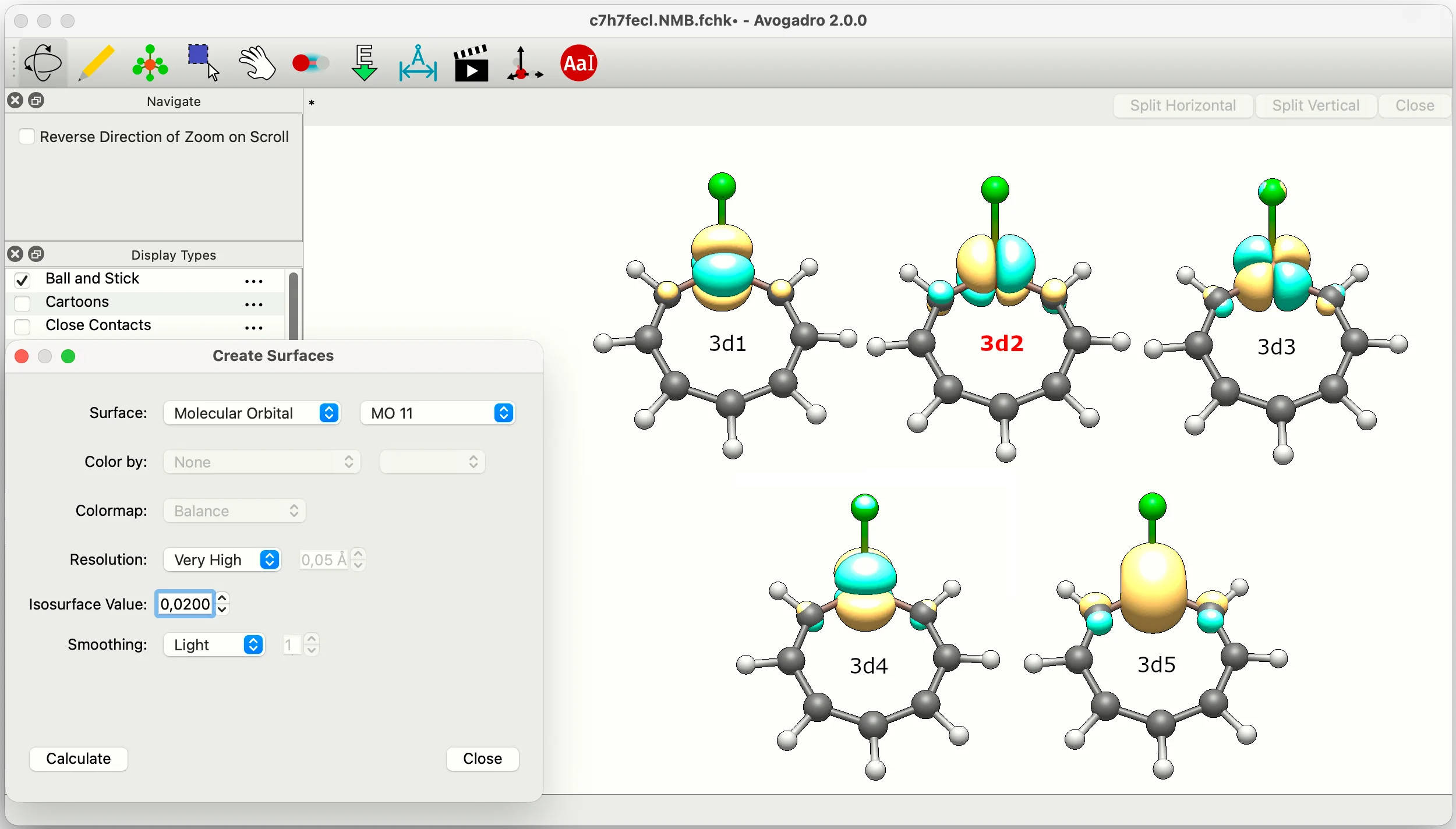
6b · Which Fe 3d orbital does the conjugating? The remaining open question is: what does the dominant Fe 3d orbital look like? To find out, dissect the π-channel in atomic-orbital resolution and export the valence NAOs:
terminal
$ runEDDB --input c7h7fecl.xyz --pathway 1-2-4-6-8-7-5-3-1 --auto-pi --export-fchk ao --table ao
The --export-fchk ao option writes the valence NAOs to c7h7fecl.NVB.fchk. According to the resulting NVB-resolution table,
output
▶ Loading and parsing input file...                                                   0s
▶ Modelling one-electron density at the GFN2-xTB/vSTO-nG level...                     0s
▶ Building natural atomic orbitals (NAO, frozen-NMB two-cycle)...                     0s
▶ Performing multicenter bond-orbital projections (BOP)...                            0s
▶ Computing natural orbitals for bond delocalization (NOBD)...                        0s
▶ Exporting NVB orbitals to c7h7fecl.NVB.fchk...                                      0s
▶ Printing analysis details:

  ┌────────────────────────────────────────────────────────────────────────────────────┐
  │           NATURAL POPULATION ANALYSIS IN ATOMIC-ORBITAL (NVB) RESOLUTION           │
  └────────────────────────────────────────────────────────────────────────────────────┘
    Index   NVB    Atom      ED_P        α         β       EDDB_P       α         β
   ─────── ───── ────────  ───────── ───────── ─────────  ═════════ ───────── ─────────
        1   4s       1 Fe   0.01867      -         -       0.01095      -         -
        2   3d1      1 Fe   0.00939      -         -       0.00182      -         -
        3   3d2      1 Fe   1.33548      -         -       0.23367      -         -
        4   3d3      1 Fe   0.05064      -         -       0.02694      -         -
        5   3d4      1 Fe   0.41971      -         -       0.07668      -         -
        6   3d5      1 Fe   1.20562      -         -       0.63937      -         -
        7   2s       2 C    0.01080      -         -       0.00602      -         -
        8   2p1      2 C    0.92891      -         -       0.61779      -         -
        9   2p2      2 C    0.01466      -         -       0.00908      -         -
       10   2p3      2 C    0.00398      -         -       0.00218      -         -
       11   2s       3 C    0.01080      -         -       0.00602      -         -
       12   2p1      3 C    0.92891      -         -       0.61779      -         -
       13   2p2      3 C    0.01466      -         -       0.00908      -         -
       14   2p3      3 C    0.00398      -         -       0.00218      -         -
       15   2s       4 C    0.00016      -         -       0.00006      -         -
       16   2p1      4 C    1.02618      -         -       0.75641      -         -
       17   2p2      4 C    0.00053      -         -       0.00032      -         -
       18   2p3      4 C    0.00306      -         -       0.00226      -         -
       19   2s       5 C    0.00016      -         -       0.00006      -         -
       20   2p1      5 C    1.02618      -         -       0.75641      -         -
       21   2p2      5 C    0.00053      -         -       0.00032      -         -
       22   2p3      5 C    0.00306      -         -       0.00226      -         -
       23   2s       6 C    0.00004      -         -       0.00003      -         -
       24   2p1      6 C    0.95082      -         -       0.70244      -         -
       25   2p2      6 C    0.00011      -         -       0.00008      -         -
       26   2p3      6 C    0.00210      -         -       0.00151      -         -
       27   2s       7 C    0.00004      -         -       0.00003      -         -
       28   2p1      7 C    0.95082      -         -       0.70244      -         -
       29   2p2      7 C    0.00011      -         -       0.00008      -         -
       30   2p3      7 C    0.00210      -         -       0.00151      -         -
       31   2s       8 C    0.00002      -         -       0.00001      -         -
       32   2p1      8 C    1.02513      -         -       0.78196      -         -
       33   2p2      8 C    0.00001      -         -       0.00001      -         -
       34   2p3      8 C    0.00139      -         -       0.00106      -         -
   ─────── ───── ────────  ───────── ───────── ─────────  ═════════ ───────── ─────────

▶ Printing summary of EDDB calculations:

        Total   ED_P population:            9.94875    per atom:     1.24359
        Total EDLB_P population:            3.97995    per atom:     0.49749
        Total EDDB_P population:            5.96880    per atom:     0.74610

    Cyclic Delocal. Index (CDI):            0.63506

▶ Calculation completed on 2026-07-27. Total time: 0s.
the dominant d-channel is the 3d5 (Fe) orbital — index 6 — carrying ~0.64e of cyclically delocalized π-density (by far the largest Fe contribution). Opening c7h7fecl.NVB.fchk in Avogadro2 (Analyze → Create Surfaces) and inspecting Molecular Orbital no. 6 reveals a 3dXY orbital, which means the metallacycle is a Möbius-Craig aromatic with a predominantly δ-type conjugation topology (see the reference paper for more examples of metallacycles with π- and δ-conjugation topology).
7. Verifying the result at the ab-initio level
As the conclusion says, a GFN2-xTB result is a fast first pass. To confirm it, generate a wavefunction for the same geometry in your quantum-chemistry program and give the file to runEDDB — the analysis and every option are identical; only the input changes. Ready-made CAM-B3LYP/def2-SVP wavefunctions of C7H7FeCl are provided below, together with the inputs that produced them:
How to prepare such inputs yourself, for each program, is described step by step in the cheat-sheet.
Where to go next. The cheat-sheet collects every command in one place. The Manual is the full reference: §3 the analysis modes, §4 every command-line option, §8 how to read the output.